.jpg)
Jumbo Kingdom
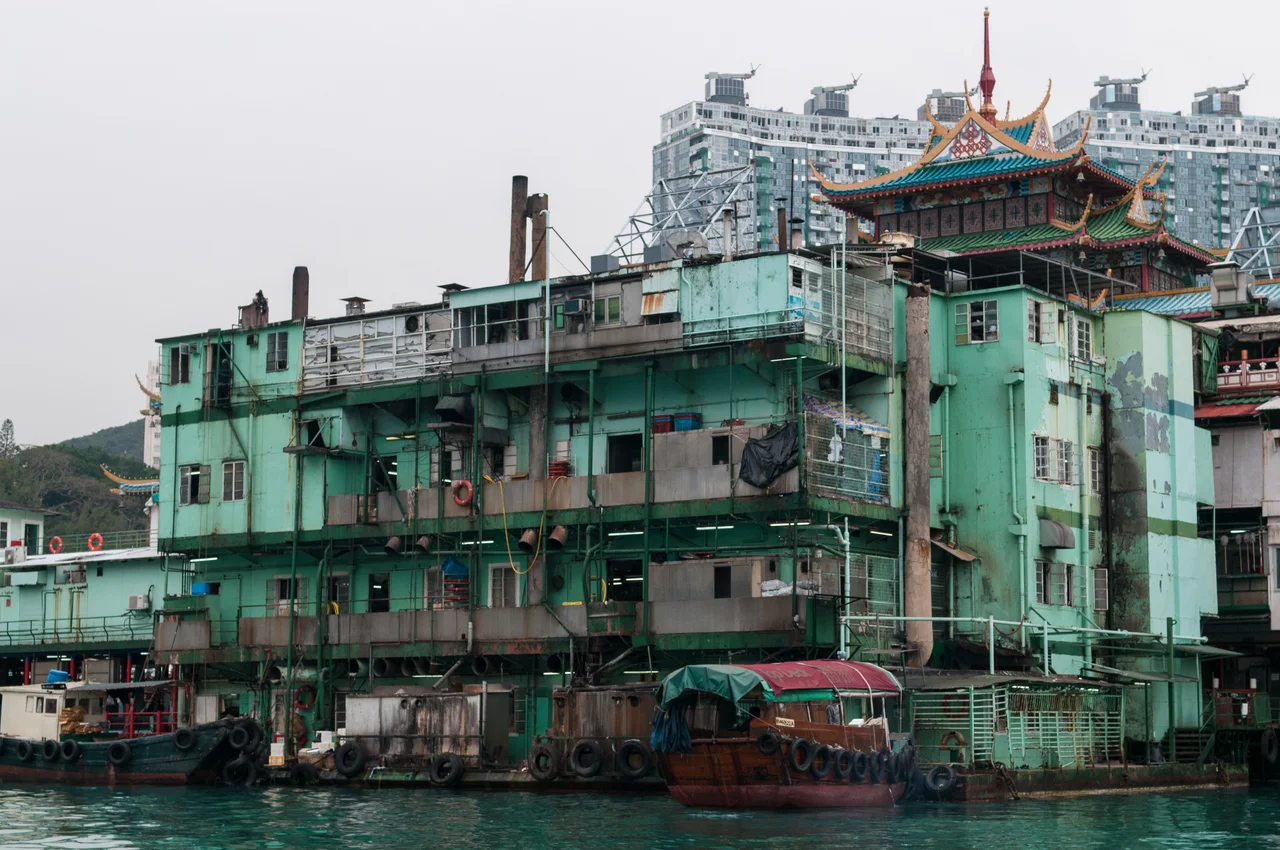
On 19 June 2022, somewhere near the Paracel Islands in the South China Sea, the Jumbo Floating Restaurant capsized. The company that owned it declined to call it sunk. In August, the Maritime Safety Administration of Hainan reported the hull keeled over and trapped on a reef near Sansha. A 46-year-old landmark, decorated in the style of an imperial Chinese palace, with a dragon throne and a six-storey pagoda, had gone to the bottom after a tow that nobody had wanted to attempt in the first place. That is how Jumbo Kingdom ended: not with ceremony, but with a corporate disagreement over terminology and a hull breach at eleven o'clock at night.
Fishermen's Barges, Imperial Palaces
Aberdeen Harbour's floating restaurant tradition goes back further than Jumbo. According to the Hong Kong Chronicles Institute, the ancestors of these restaurants were fishermen's barges from Guangzhou and the Pearl River delta, built with stages for banquets, singing, and dancing. By the 1920s and 1930s, Aberdeen's fishing community was operating similar vessels, at first serving only their own community and gradually opening to the broader public. Jumbo itself was conceived on this foundation. The original Jumbo barge was ordered by a local operator, built by the Kowloon Chung Hwa shipyard at a cost of HK$14 million, and destroyed by fire in October 1971 before it could open. Gambling magnate Stanley Ho and jewellery tycoon Cheng Yu-tung bought the remnants in 1972, spent HK$30 million on reconstruction, and reopened the restaurant in 1976 — this time with a dragon throne, an aquarium, and the full theatre of an imperial palace floating in a typhoon shelter.
Thirty Million Visitors
Over 44 years of operation, Jumbo Kingdom attracted more than thirty million visitors. Queen Elizabeth II came. So did Jimmy Carter, Tom Cruise, Chow Yun Fat, and Gong Li. The restaurant appeared in the James Bond film The Man with the Golden Gun in 1974 — the year after the rebuilt version opened — and later in Infernal Affairs II, Contagion (2011), and the music video for 'All in One' by Hong Kong boy band Mirror. The NBC miniseries Noble House depicted the compound being destroyed by fire, a fictional end that felt prescient. On the first deck, the Dragon Court offered fine dining in a dining room blending Ming Dynasty style with contemporary Chinese design. On the fourth floor, staff ate at a canteen called So-Kee Coffee Shop, which served noodles and Hong Kong street food. The building that tourists photographed was a stage set. Behind it, people worked.
Nobody Wanted It
The COVID-19 pandemic closed Jumbo Kingdom in 2020. It had, according to its parent company Aberdeen Restaurant Enterprises, been unprofitable since 2013, with accumulated losses exceeding HK$100 million by 2022. What followed was a protracted failure of imagination and will. Ocean Park Hong Kong agreed to receive the vessel, then declined. Proposals to relocate it onto land, or convert it into a Bruce Lee museum, were met with objections. The Hong Kong Jockey Club did not respond to suggestions it might take the vessel in. The Antiquities Advisory Board noted that ships are not covered under the Antiquities and Monuments Ordinance and cannot be evaluated for conservation. The government said it was 'not good at running such premises.' Inspection fees, repair costs, licensing fees, and berthing costs continued regardless. Every party cited high maintenance costs as a reason to refuse the offer of a free landmark.
The Tow
On 31 May 2022, just before midnight, the kitchen boat began listing after a hull breach, while tow preparations were underway. The main barge was towed out of Aberdeen on 14 June, destination declared to be Cambodia, though the company did not confirm this. On 19 June, in bad weather near the Paracel Islands, it capsized. The tugboat used, the Jaewon 9, had in 2021 been involved in a separate incident where the vessel it was towing sank after the towing line snapped. Industry experts later noted that a semi-submersible ship — the kind used to transport a sister vessel to Manila Bay — would have been safer, but such ships are rare and expensive. Jumbo was top-heavy, its multi-storey superstructure making the deep-sea tow inherently risky. A student named Shiu Ka-heng had already created a digital 3D model of the restaurant from photographs, hoping to preserve it virtually. He had the foresight. Others had the time, but not the will.
What Remains
The Tai Pak Floating Restaurant, Jumbo's smaller neighbour — established in 1952 when Wong Lo-kat and partners converted a boat into a 105-foot floating dining room — survived. Authorities allowed it to remain as a laid-up vessel, and new owners acquired it in 2022. Tai Pak had its lights restored in late 2024 and plans to reopen in 2026. In Aberdeen Harbour, the pier along Aberdeen Promenade still stands. A tourism lawmaker said after Jumbo's loss that 'the government, conservationists, historians and the commercial sector should be working together to protect historic sites but everyone had stalled too long.' He was right. Jumbo Kingdom is on a reef in the South China Sea now, and the argument about who was responsible continues without it.
From the Air
Jumbo Kingdom was located at approximately 22.243°N, 114.162°E in Aberdeen Harbour on the south side of Hong Kong Island, within the Aberdeen South Typhoon Shelters. From the air, Aberdeen Harbour is visible on the southern coast of Hong Kong Island, identifiable by its dense boat moorings and the distinctive topography of the surrounding hills. The nearest international airport is VHHH (Hong Kong International Airport, Chek Lap Kok), approximately 22 km to the northwest. Viewing altitude of 2,000–4,000 ft provides a clear overview of Aberdeen and the surrounding Ocean Park and Ap Lei Chau district. The Jumbo barge is no longer present at this location.
Nearby Stories
- Lok Ma Chau Loop 2.3 km away
- Portas do Cerco 2.3 km away
- Kweilin Incident 17 km away
- Wanshan Archipelago Campaign 34 km away
- Nanxiong Formation 115 km away
- Battle of Nanpeng Island 148 km away
- Heyuan 169 km away
- Cape Maobitou 632 km away