
K'gari
Rainforest should not grow here. There is no soil in any sense a gardener would recognise, only sand, more than a hundred kilometres of it, piled by wind and current over three quarters of a million years. Yet on K'gari the satinay trees climb past sixty metres, their roots threaded through dunes that reach 240 metres into the sky, and somewhere beneath them a creek runs so clear it looks like polished glass moving over white sugar. The Butchulla people, who have lived here for thousands of years, named the island for a white spirit in their creation story. The name means paradise. Stand in the green hush of Central Station, listening to water you cannot quite see, and the word feels less like marketing than plain description.
The Name Returned
For most of two centuries, maps called this place Fraser Island, after a shipwreck survivor whose story the colony chose to remember. The Butchulla never stopped calling it K'gari. In 2023 the Queensland Government made it official, dropping the colonial name entirely so that the island and the locality on it carry only the Butchulla word again. It was the culmination of a long campaign by the traditional owners, and it changed how visitors arrive: you come now to a place that announces itself in the language of the people who know it best. Paradise, in the Butchulla telling, is not a slogan but a being, a beautiful white spirit who, in the Dreaming, lay down and became the land. To say the name is to step, however briefly, into their story of how the world was made.
Lakes Like Held Breath
The island holds more than a hundred freshwater lakes, and they come in two moods. The tea-coloured ones, stained by paperbark and leaves, sit dark and still under the trees. Then there is Lake McKenzie, the jewel, a perched lake held aloft in a bowl of sand far above the water table, fed by nothing but rain. Its water is so pure it cannot support much life, and so clear that swimmers seem to float on light, the white silica sand throwing the sun straight back up through impossible blue. Walk to Lake Wabby instead and you find its green water under siege, a vast sand blow creeping over the rim a little more each year, swallowing the lake by slow degrees. Locals carry bodyboards up the dune to slide down into it, though diving headfirst is how people break their necks here, every summer.
Seventy-Five Mile Highway
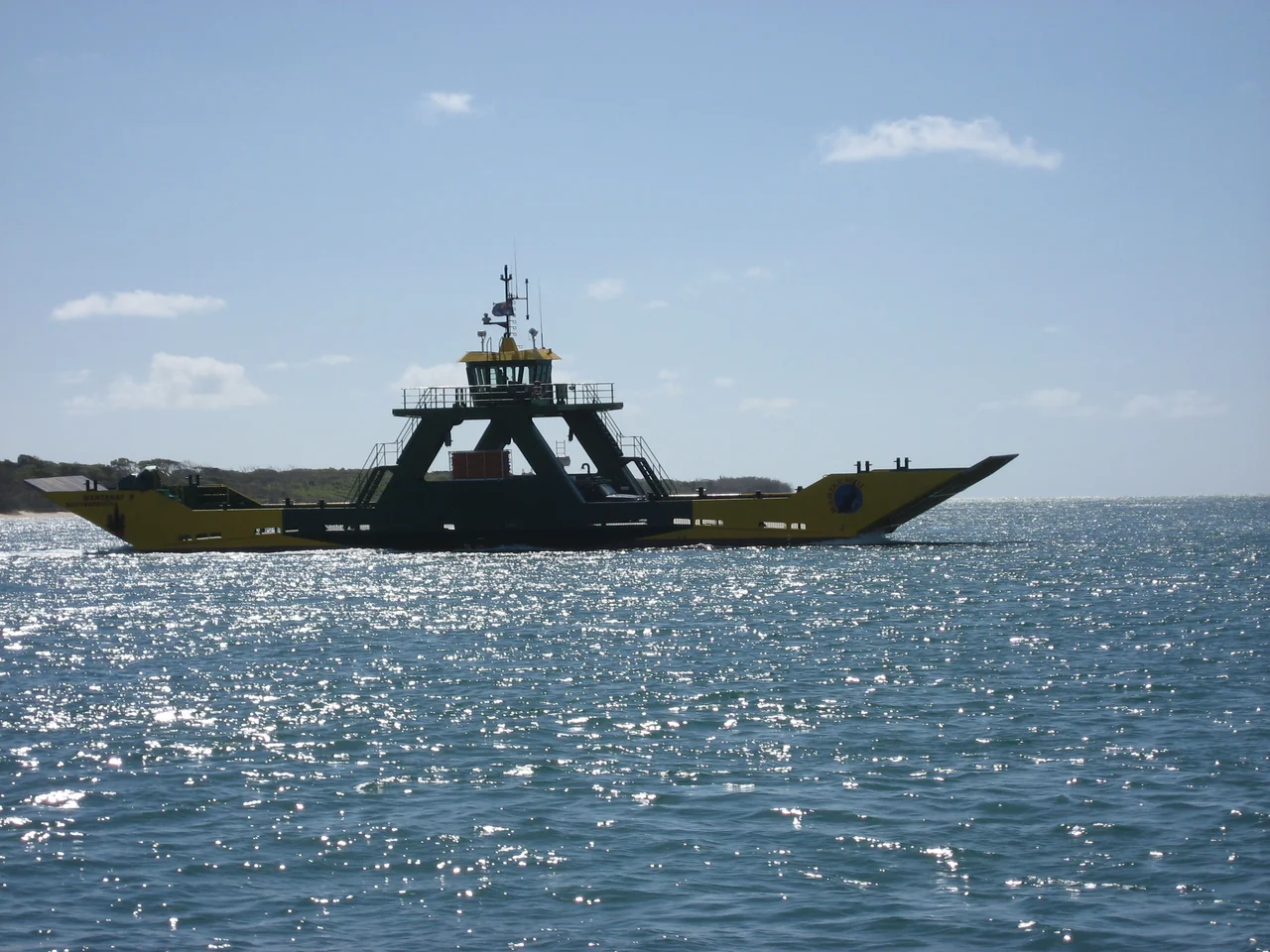
There are no sealed roads worth the name. To travel K'gari is to drive a four-wheel drive along the beach itself, an expanse of firm sand the law treats as an actual highway, complete with an 80 kilometre speed limit and the occasional police breath test. The inland tracks are worse and stranger, soft sand that turns to talcum in the dry, where a bogged vehicle waits hours for a passing bus to drag it free. Halfway up the eastern shore the rusted ribs of the Maheno break the horizon, a 1905 ocean liner driven ashore by a cyclone in 1935 and left to the salt. North of it the beach ends at Indian Head, a rocky headland where you climb to look down through clear water at sharks, rays, and turtles cruising the shallows, and just beyond, the Champagne Pools fizz white as the surf pours in over the rocks.
Living With Wongari
The dingoes of K'gari are among the purest in eastern Australia, genetically distinct from mainland dogs, and to the Butchulla they are wongari, animals woven into the island's law and story. There are perhaps 120 of them. They are also the reason every campsite is fenced and every scrap of food locked away, because a wongari that learns to associate people with meals loses its wariness, and a wild dog without wariness becomes dangerous. A child was killed here in 2001, and the rules that followed, the fines for feeding, the cages for food, exist to protect both visitors and the animals themselves. The hardest thing K'gari asks of you is restraint: to admire a wongari trotting the tideline at dusk and give it nothing, so that it stays wild, and stays.
Still Recovering
In December 2020, fire tore through the island, burning across landscapes that take a long time to heal. K'gari is no stranger to deep time. Its dunes record 700,000 years of changing climate and sea level, the longest and most complete sequence of coastal dunes anywhere on Earth, and each winter humpback whales bring their calves into the sheltered waters of Platypus Bay to rest on the long swim south. The island absorbs and endures. But the burn scars are a reminder that paradise, even one this ancient, is not indestructible, and that the protection written into its World Heritage listing in 1992 is a promise visitors are asked to keep, three days at a time, one careful footprint at a time.
From the Air
K'gari stretches along the southern Queensland coast at roughly 25.24 degrees south, 153.15 degrees east, about 300 km north of Brisbane and a short hop east of Hervey Bay. From the air it is unmistakable: a 122 km blade of sand, the longest beach forming a pale eastern edge against the open Pacific, with darker rainforest and the glint of perched lakes inland, and the Great Sandy Strait separating it from the mainland to the west. Hervey Bay Airport (ICAO YHBA) is the main gateway, just across the water; charter aircraft also land directly on the eastern beach at low tide only, sharing the sand with vehicles. Recommended viewing altitude is 3,000 to 5,000 feet to take in the full sweep of beach, dune blows, and lakes. Watch for sea breezes and summer storms; winter offers the clearest air and the whales of Platypus Bay.
Nearby Stories
- 1936 Bundaberg distillery fire 24 km away
- Childers Palace Backpackers Hostel fire 30 km away
- Brennan & Geraghtys Store 42 km away
- Bundaberg Rum 75 km away
- Cressbrook Homestead 175 km away
- Cape Byron 350 km away
- Wreck Reefs 354 km away
- Cape Byron Light 380 km away