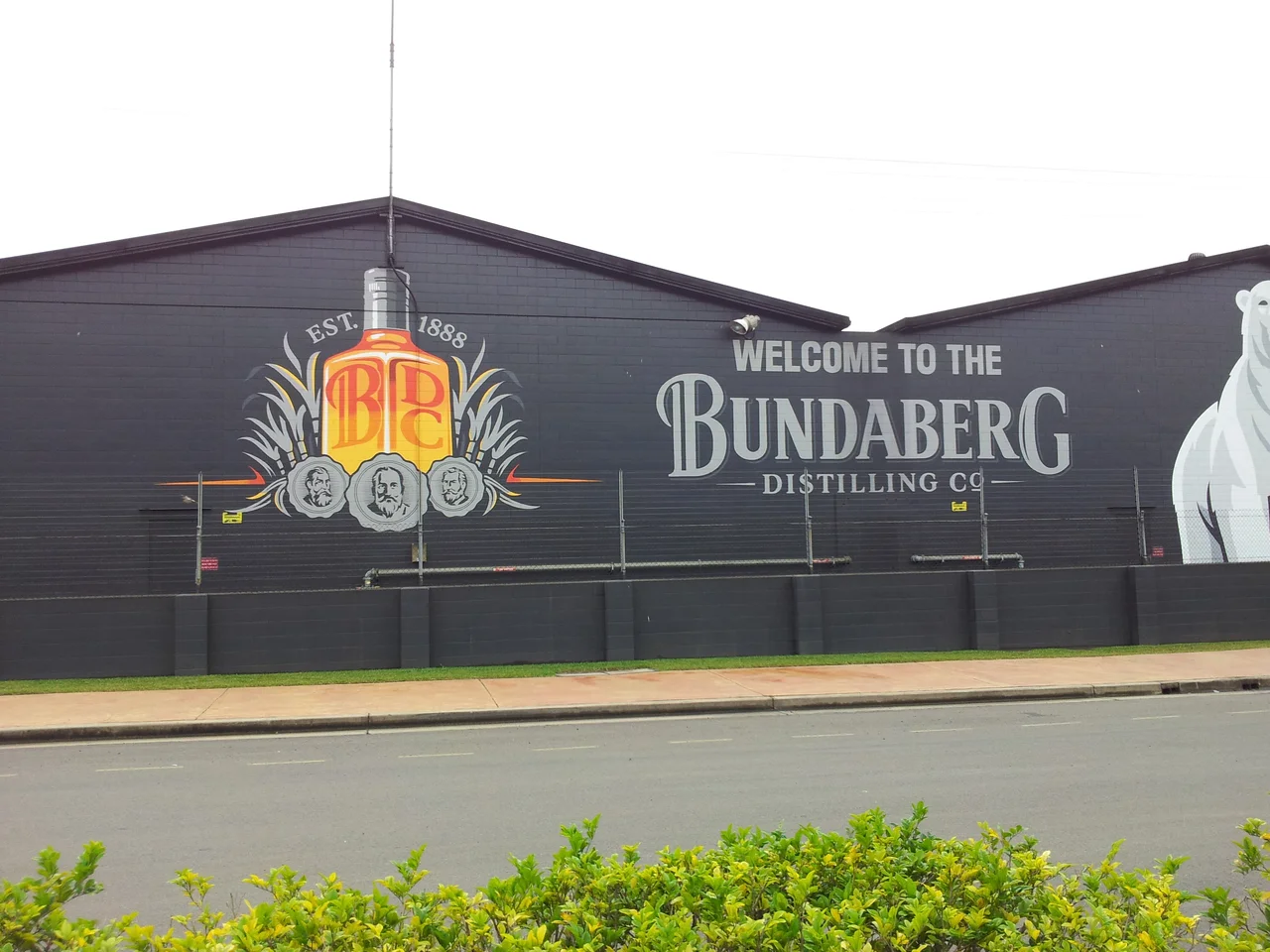

Bundaberg Rum
A polar bear is an absurd mascot for a rum brewed eight degrees south of the Tropic of Capricorn, where the air hangs thick with the smell of crushed cane and the Burnett River runs warm to the Coral Sea. That was rather the point. In 1961, looking to soften the image of a spirit then seen as the drink of hard old men, the distillery's marketers chose Bundy R. Bear precisely because nothing about him made sense in Queensland. A rum so warming it could see off a blizzard that never comes. Australians took to the joke, and to the rum, with a loyalty that has outlasted fires, floods, and foreign ownership.
A Problem Worth Drinking
Bundaberg Rum began as a solution to garbage. The sugar mills clustered along the Burnett River produced mountains of molasses, the dark, sticky residue left after the sugar crystals were spun out. Molasses was heavy, hard to cart, and barely worth turning into stock feed. The cane men did the arithmetic and saw something better: alcohol. On 1 August 1885, in the Royal Hotel, the district's biggest mill owners gathered around a table with W. M. C. Hickson in the chair and resolved to distill their way to profit. They put up 5,000 pounds and became the first directors of the Bundaberg Distilling Company. Operations began in 1888, and the first rum ran from the stills in 1889. What had been waste flowing toward the sea became a product that would carry the town's name across a continent.
Fire on the River
The distillery has twice gone dark, and both times fire was the reason. Production stopped from 1907 to 1914, and again from 1936 to 1939. The second blaze remains the one Bundaberg still tells stories about. Burning rum poured from the wrecked buildings into the Burnett River, a slick of high-proof spirit that ran with the current and killed fish along its path. For a town built on the river, it was a strange and terrible sight, the water itself seeming to catch the distillery's flames. The company rebuilt each time. There is a particular toughness in an enterprise that turns a sugar mill's leftovers into liquor, watches it burn, and simply starts again, and that toughness became part of the brand long before any advertising agency tried to bottle it.
The Bear in the Heat
By 1961, rum had an image problem. It read as the drink of an older, rougher generation, and the company wanted a broader, more sociable audience. The answer was a polar bear, drawn by the agency to lean into a larrikin idea of Australian mateship. The conceit was deliberately ridiculous. Here was an Arctic animal selling a tropical spirit, the suggestion being that Bundy could ward off any cold, in a part of the world where cold barely registers. Bundy R. Bear became one of the country's most recognisable mascots, beloved enough that the advertisements themselves became cultural touchstones, even as the brand drew criticism for how readily that affection reached the young.
Bottled Somewhere Else
In 2000, the distillery passed to the British drinks giant Diageo, and in 2014 the new owners decided to move bottling operations more than a thousand kilometres south, to a Sydney suburb called Huntingwood. For Bundaberg, a region still recovering from devastating floods, the lost jobs stung. The Queensland premier called it disappointing; the local mayor worried about the blow to tourism. Diageo insisted it remained committed to the town, that distilling, maturing, and blending would stay where they had always been, and that premium lines like the Master Distillers' Collection would still be bottled here. The rum is still made in Bundaberg, from Bundaberg molasses, the way it has been for well over a century. Some of it just gets dressed for sale a long way from home.
From the Air
The Bundaberg Distillery sits at 24.85 degrees south, 152.37 degrees east, in Bundaberg East on the south bank of the Burnett River, a few kilometres before the river meets the Coral Sea. From the air the river's dark ribbon winding through a quilt of green cane fields is the giveaway, with the port and the river mouth to the northeast. Bundaberg Airport (ICAO YBUD) lies just southwest of town and serves the coastal run to Hervey Bay and Brisbane; Hervey Bay Airport (YHBA) is roughly 90 km to the south. Recommended viewing altitude is 2,500 to 4,000 feet for a clear read of the river bends, cane country, and the reef-bound coast beyond. Visibility is usually excellent outside the summer wet season.
Nearby Stories
- Childers Palace Backpackers Hostel fire 17 km away
- K'gari 25 km away
- Lady Elliot Island 63 km away
- Double Island Point Light 121 km away
- Cape Capricorn Light 141 km away
- Bunya Mountains National Park 188 km away
- Great Keppel Island 210 km away
- Wreck Reefs 365 km away