.jpg)
Brennan & Geraghtys Store
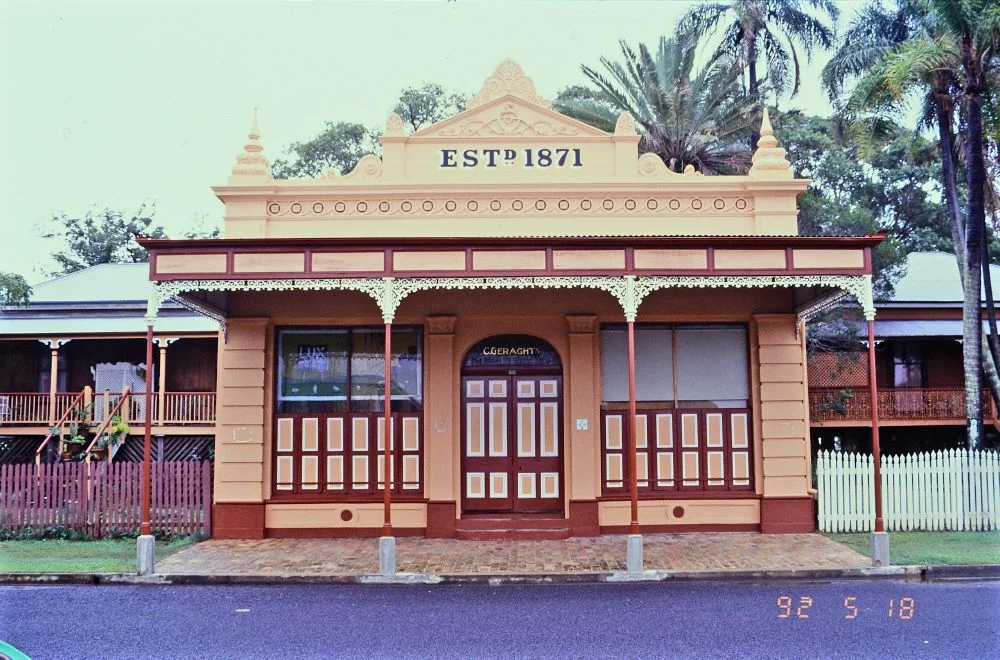
When the Brennan & Geraghty's store finally closed in 1972, the strange thing was not that it shut. It was what stayed inside. Tins of 1885 Canton tea. Soap from the 1920s. Toilet paper from the 1950s. Ledgers and invoices going back to 1871. For a hundred years the same Irish family had run this grocery on Lennox Street in Maryborough, and across all that time they had barely thrown anything away. The last of them, George Geraghty, kept it that way deliberately, determined to round out a full century of trading from the same premises. What he left behind is now one of Australia's most remarkable accidental museums: more than 100,000 items, all original to the shop, a whole vanished way of buying and selling preserved on the shelves where it happened.
Two Irishmen and a Boomtown
Patrick Brennan and Martin Geraghty arrived in Maryborough from Ireland in 1863, into a town on the rise. Maryborough was a busy river port, an outlet for the wool, tallow and timber of the Wide Bay and Burnett country, and a gateway through which some 22,000 immigrants entered Queensland between 1862 and 1890. When gold was struck at nearby Gympie in 1867, the town's fortunes surged. Brennan had worked as a station storekeeper and tried his luck in the early goldfields; Geraghty married Patrick's sister Catherine and built a cottage on Lennox Street. In 1871 the two men formed a partnership, knocked the interior walls out of the cottage, and turned it into a store. They were the only bulk importers in town, and through the boom years of the 1880s their interests spread into orchards, marmalade, brickmaking, even a cross-river ferry.
The Shelves That Time Forgot
Walk in today and the store is divided into three rooms by cross walls, linked by a small trolley that runs on timber rails from front to back, the way stock once moved through the building. The front room keeps its original painted finishes; the rooms behind were never painted at all, and the bare timber shows a century of patching and alteration, the physical record of a business growing and then shrinking again. Stock fills the fixed shelving and cabinets just as it would have for a customer in the 1930s. Most of it dates from that interwar period, brands long since discontinued, packaging in forms no shopper would recognise now. Alongside the goods sits an almost complete run of trading records stretching back to 1871, with a thick collection of advertising material. It is rare for a shop to survive at all. To survive with its own stock and its own paperwork intact is rarer still.
A Family That Held On
The business did not simply prosper and end. In the 1890s it failed; in 1896 the creditors voted to wind up the firm, and over the following years the partnership's assets were sold off and its debts paid. The store itself was bought by Martin's son Frank, who rented it back to the family for ten shillings a week. After the partnership was finally dissolved in 1903, Catherine Geraghty ran the shop until her death in 1934, helped by her children Agnes, Florence and George. George carried it the rest of the way. He kept trading into the 1970s for a reason that was as much sentimental as commercial, wanting to complete one hundred years of business from the same building, and he very nearly managed it exactly. He died in 1973, the year after the doors closed.
Saving the Whole Story
After George's death, the local council issued a demolition order on the old store. By the 1970s, shops like this had become obsolete, and most had already been cleared away. What saved this one was the very thing that made it unusual: George had changed nothing and discarded nothing. In 1975 the National Trust bought the entire Geraghty complex, the store flanked by the family's two timber houses, including Uskerty, built for Catherine in 1904. A local fundraising campaign through the 1980s, backed by strong community feeling, paid for its conservation, and in 1990 the store opened to the public as a museum. It was added to the Queensland Heritage Register in 1992, recognised as an unusually intact survivor of a kind of store that was once common across the state and is now almost entirely gone.
From the Air
Brennan & Geraghty's Store sits at 25.54 degrees south, 152.70 degrees east, at 62 to 66 Lennox Street in Maryborough, in Queensland's Fraser Coast region. The town lies on the Mary River a short way inland from the coast, its heritage core laid out in a grid of nineteenth-century streets; the store is a low timber building with a rendered brick facade and a footpath awning, modest from above and easy to lose among its neighbours. Nearest airport is Hervey Bay (ICAO YHBA) about 30 kilometres northeast; Maryborough's own aerodrome (YMYB) is closer still, just southwest of town. Bundaberg (YBUD) lies to the north. A viewing altitude of 1,500 to 2,500 feet shows the bends of the Mary River and the old port township; the surrounding country is flat cane and pasture land.
Nearby Stories
- K'gari 41 km away
- Double Island Point Light 45 km away
- Bunya Mountains National Park 127 km away
- Aarhus Historic Shipwreck 130 km away
- Cape Moreton Light 163 km away
- Jimbour Homestead 183 km away
- Heron Island 210 km away
- Wreck Reefs 406 km away