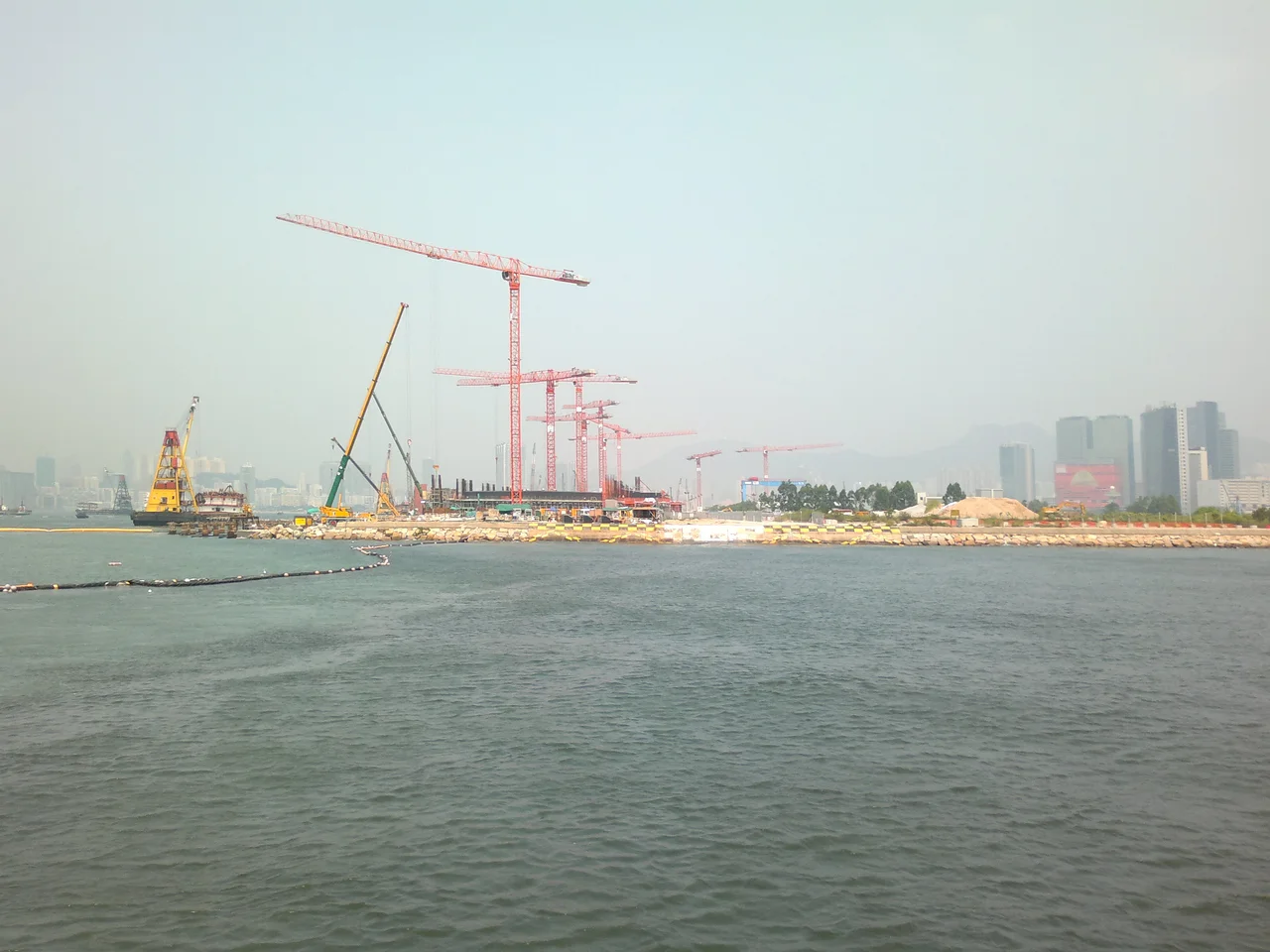

Kai Tak Cruise Terminal
The runway juts out into Kowloon Bay like a concrete pier, pointing directly at the skyscrapers of Hong Kong Island — which is precisely what made landing here so terrifying. Pilots knew it as the 'Kai Tak heart attack.' The approach required banking sharply over rooftop laundry lines at 200 feet, lining up with a checkerboard painted on a hillside, then dropping onto one of aviation's most dramatic strips of asphalt. When Kai Tak Airport closed in 1998, it left behind that extraordinary piece of reclaimed land, half a kilometer of runway tapering into Victoria Harbour. The question of what to do with it occupied planners for years. The answer, ultimately, was to point it toward the sea in a different way: to let the world's largest ocean liners dock at the very tip of the old runway, arriving into one of the world's most iconic harbor views.
A Runway Reborn
The geometry of Kai Tak's old runway determined everything about the cruise terminal. The strip angles out into Kowloon Bay at a precise bearing, and the terminal built upon it follows that logic to its logical conclusion — two berths capable of handling vessels up to 360 meters long, pointing outward toward open water. Foster + Partners, the British firm that won the international design competition, leaned into the runway's linearity rather than fighting it. The result is a building of clean, sweeping lines: a vast undulating roof hovering over a 70-meter interior that can be converted from a passenger processing hall into a concert venue or exhibition space. The Hong Kong government and construction consortium Dragages Hong Kong signed the design-and-build contract in May 2010, and the first berth opened in mid-2013. The Mariner of the Seas was the first cruise ship to dock, on 12 June 2013.
Why Hong Kong Needed This
By the mid-2000s, Hong Kong's existing cruise facility at Ocean Terminal in Tsim Sha Tsui was straining at the seams. Berth utilization had climbed from 71% in 2003 to 76% — and between 2001 and 2005, eleven cruise vessels had been forced to anchor mid-stream or tie up at container terminals because Ocean Terminal simply could not accommodate them. The government's Secretary for Economic Development at the time, Stephen Ip, identified the shortfall clearly: Hong Kong needed additional berths by 2009, and more beyond 2015 to capture the growth of the regional cruise market. The Kai Tak site offered something no other location could: deep water, clear maneuvering room, and an approach that frames the harbor panorama. The development cost, excluding commercial facilities, ran to approximately HK$2.4 billion.
A Terminal That Never Sleeps
The deliberate flexibility of Foster + Partners' design reflects a practical reality: cruise ships are not in port all year round. Rather than building a facility that sits empty between sailings, the architects created an interior that serves multiple purposes. The 70-meter central hall supports performances, exhibitions, and trade events, with restaurants and shops active year-round. The sustainable design incorporates energy-saving systems and renewable power generation, along with recycled rainwater used for cooling — a forward-looking choice for a building on the water. Roughly 80% of calls at the terminal have been 'homeporting' calls, meaning ships are based here for a season rather than simply stopping. The first major homeport season was the Voyager of the Seas, resident at Kai Tak from June to October 2015.
Ships of Every Flag
Since its 2013 opening, the Kai Tak Cruise Terminal has welcomed ships from across the spectrum of global cruise lines: Cunard and Royal Caribbean, Costa and Silversea, the American Semester at Sea program and the venerable Fred. Olsen Cruise Lines. The range reflects Hong Kong's position at the intersection of Asia's booming cruise market and the international circuits of the world's great ocean liners. The terminal can handle up to 8,400 passengers at peak design load — and 1,200 crew — simultaneously embarking and disembarking. Where pilots once flinched at rooftops rising to meet them, passengers now find the harbor spreading open on three sides, the hills of Kowloon behind them and the towers of Central ahead.
The Rooftop That Remembers
Above the terminal, accessible by public escalator, is a rooftop park — a long green promenade that looks back down the full length of what was the runway. Stand there on a clear day and you can trace the original alignment, now buried under new roads and development, pointing back toward the hills the old pilots used as their reference. The park has become one of Kowloon's best viewpoints, a quiet strip of grass and steps above a building that hums with arriving and departing ships. It is a place where the memory of one kind of arrival — white-knuckled, low and fast — gives way to a completely different kind: slow, enormous, gliding in from open sea with the entire harbor laid out as a welcome.
From the Air
Kai Tak Cruise Terminal sits at coordinates 22.3075°N, 114.213°E — at the tip of the old Kai Tak Airport Runway 13/31, which juts into Kowloon Bay. From altitude the terminal's long parallel berths are unmistakable, pointing southeast into the harbor. Nearby VHHH (Hong Kong International Airport) at Chek Lap Kok is approximately 27 km to the west-southwest. Recommended viewing altitude 2,000–4,000 feet on approach from the west provides the iconic harbor panorama with Victoria Peak, the Central skyline, and the terminal's runway geometry all visible simultaneously.
Nearby Stories
- Lok Ma Chau Loop 2.3 km away
- Portas do Cerco 2.3 km away
- Kweilin Incident 17 km away
- Wanshan Archipelago Campaign 34 km away
- Nanxiong Formation 115 km away
- Battle of Nanpeng Island 148 km away
- Heyuan 169 km away
- Cape Maobitou 632 km away