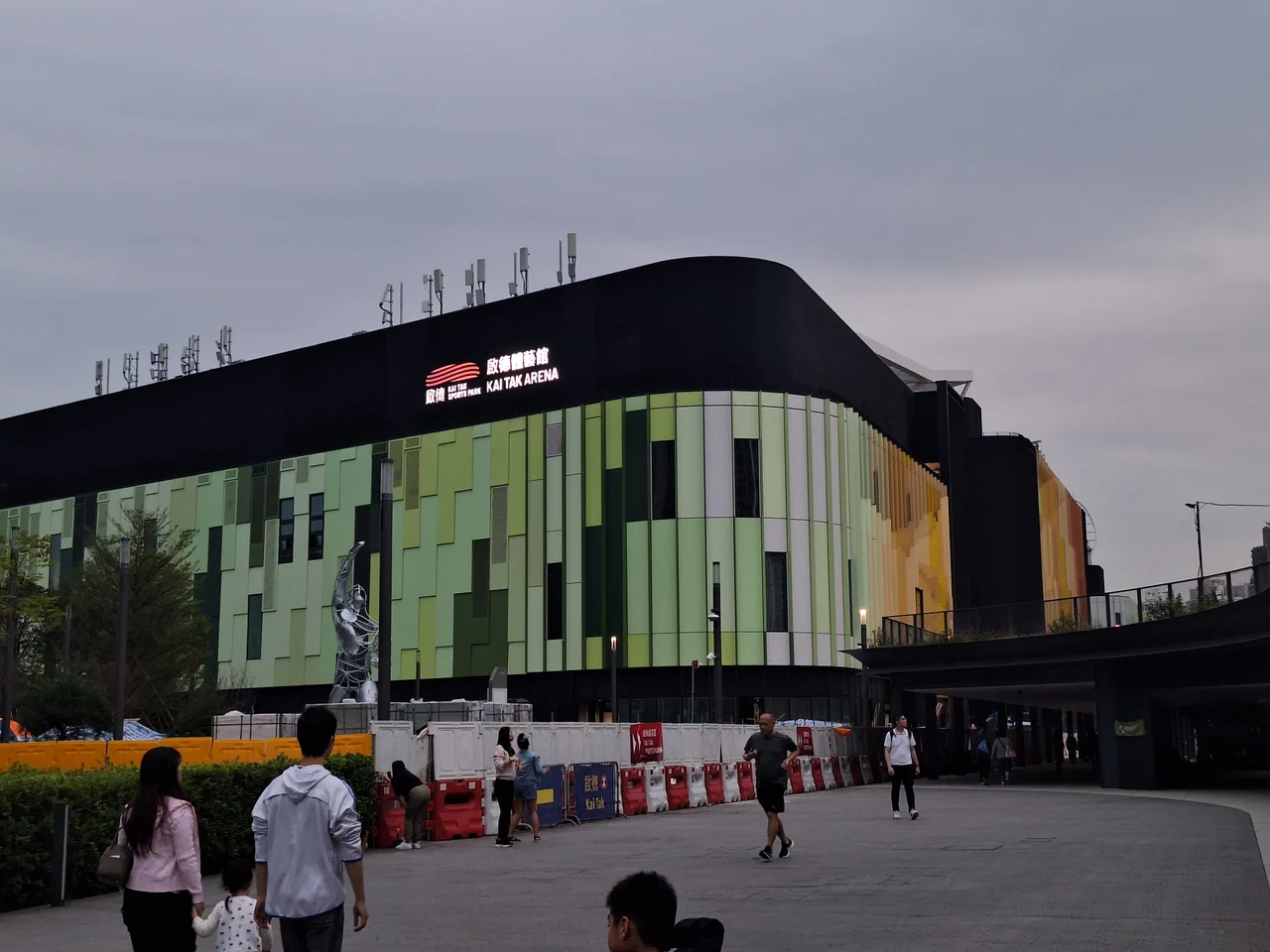

Kai Tak Sports Park
Coldplay played four nights here in April 2025. Nearly 184,000 people came. Liverpool and AC Milan met in a preseason rematch of their iconic UEFA Champions League finals. Arsenal and Tottenham played the first North London derby ever staged outside England. In the space of a few months, a patch of reclaimed land in Kowloon — once a car park next to a legendary but long-dead airport — announced itself as one of the most consequential sports and entertainment venues in Asia. Kai Tak Sports Park had arrived, dramatically and without apology, as Hong Kong's answer to a long-standing question: what does a world-class city do with the bones of its most storied piece of aviation history?
The Weight of What Came Before
Kai Tak Airport closed in July 1998. In its final years it was ranked among the world's most dangerous airports: the approach required pilots to bank steeply over Kowloon's rooftops at low altitude, lined up with a checkerboard on a hillside. When the last commercial flight departed, it left behind a vast slab of reclaimed land in the middle of one of the world's densest cities. What to do with it became one of Hong Kong's most complex planning challenges. The sports park occupies roughly 28 hectares to the northwest of the old runway area, on what was once a car park. The decision to anchor the redevelopment with a major sports facility came from a recognition that Hong Kong — a city of 7 million people squeezed into limited land — had no venue capable of hosting major international sporting events or the world's biggest touring concerts.
A Decade of Debate and Construction
The road from idea to opening was long. American engineering firm AECOM began the Kai Tak Development master plan in early 2007. Hong Kong legislators debated the stadium's financing for years; it took until June 2017 for the Legislative Council to grant approval — after a six-hour debate — for the HK$31.9 billion project. Thirty-six lawmakers voted for it; twenty-one against. The contract went to Kai Tak Sports Park Limited, a subsidiary of New World Development and NWS Holdings. Groundbreaking was in April 2019. The park was originally due to be completed by June 2023, with a government penalty of HK$500,000 per day for missing the main stadium's usage requirements. Resource shortages pushed the opening into 2025. The main contractor Hip Hing Engineering, supported by design firms Populous, Robert Bird Group, and Arup, ultimately delivered a facility the South China Morning Post compared favorably to London's Olympic Park.
Inside the Park
The centerpiece is Kai Tak Stadium: a 50,000-capacity bowl with a retractable roof, capable of transforming between a sport configuration and a concert layout. Alongside it sits the 10,000-seat Kai Tak Arena, which hosted a preliminary round of the 2025 FIVB Women's Volleyball Nations League, and a 5,000-seat Public Sports Ground. The whole complex is organized around Kai Tak Sports Avenue, a covered pedestrian spine running from Station Square — where the MTR's Kai Tak and Sung Wong Toi stations connect — all the way to a harborfront dining area called Dining Cove, with views across Victoria Harbour. The design is deliberately porous: all major entry points connect to public transport, and the Avenue functions as a neighborhood street on non-event days.
The World Comes to Kowloon
The main stadium's first Hong Kong Sevens rugby tournament drew over 110,000 fans to the three-day event in 2025. The first football match at the stadium was a 2027 AFC Asian Cup qualifier between Hong Kong and India on 10 June 2025, sold out the day before kickoff. Then came the preseason friendlies — Liverpool versus AC Milan on 26 July, invoking memories of their 2005 and 2007 Champions League finals, followed by the Arsenal-Tottenham North London derby on 31 July, the first time those clubs had met outside England. Hong Kong also served as a co-host, alongside Guangdong and Macau, for the 2025 National Games of China, with Kai Tak Sports Park as one of the venues. In the space of a single year, the park had become a fixture on the global sports calendar.
More Than a Stadium
What distinguishes Kai Tak Sports Park from a simple arena is its ambition as a piece of urban fabric. The park is not fenced off between events — it is intended to be part of the city. The public sports ground is available for community use, the sports avenue is walkable daily, and the harbor views from Dining Cove require no ticket. The venue sits in a part of Kowloon that was, for most of the late twentieth century, defined by the anxiety of the airport: noise, danger, the impossibility of building anything too tall nearby. The opening of the sports park did not erase that history. Instead, it repurposed the same piece of land for a different kind of collective experience — one in which the crowds come not with trepidation, but with anticipation.
From the Air
Kai Tak Sports Park sits at 22.3219°N, 114.1969°E in the Kowloon Bay district. From altitude the stadium's distinctive retractable roof is clearly visible on the northwest side of the former airport footprint, with Victoria Harbour to the south and the Kowloon hills to the north. VHHH (Hong Kong International Airport) is approximately 27 km to the west-southwest. Recommended viewing altitude 3,000–5,000 feet provides a clear view of the entire Kai Tak redevelopment zone, including both the sports park and the cruise terminal pier extending into the bay.
Nearby Stories
- Lok Ma Chau Loop 2.3 km away
- Portas do Cerco 2.3 km away
- Kweilin Incident 17 km away
- Wanshan Archipelago Campaign 34 km away
- Nanxiong Formation 115 km away
- Battle of Nanpeng Island 148 km away
- Heyuan 169 km away
- Cape Maobitou 632 km away