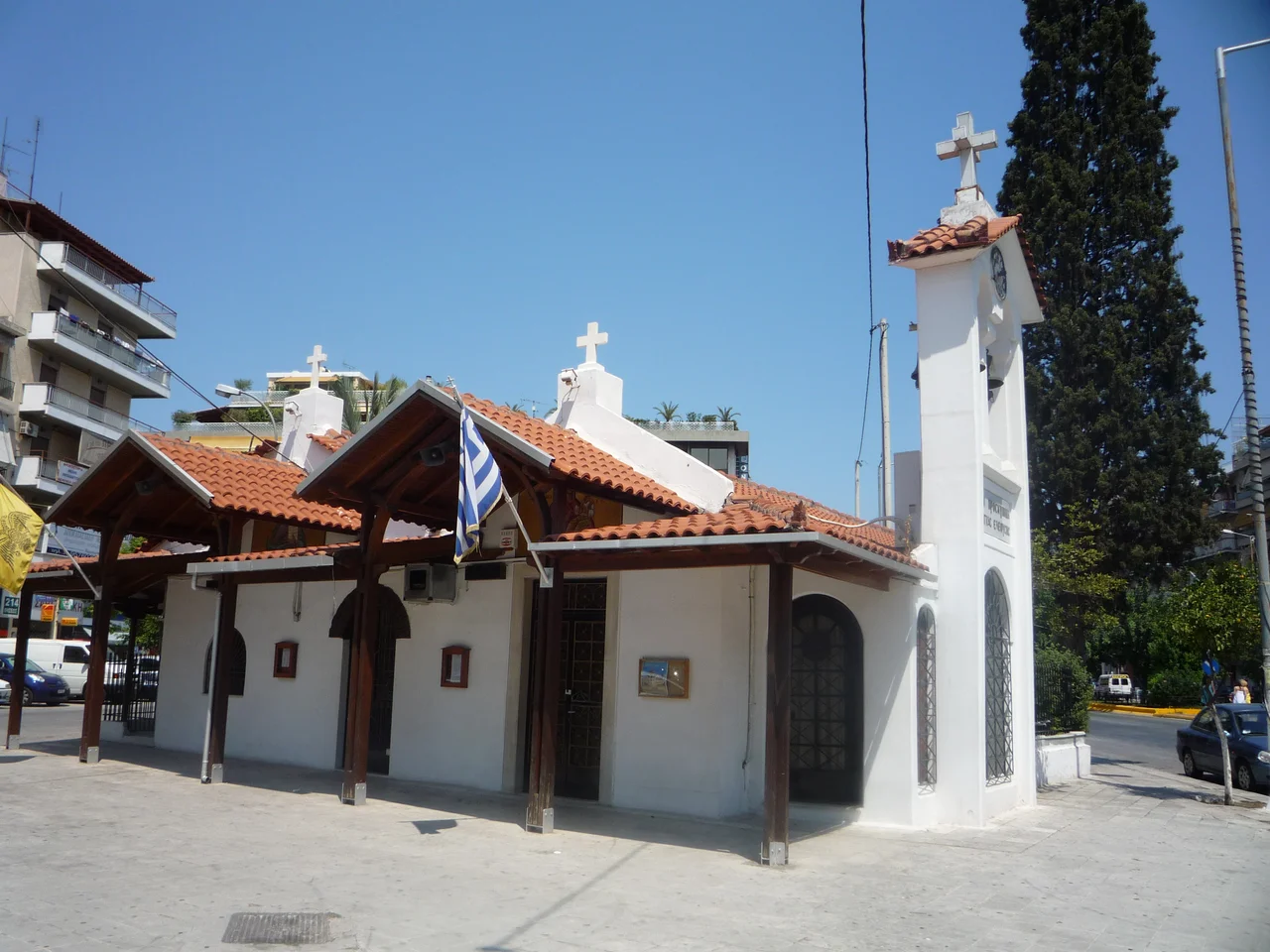

Kallithea
The name Kallithea means "beautiful view" in Greek, a tag that was never quite ironic and never quite accurate either. Look south from this densely built municipality just three kilometres from Syntagma Square and Phaleron Bay opens before you — salt-blue water, the low profile of the hills beyond Piraeus, the haze that settles over Athens in summer when the thermometer pushes past 36 degrees. The view is real. But Kallithea is less about views than about layers: of people, of sounds, of tragedy weathered and transformed into something vital. Greece's eighth-largest municipality grew dense with purpose and grief in equal measure, and it shows.
Where Theseus Came Ashore
Mythology chose Kallithea as its landing strip. According to Greek tradition, Theseus beached his ship on these shores after sailing back from Crete, the Minotaur defeated and the black-sailed grief of his father's misunderstanding still ahead. The district's emblem is Theseus for exactly this reason. Beneath the modern streets, the 5th-century BC city planners knew this land too — the Long Walls protecting Athens stretched west through what is now Kallithea, and the Phalerum Wall ran east, fortifying the corridor to the sea. The ancient town of Xypete sat somewhere within this area, its citizens mentioned by Plato himself. History here does not require excavation; it simply surfaces whenever anyone looks closely enough.
Two Olympics, One Neighbourhood
Kallithea's modern identity began taking shape in December 1884, when the plans for the new city were officially approved. Sixteen years later, the district played host to the 1896 Summer Olympics — the first of the modern era — when the Kallithea Shooting Range (Skopeftirion) opened for competition. The athletes who came for those historic games also competed at the Panathinaiko Stadium two kilometres to the northeast and the Neo Phaliron Velodrome two kilometres to the southwest. A century and eight years later, the 2004 Athens Olympics returned: handball and taekwondo filled the new Sports Pavilion at the bottom of Syngrou Avenue, while beach volleyball drew crowds to the Olympic Beach Volleyball Centre on Kallithea Bay. The tramway depot that opened here in 1910 gave way to universities, and the universities gave way to the quiet, ordinary ambition of a working city.
A Harbour for the Displaced
The 1920s changed Kallithea more profoundly than any building programme could. Thousands of people — displaced Greeks from Pontic cities on the Black Sea coast, survivors of the Asia Minor Catastrophe of 1922, families expelled from Sinope, Trabzon, Samsun, and dozens of other ancient Greek settlements now part of Turkey — arrived in cascading waves following the Treaty of Lausanne in 1923. They settled near the old Olympic shooting range. Later, in the 1930s and again after the Soviet Union's dissolution in the 1990s, more waves followed: Greeks from Georgia, Kazakhstan, Uzbekistan, whose ancestors had been scattered by Stalin's ethnic deportations. Each group brought language, food, music, grief, and an unshakeable attachment to places that no longer existed as they remembered them. The fraternal organisations they founded — the Argonauts-Comnenus society, the Constantinopolitan Society — still keep those memories alive.
The Sound of Tzitzifies
South Kallithea, the neighbourhood known as Tzitzifies, gave Greece some of its most beloved music. Rebetiko — the rough, modal, deeply personal genre that emerged from the cafés and dockside taverns of the 1920s refugee communities — found fertile ground here. Markos Vamvakaris, Vassilis Tsitsanis, Sotiria Bellou, Manolis Chiotis, Stelios Kazantzidis: these names are not just performers but pillars of Greek popular culture, and many of them performed in Tzitzifies. The neighbourhood was also home to Greece's only horse track until 2004, when the Hippodrome moved to Markopoulon near the international airport. What remains is a tram line, a memory of races and music, and a waterfront that hosted Olympic beach volleyball and still faces the sea every evening in exactly the light that justifies the name.
What the Streets Remember
The old Olympic shooting range building did not age quietly. After the 1896 Games it became a school. The Nazi Occupation of 1941 turned it into a prison; among those jailed there were fighters of the Greek Resistance and victims of the Greek Civil War, including the communist leader Nikos Beloyannis. The building was demolished in 1966. Two universities — Harokopio and Panteion — now ground the district in education. The Stavros Niarchos Foundation Cultural Center anchors the cultural life of south Athens a short walk from Kallithea's tram station. Metro Line 1 links the neighbourhood to the wider city. Kallithea FC plays at the Grigoris Lambrakis Stadium, which the club has called home since 1972. The beautiful view is still there. So is everything that happened in front of it.
From the Air
Kallithea lies at approximately 37.95°N, 23.70°E, occupying the southern approach into central Athens from the sea. From the air at 3,000–5,000 feet, the district is recognisable by its tight urban grid, the wide cut of Syngrou Avenue running northeast toward the city centre, and the blue ribbon of Phaleron Bay to the south. The Stavros Niarchos Foundation Cultural Center — a striking glass-and-steel structure by Renzo Piano — is the most visible modern landmark from altitude. Athens International Airport (LGAV / Eleftherios Venizelos) lies approximately 25 km to the east-southeast.
Nearby Stories
- Parnitha 3.4 km away
- Kea (island) 7.3 km away
- Sanctuary of Apollo Maleatas 11 km away
- Sousaki Volcano 12 km away
- Battle of Leuctra 14 km away
- Great Sand Beach 18 km away
- Agios Georgios (island) 23 km away
- Skyros 84 km away