
Kalloni
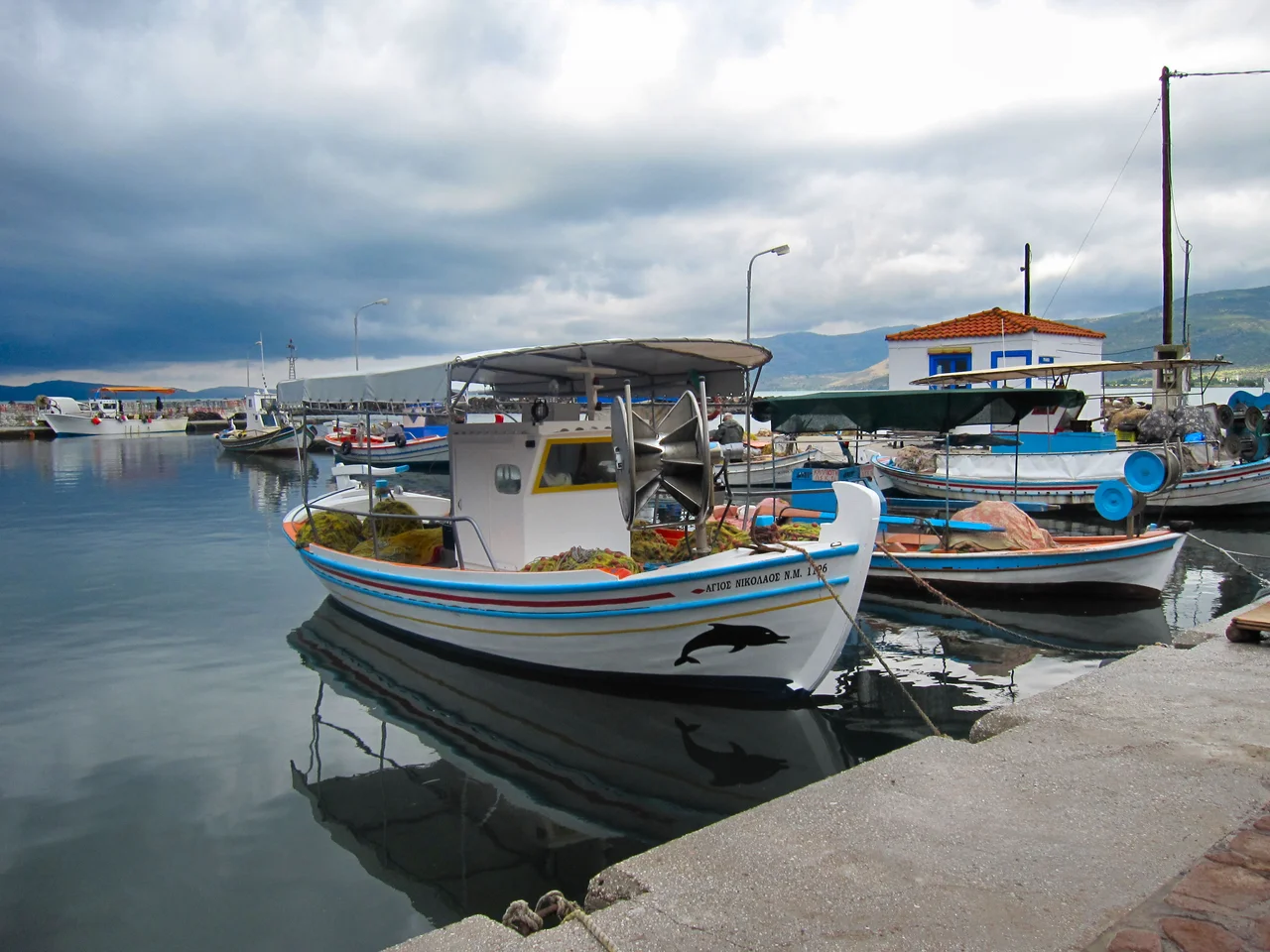
In July, the smoke off the grills at Skala Kalloni carries a single smell for miles: sardines, split and salted and laid over coals, served by the plateful with cold ouzo while a band plays and dancers fill the square. The little fishing harbor at the bottom of the gulf becomes, for a few warm nights, the center of the island. Kalloni sits inland from that harbor, a town of roughly 7,800 people at the geographic heart of Lesbos, where the roads have crossed since antiquity and where the water of one of the Aegean's strangest gulfs comes almost to the doorstep.
The Gulf That Feeds an Island
The Gulf of Kalloni is not really a bay. It is a vast, shallow lagoon, nearly closed off from the open sea, fed by six rivers that drain a fertile plain of about a hundred square kilometers. Warm, brackish, and rich, it behaves more like a giant tide pool than a stretch of Mediterranean. That is why the sardines come. The Kalloni sardine, sardella Kallonis, is prized across Greece, salted into a delicacy and grilled fresh at the summer festival that draws crowds to Skala Kalloni each July. The same shallow richness that fattens the fish also sustains a procession of wildlife: flamingos stalk the salt pans on pink legs, dolphins and porpoises work the channels, and seals haul out along quieter shores. The water gives the town its life, and has for as long as anyone has lived here.
Where Aristotle Watched the World
Around 345 BC, Aristotle left Athens. He had studied at Plato's Academy for twenty years, and when the headship passed to someone else, he went east, to the island of his friend and student Theophrastus. They settled by a lagoon then called Pyrrha, the body of water now known as the Gulf of Kalloni. There, by these shallows, Aristotle did something no one had done before. He looked closely at living animals and wrote down what he saw. The fish, the shellfish, the breeding habits of creatures in the warm water became the raw material for his treatises on the history, parts, movement, and generation of animals, the founding texts of biology. The father of botany worked at his side. It is a quiet thing to stand here and know that the systematic study of life began on the edge of a gulf that still teems with the same fish.
Crossroads and Sanctuaries
Kalloni has always been a place people pass through. Its position at the center of Lesbos made it the natural junction of the island's roads, and that has scarcely changed since ancient times. Monasteries ring the town, and the plain holds older sacred ground. At Messa stood a great temple to Zeus, Dionysus, and Hera, a worship and meeting place for all the people of Lesbos and, by the early second century BC, the seat of a federation of the island's cities. Pilgrims came here as they came to the sanctuary at Pyrrha. Centuries later a Christian basilica rose over the temple, then a Byzantine church over that, layer settling onto layer. Under Ottoman rule the town was known as Kalonya, a township center in the district administered from Molyvos. Lesbos joined the Kingdom of Greece in 1912, but the old crossroads kept its work, trading and feasting and gathering as it always had.
Festivals and the Working Year
The calendar here is marked by celebration. On 7 July comes the panigyri of the Holy Trinity, three days of feasting and horse races. In nearby villages the rhythm continues: a wine festival at Anemotia, livestock fairs at Agra, and on 16 August a festival in Kalloni's main square that honors the émigrés who left the island and the ties that still bind them to it. These are not performances for tourists. They are the way a farming and fishing community keeps time, vineyards and gardens watered year-round by abundant spring and underground water, the plain green where other Aegean islands are bare. Come in summer and you eat what the gulf and the land provide, to music, in a square that has been hosting gatherings for a very long time.
From the Air
Kalloni lies at 39.23 degrees N, 26.21 degrees E, at the head of the Gulf of Kalloni in the center of Lesbos. From the air the gulf is the island's most distinctive feature, a near-enclosed shallow lagoon nearly bisecting Lesbos from the south. Mytilene International Airport (ICAO: LGMT) is roughly 35 km southeast on the island's eastern coast. A viewing altitude of 4,000 to 6,000 feet shows the full sweep of the gulf, its salt pans, and the surrounding plain; the central Aegean's exceptional sunshine usually keeps visibility excellent.
Nearby Stories
- Antandrus 6.8 km away
- Agios Isidoros, Lesbos 19 km away
- Adramyttium 30 km away
- Troy 45 km away
- Destruction of Psara 51 km away
- St. Helena Church 72 km away
- Psara 82 km away
- Battle of Athos 85 km away