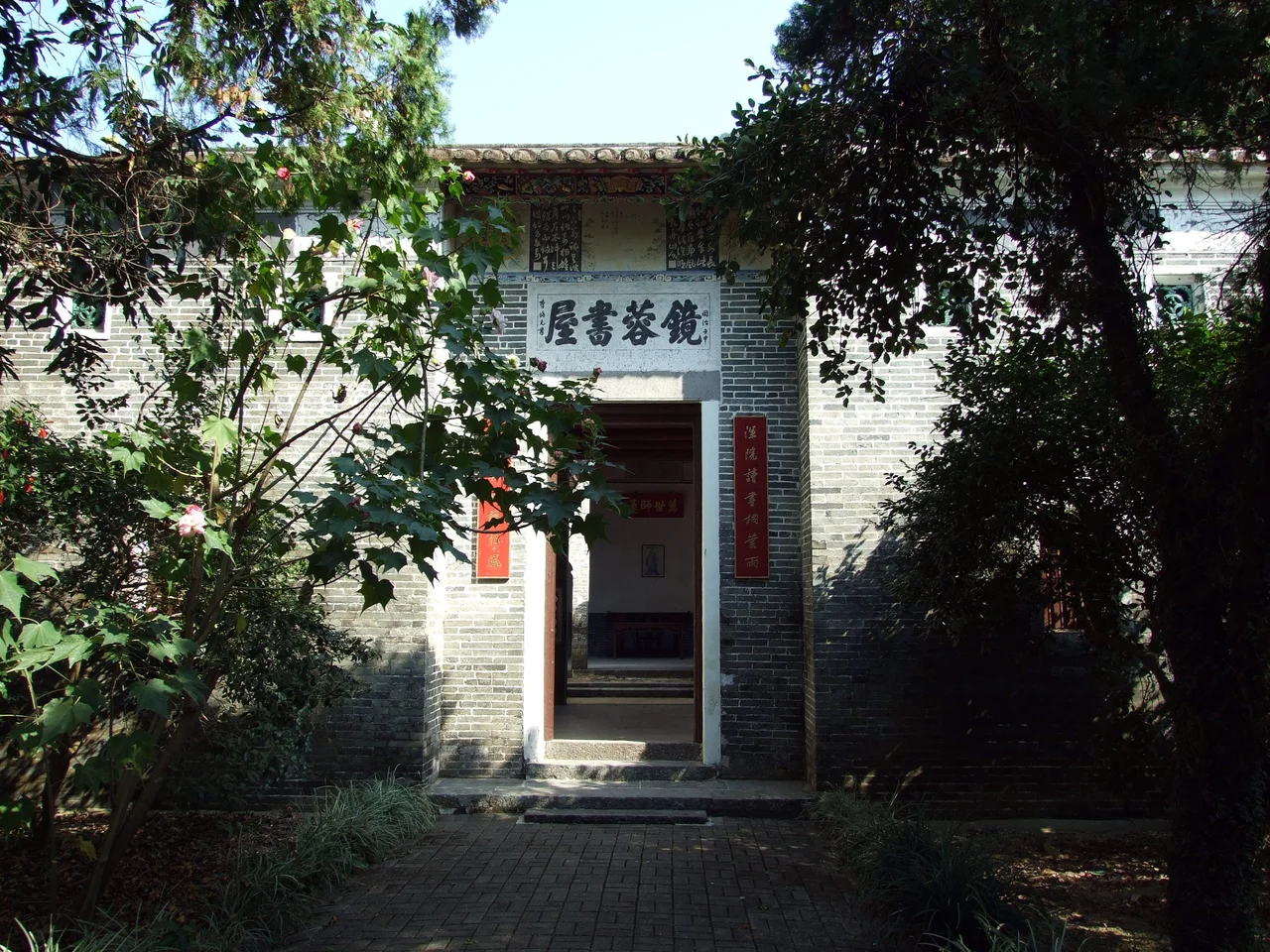

Kang Yung Study Hall
A hibiscus tree grows in front of Kang Yung Study Hall, and the building itself is inscribed with its name in characters written by Li Peiyuan — details that have survived the Qing dynasty, British colonial rule, the transformation of Hong Kong, and the closure of the border less than a kilometer away. The study hall sits in Sheung Wo Hang Village, in the Sha Tau Kok area of the northern New Territories, built by a Hakka family named Li at some point in the early Qing period. The government of Hong Kong declared it a statutory monument in April 1991. Two years later, a comprehensive restoration returned the building to something close to its original condition.
The Hakka Families of the Northern Villages
The Hakka people — whose name translates roughly as 'guest families,' a reference to their history of migration across southern China — settled the hills and valleys of the New Territories in successive waves over centuries. The Li family of Sheung Wo Hang was among them, establishing the village and, in due course, the study hall that would outlast much of what surrounded it. Hakka communities placed extraordinary emphasis on education as a path to social mobility: the imperial examination system rewarded scholarly achievement regardless of family origin, and a study hall was both a practical investment and a statement of communal ambition. To build one that attracted students from as far as Tai Po, Sha Tin, and Tsuen Wan — all of them coming to board and study in Sha Tau Kok — was a considerable achievement for a rural village near the territory's northern edge.
A Name With Two Stories
The study hall's name, Kang Yung, carries two competing explanations, and the village has declined to settle definitively on either. One theory reaches back to the Tang dynasty and a collection of supernatural tales called Miscellaneous Morsels from Youyang. In that account, a scholar named Li Guyan failed the imperial examination and traveled to Sichuan, where an old woman told him he would pass the following year 'under the lotus mirror.' The next year's exam question featured exactly that image — girl, mirror, and lotus — and Li Guyan placed first in the Jinshi class. The other theory is more local and more recent: Tang Yung-kang, a student from Lung Yeuk Tau in Fanling, passed the imperial examination in 1871, an achievement unprecedented in the region for 200 years. The study hall's name, by this account, commemorates that extraordinary success. Some villagers believe the building is older than 1872, which would complicate the second story without quite refuting it.
Confucius in the Main Hall
The physical arrangement of Kang Yung Study Hall follows the classical pattern for such institutions. The main hall is dedicated to Confucius — not as a deity in any straightforward sense, but as the philosophical anchor of the educational tradition the building embodied. Side halls served as classrooms; an upper floor provided sleeping quarters for boarding students who had traveled from distant districts. The architecture is restrained, its proportions adjusted to the scale of a rural building rather than an urban institution, and the materials are local — brick and timber that have weathered into the gentle dilapidation that preceded the 1993 restoration. Walking through the rooms, you can read the spatial logic of Qing-dynasty pedagogy: the ritual center, the teaching spaces arranged around it, the domestic provision for students who had left their homes to be there.
From Scholars to Schoolchildren to Silence
Kang Yung Study Hall outlasted the examination system that justified its existence. After the imperial examinations were abolished in 1905, the building transitioned into a rural primary school, adapting its purpose while preserving its form. Students continued to arrive, though now they were local children rather than examination candidates from across the New Territories. The school operated for decades, running through the upheavals of the twentieth century, until the summer of 1986 when the last batch of students left. The building sat empty for several years before its 1991 monument designation and 1993 restoration gave it a different kind of life: not a functioning school, but a preserved record of what schooling once looked like in this part of Hong Kong. The border is close. The Frontier Closed Area begins not far to the north. That proximity, and what it has kept undeveloped, is part of why the village and its study hall are still here.
From the Air
Kang Yung Study Hall sits at approximately 22.522°N, 114.195°E in Sheung Wo Hang Village, Sha Tau Kok, in Hong Kong's North District. The location is in the far northeastern corner of the New Territories, very close to the Frontier Closed Area boundary and the border with mainland China. From the air at 2,000–4,000 feet, the Sha Tau Kok inlet and the narrow strip of developed land along the Hong Kong–China border are visible to the north. The village cluster in the surrounding hills is small and green. The nearest major airport is VHHH (Hong Kong International), approximately 45 kilometers to the southwest. ZGSZ (Shenzhen Bao'an International) lies roughly 50 kilometers to the west-northwest. Sha Tau Kok itself is identifiable from altitude by the inlet that gives the town its character.
Nearby Stories
- Hong Kong Disneyland 4.1 km away
- Mount Guanyin (Dongguan) 7 km away
- 2024 Lixinsha Bridge Collapse 7.4 km away
- Portas do Cerco 12 km away
- Lotus Hill 15 km away
- Nanxiong Formation 78 km away
- Heyuan 130 km away
- Checheng Fu'an Temple 629 km away