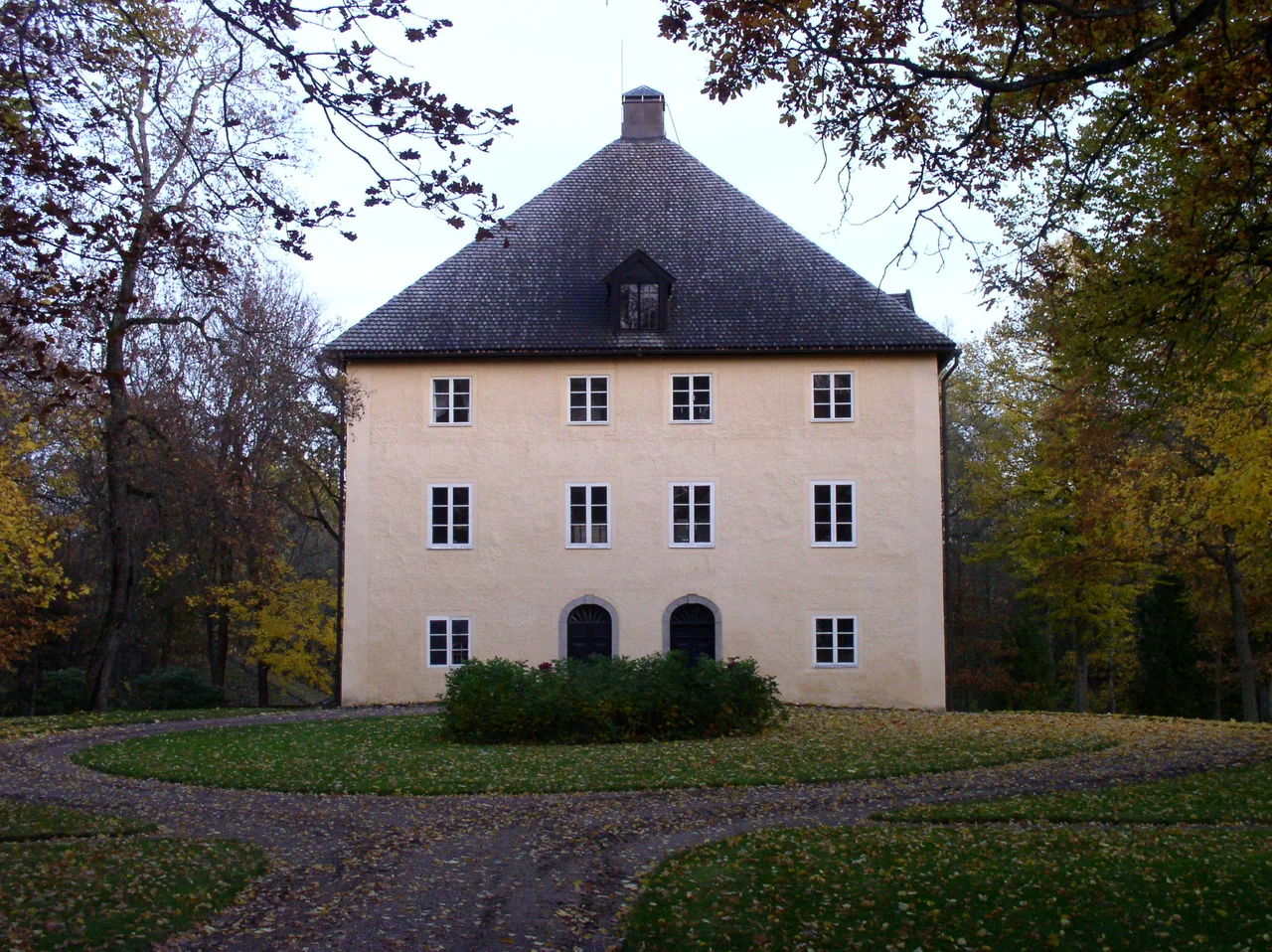

Kankainen Manor
By the 1750s there were trees growing inside it. Visitors reported vines working through the masonry and saplings rooted in the floors of a house that had been the seat of one of the great families of the Swedish kingdom. That building is now routinely described as the oldest surviving residential building in Finland. Both things are true, and the gap between them is the whole story of Kankainen: a house that has been half-lost at least three times and has come back each time slightly different, missing a floor or gaining one, until what stands beside the little river south of Masku is less a preserved medieval object than a very long argument about whether to let it fall down.
The Cube Beside the River
Kankainen Manor - Kankaisten kartano in Finnish, Kankas gård in Swedish - sits about a kilometre south of the Masku town centre, along a small river running toward the coast. The village first appears in writing in 1346, and the estate is thought to have been established in the 1410s by Klaus Lydekesson Diekn, then bailiff of Turku Castle. The main house as it stands was built around 1550 by Henrik Klasson Horn, but he built on something older: the basement and foundations date from the end of the fifteenth century, and it is those lower courses that carry the claim of being Finland's oldest surviving dwelling. The form is unusual and memorable - an almost perfect cube of stone, three storeys, more castle than farmhouse. In 2009 the Finnish Heritage Agency listed it among the country's nationally significant built cultural environments.
Two and a Half Centuries of Horns
The Horn family held Kankainen from 1437 to 1695, and the house is inseparable from them - they took their name from it, becoming Horn af Kanckas. Henrik Klasson Horn (c. 1512-1595) married Elin Arvidsdotter around 1544, moved in, and went on to a career that kept him away from it for years at a stretch. He was made a high councillor in 1566, governor of Reval - modern Tallinn - and Livonia during the Livonian War, and Governor-General of Finland from 1572 until about 1580. He and Elin had at least ten children. He died at Kankainen in 1595, in his eighties, in the house he had built. Kings came to the door: Gustav I in 1556, and Gustavus Adolphus in 1616. For a stone cube on a Finnish river, that is a considerable amount of the sixteenth century passing through the hall.
Ruin
The seventeenth-century reductions clawed a large share of the manor's land back to the crown, and in 1695 Evert Horn the Younger surrendered the estate to major general Johan Ribbing to settle a debt, ending the family's tenure. Worse followed. The house was damaged during the Greater Wrath, the Russian occupation of Finland between 1714 and 1721 in the closing phase of the Great Northern War - a catastrophe measured not in damaged manors but in people, with something on the order of twenty thousand Finns killed and tens of thousands of women and children carried off into slavery, some to labour on the building of Saint Petersburg, others trafficked far to the south. Set against that, a wrecked roof at Kankainen is a footnote. But the roof stayed wrecked, and the decades that followed did the rest, until the trees moved in.
Rebuilt, Burned, Rebuilt
Nils Hasselbom, a professor at the Royal Academy of Turku, bought the ruin in 1756 and had it renovated in 1762-1763 to plans by Augustin Ehrensvärd, the officer better known for raising the great sea fortress off Helsinki. The work was pragmatic and slightly ruthless. The ruined third floor was simply removed, leaving a two-storey block; the windows were realigned into symmetry; and because the main entrance sat off-centre and offended the eye, a second door was added that opens onto nothing at all. Then in 1819 Nils Nilsson Fredensköld fell asleep beside his books without putting out the candles, and the fire that followed destroyed most of the manor's archive - centuries of its own memory gone in a night. Colonel Berndt Aminoff bought the place at auction in 1846. It passed to his son Carl Fredrik Aminoff, who died childless during the Finnish Civil War in 1918 and left it to a relative, Claes Aminoff. He rebuilt the third floor in 1935 and gave the house back its cube.
Still There
So the building you can see today is fifteenth-century in its footings, sixteenth in its walls, eighteenth in its window rhythm and twentieth in its top floor, with a false door on the front that exists purely for the sake of balance. It is a strange kind of authenticity - not a thing frozen, but a thing continually repaired by people with different ideas about what it was supposed to look like. Ownership has kept moving too: the Åbo Akademi foundation held it until 2018, when it was sold on to a private property company. The river still runs past. The oldest stones in the cellar were laid before Finland had a printing press or a university, and they are quietly carrying a top floor that is younger than the aeroplane.
From the Air
Kankainen Manor stands at 60.5578 N, 22.0961 E, roughly 1 km south of Masku centre and about 20 km northwest of Turku in Southwest Finland. Look from 1,000 to 2,000 ft for a compact pale cube with a steep roof set close to a small river in open farmland, distinctly taller than the farm buildings around it. Stenberga castle rock lies about 6 km southwest and Naantali about 13 km south. Turku Airport (EFTU) is roughly 15 km southeast; Helsinki-Vantaa (EFHK) about 165 km east. The building's height-to-footprint ratio is its best identifier from the air - most rural buildings in this landscape are long and low, and this one is neither.
Nearby Stories
- Karuna Church 3.6 km away
- Kustavi 4.9 km away
- Paimio 15 km away
- Pyhämaa 15 km away
- Vaskijärvi Strict Nature Reserve 15 km away
- Tibet Art Center 21 km away
- Battle of Sandöström 31 km away
- Battle of Bomarsund 67 km away