
Karkali Strict Nature Reserve
Finland is a spruce country, and at Karkali the spruce gets cut down on purpose. On a narrow peninsula reaching out into Lake Lohjanjärvi, a single square kilometre of forest has been protected since 1964 in order to be something most of Finland is not — a lehto, a rich deciduous grove of linden and hazel growing on unusually lime-heavy soil. Norway spruce pushes in from the east and shades that grove out, so the forest administration periodically goes in and fells the intruders, leaving the trunks where they drop. The rotting wood is not tidied away. Deadwood is part of the point.
One Square Kilometre of Lime
Calcareous bedrock is the whole reason Karkali exists as a reserve. Most Finnish soil is acidic and grows conifers; here, lime in the ground supports plants that struggle almost everywhere else in the country, and species that are rare nationally flower along the trail in ordinary abundance. Hazel is everywhere, linden is the signature tree, and around two hectares of the reserve is peatland rather than grove. Roughly forty bird species nest inside that one square kilometre, and eleven different ferns grow here. This is a small piece of ground doing a disproportionate amount of botanical work, which is precisely why the rules governing it are stricter than almost anywhere else a Finn can walk.
An Archbishop's Nut Paths
People lived on the Karkali peninsula from the sixteenth century onward. Three houses once stood in what is now the reserve, and the last of them was still occupied into the 1910s; traces of the buildings remain in the undergrowth. The small meadow in the middle of the reserve is not a natural clearing at all but a farmyard, kept open by mowing it once a year — a scrap of managed grassland preserved as carefully as the forest around it. In 1902 Gustaf Johansson, then Archbishop of Finland, built himself a summer villa at the point of the peninsula and cut a network of paths through the woods so that he could gather hazelnuts comfortably. The villa is gone. The paths outlived him and became the nature trails visitors walk today.
A Reserve Without a Right of Way
Finland's everyman's right — the freedom to roam, camp and pick berries almost anywhere — is one of the country's defining liberties, and inside a strict nature reserve it does not apply. At Karkali visitors must stay on marked trails. Hunting, fishing, collecting plants, invertebrates or stones, and picking flowers, edible berries or mushrooms are all forbidden, and the prohibition covers dead specimens as well as living ones; you may not carry off a fallen leaf any more than a growing one. Fires of every kind are banned, disposable barbecues included. Nobody may stay overnight. Dogs are welcome but must be leashed. There is no entrance fee, which is the one place the reserve is generous: it costs nothing to visit and everything is forbidden once you arrive.
Four Loops
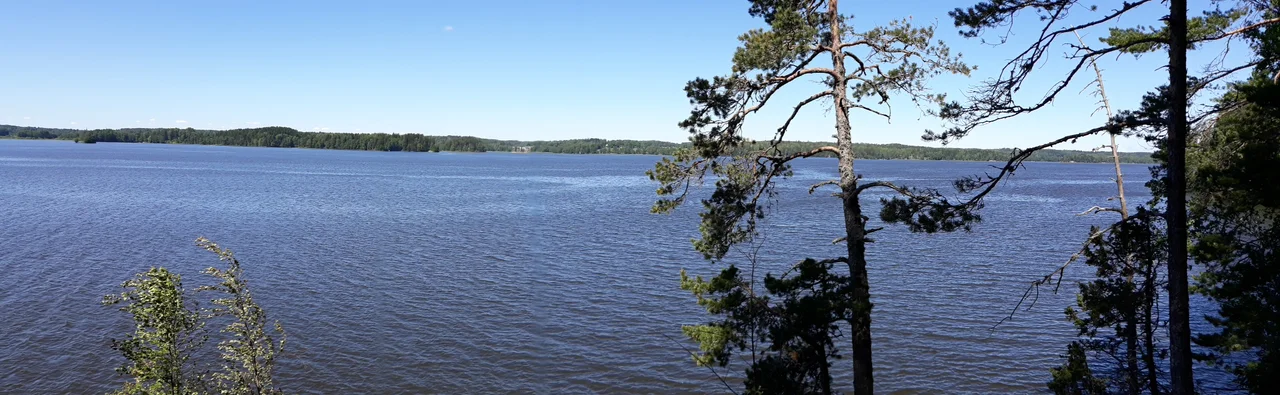
The marked trail is laid out as nested loops of half a kilometre, one kilometre, three kilometres and six, all starting and ending at the same point beside the entrance. Only the longest reaches the tip of the peninsula, and only the longest is properly demanding; the rest are easy walking with information boards along the way. From the far loop the views open across Lohjanjärvi. Swimming is permitted from one sandy shore on the southern side of the reserve, which is also the single place a boat may legally land, but the lake is deep and its bottom drops away steeply close in. Ticks are the real hazard here rather than anything larger. Lohja town centre, and the nearest shop, is about eighteen kilometres away.
Torhola, Three Kilometres Away
Just outside the reserve boundary lies Torhola, Finland's largest limestone cave — thirty-one metres long, thirty-six wide, with fourteen metres of vertical relief between its highest and lowest points. It was cut by water dissolving the lime out of the bedrock and leaving the harder leptite gneiss standing, the same chemistry that gives Karkali its extraordinary plants, working downward instead of up. The cave runs in three stages: a bright, roomy entrance chamber, a darker and lower main hall, and a cellar reached through a narrow vertical squeeze that opens out again before pinching shut. Small stalactites hang from the ceiling. Bats overwinter inside, so autumn and winter visits are discouraged, and nobody should go into the deeper sections alone — mobile phones do not work under that much rock.
From the Air
60.2406 N, 23.8006 E, on a peninsula in Lake Lohjanjärvi, about 18 km west of Lohja in southern Finland. Best appreciated from 2,000-3,500 ft, where the reserve reads as a distinctly different colour from the forest around it — broadleaf canopy against conifer, brilliant in early October when the lindens turn. The peninsula's long, narrow shape and the small mown meadow near its middle are the identifying features. Nummela Airfield (EFNU) lies roughly 30 km east, Kiikala (EFIK) about 35 km northwest, Helsinki-Vantaa (EFHK) about 70 km east-northeast. Lohjanjärvi freezes hard in winter and the whole lake reads as flat white; morning mist over the water is common in late summer.
Nearby Stories
- SuperShe Island 3.2 km away
- Teijo National Park 14 km away
- Hanko Peninsula 14 km away
- Hiidenlinna 18 km away
- National Museum of Finland 37 km away
- Sarka (museum) 42 km away
- Hakoinen Castle 49 km away
- Peter the Great's Naval Fortress 54 km away