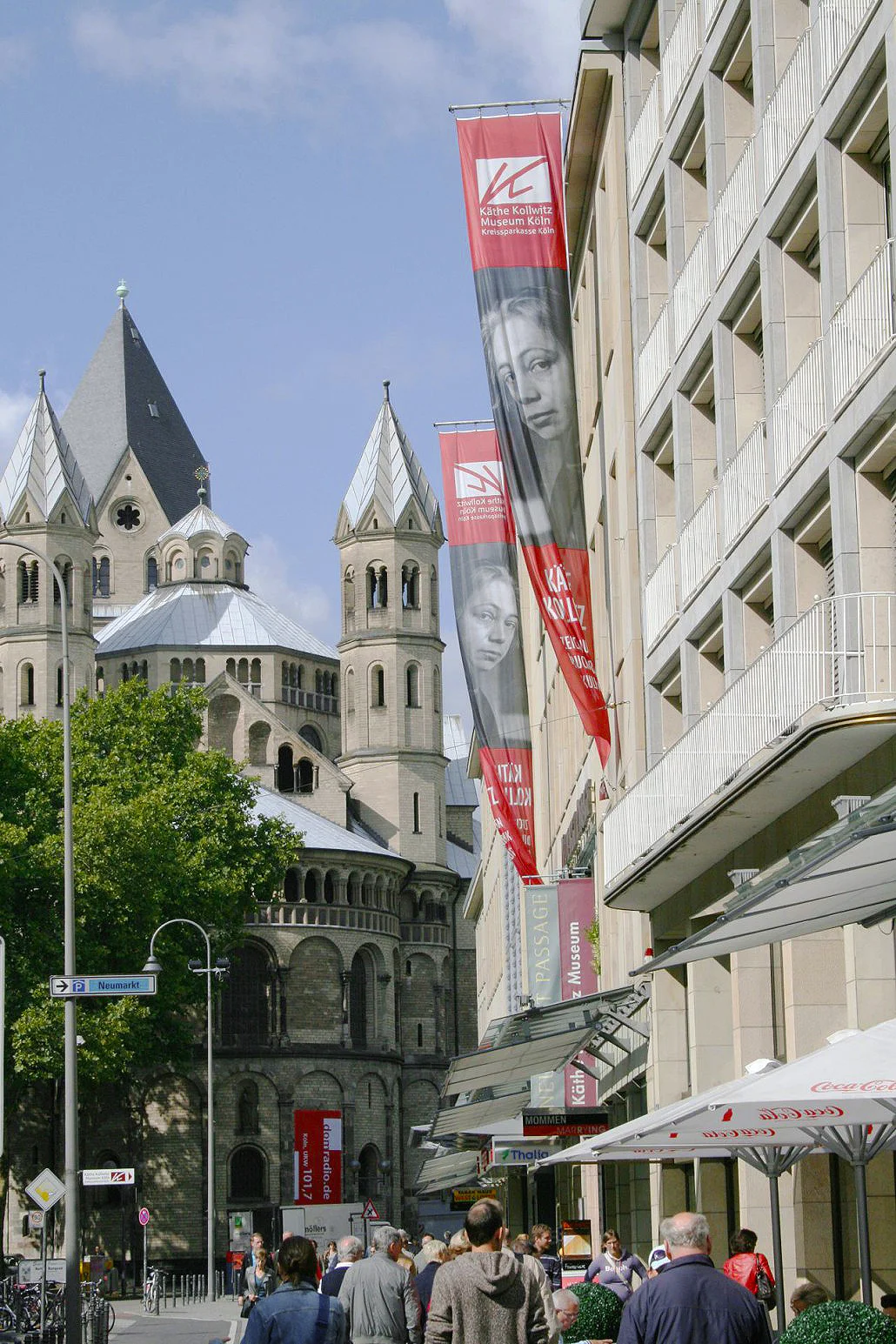

Käthe Kollwitz Museum
Käthe Kollwitz outlived her son Peter, who died as a teenage volunteer in the trenches of Flanders in 1914. She outlived her grandson Peter, named for him, who was killed on the Eastern Front in 1942. She died in April 1945, days before the Nazi regime collapsed. Between those losses she made some of the most unflinching art of the twentieth century - charcoal drawings of weavers' uprisings, lithographs against the death of soldiers, bronze sculptures of grieving parents. The largest collection of her work in the world sits, improbably, on the top floor of a 1980s shopping arcade in Cologne, kept there by a savings bank that decided her subjects were its own.
Why a Bank Owns It
The Käthe Kollwitz Museum Cologne is owned and operated by the Kreissparkasse Köln, a regional savings bank. This is not a quirk of corporate philanthropy. The German savings bank movement was founded in the nineteenth century explicitly to serve the poor - workers, the unemployed, families one bad week from ruin. Kollwitz drew those same people. Hunger, poverty, the deaths of children from preventable diseases, the grief of women whose husbands did not come home from war: these were her subjects from the 1890s to her death in 1945. When the bank started collecting her work in 1976, then opened the museum on the 40th anniversary of her death in 1985, the framing was deliberate. The art and the institution shared a constituency.
The Cycles
Kollwitz worked in long, sustained series. Ein Weberaufstand, The Weavers, was a cycle of lithographs and etchings made between 1893 and 1897, inspired by Gerhart Hauptmann's play about the 1844 Silesian weavers' revolt - women and men with hollow cheeks pushing against the doors of a factory owner. Bauernkrieg, the Peasants' War cycle, came between 1901 and 1908, depicting the failed 1525 uprising of German peasants against their lords. Krieg, War, made in 1921 and 1922 as woodcuts, was her response to the death of her son and the unending grief she had seen in other mothers. The Cologne museum owns all of these cycles, plus Proletariat from 1925 and the lithographic cycle Tod, Death, from 1934 to 1937. To walk the rooms is to move through one woman's accumulated witness, decade by decade.
The Grieving Parents
Kollwitz spent fourteen years, from 1918 to 1932, working on a memorial sculpture for her dead son. Die trauernden Eltern - The Grieving Parents - is a pair of figures, a mother and father kneeling. The father's hands grip his own shoulders, holding himself together. The mother bends forward, face hidden. They are not heroic. They are not consoled. The originals stand at the Vladslo German war cemetery in Belgium, where Peter is buried. The Cologne museum holds many of the preparatory drawings, plus a copy of the sculpture installed in the ruined church of Alt St. Alban in Cologne - a copy made in 1956 in the workshop of Ewald Mataré by his students Erwin Heerich and Joseph Beuys. Beuys, who would become one of the most influential German artists of the postwar era, helped cast a Kollwitz.
Banned, Then Determined
The Nazis declared Kollwitz's work degenerate. In 1933 she was forced to resign from the Prussian Academy of Arts, the first woman ever elected to it. Her work was removed from public museums. The Gestapo interrogated her in 1936 and threatened her with a concentration camp; she replied that she had been ready to take her own life if it came to that. She kept working. Her last lithograph, made in 1941, was Saatfrüchte sollen nicht vermahlt werden - Seed fruit is not to be ground down - a mother shielding her children. Her motto in the 1920s had been simple: I am determined to have an impact in these times. She did. The complete collection of those posters, made for trade unions and peace movements and famine relief committees, is held in Cologne.
Fifteen Bronzes and the Shopping Arcade
The museum is housed in the Neumarkt Gallerie, a thousand square meters on the top floor of a shopping arcade designed by Hans Schilling and opened to Kollwitz visitors in 1989. It owns all fifteen of her bronze sculptures that can be displayed as museum pieces, plus three hundred drawings, more than five hundred prints, all of her posters, and a Grabrelief Levy from 1938 at the Jewish cemetery in Cologne's Bocklemünd district. Kollwitz's granddaughter, Dr. Jutta Bohnke-Kollwitz, was the founding director. The unlikely setting - escalators below, art history above - turns out to be appropriate. Kollwitz drew people who shopped at savings-bank-funded counters, who lived above shops, who buried their children in cities like this one. The arcade is exactly where her work belongs.
From the Air
50.94N 6.95E. Neumarkt is in central Cologne, just south of the cathedral district. Nearest airport: Cologne/Bonn (EDDK), 15 km southeast. From the air the Neumarkt square is a clear open rectangle amid the dense Innenstadt grid; the Neumarkt Gallerie's distinctive 1980s glass roof marks the museum's location on the top floor.
Nearby Stories
- Diamond Interchange: How a Simple Idea Reshapes Towns Like Julich 2.8 km away
- Dusseldorf-Unterbach 6.1 km away
- Baumwollspinnerei Ermen & Engels 11 km away
- RAF Bruggen 15 km away
- Hagen Open-air Museum 21 km away
- Belgium 130 km away
- Marcinelle Mining Disaster 173 km away
- Zwingenberg Castle 178 km away