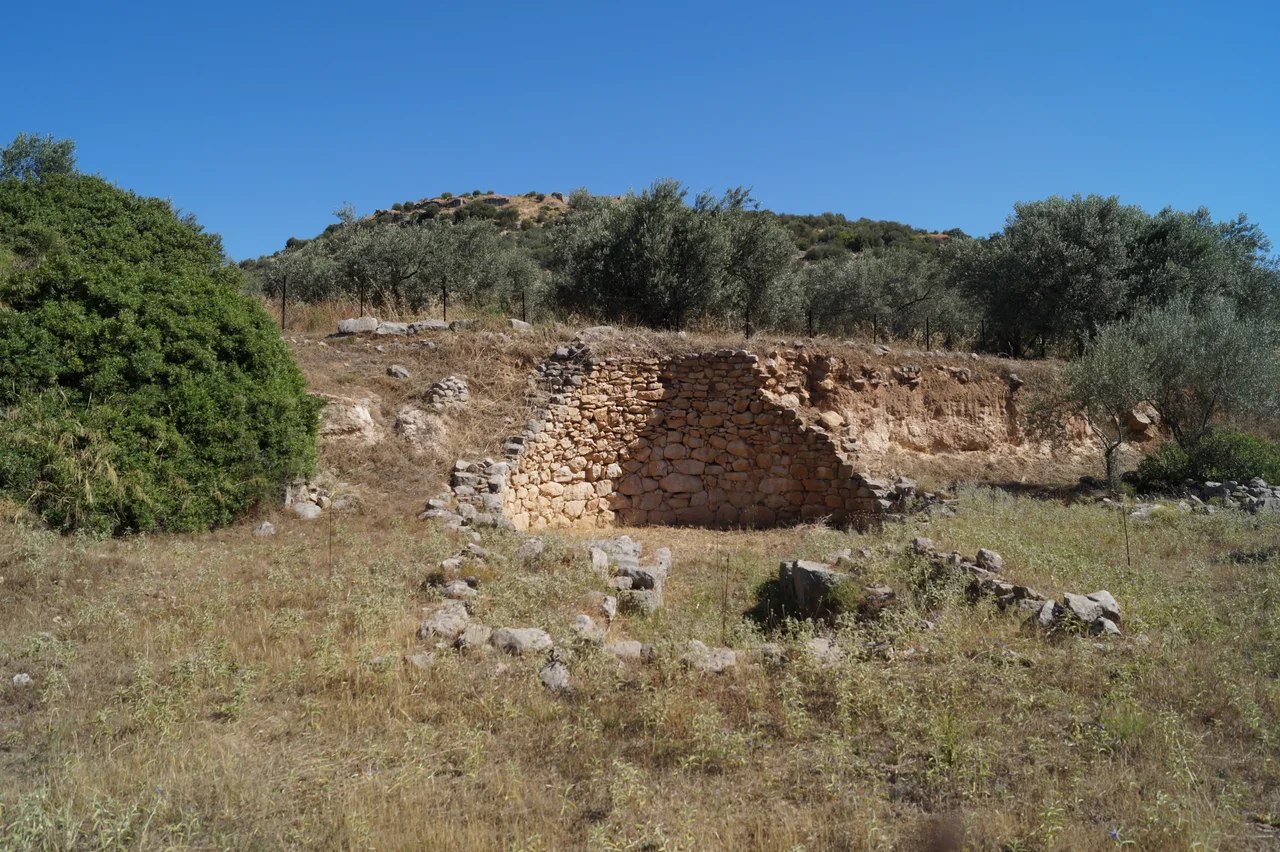

Kazarma Tholos Tomb
Three people were buried here between 1500 and 1450 BC — a woman in the first shaft, two men in the others — and nobody disturbed them for three thousand years. The Kazarma tholos tomb sits on the southern slope of a hill in what was once called Kazarma, now Agios Ioannis, in the Argolid of Greece. It is a beehive tomb, the distinctively Mycenaean form in which a corbelled stone dome rises over a circular chamber, accessible through a long entrance corridor. This one was modest by the standards of the great tombs at Mycenae, but it served people who mattered: a local elite who apparently controlled the road between Epidaurus and Argos, the ancient artery threading through the hills just to the north.
The Architecture of the Afterlife
Mycenaean builders approached death as an engineering problem. The tholos form solved it elegantly: a dromos — an open approach corridor, here about five metres long and two and a half metres wide — led to a stomion, or doorway passage, which opened into the domed chamber itself. The dome originally measured 7.20 metres across and roughly seven metres high. Builders used large stones for the lower courses and smaller stones as the structure curved inward, a technique with close parallels in the tombs at Mycenae. Only the rear portion of the dome survives to a height of four metres today, but enough remains to understand the geometry of what was built. Three shaft graves were cut directly into the soft bedrock floor of the chamber, each sealed with large stone slabs. The graves contained not just the dead but their belongings: Palace Style pottery, earlier Bronze Age vessels, jewelry, and bronze weapons — an inventory that speaks to wealth and connections across the Mycenaean world.
Three Burials, Then Two Centuries More
The tomb did not seal itself after those first three burials. It remained in use, presumably by the same family, for more than 250 years. The occupants accumulated, generation by generation, within the same domed room. Then, sometime around the beginning of the 12th century BC — the Late Helladic III C period, the final troubled century of Mycenaean civilization — something changed. Two more bodies were laid in the chamber, this time without any grave goods. A fire was lit inside. The tomb was permanently sealed. Before the entrance was blocked, a calf and a small skyphos, a two-handled drinking cup, were sacrificed on a stone heap outside. The archaeology suggests both farewell and finality: a deliberate closing ritual for a place that had held a family's dead for a very long time. Beneath the tomb floor, earlier deposits show the site was already occupied in the Early Helladic period, pushing human presence here back toward 2500 BC or earlier.
Excavation and the Road Still Traveled
Spyridon Marinatos led the excavation beginning in September 1968, working on the property of the Giannoulis brothers. Marinatos was one of Greece's most celebrated archaeologists — he would go on to excavate Akrotiri on Santorini before his death on site there in 1974 — and his work here was careful and systematic. The finds from Kazarma are now held in the Archaeological Museum of Nafplio, about 20 kilometres to the southwest. The tomb itself sits just eight metres north of the modern road to Lygourio and 1.5 kilometres north of the national road EO 70. The ancient road this family once controlled — the route linking Epidaurus and Argos — still runs through the same landscape. The alignment has shifted but the geography has not: this valley was always the logical corridor through these hills, and someone always controlled it.
A Beehive in the Landscape
Roughly 300 metres to the north of the tomb, according to the source article, another Mycenaean structure once stood — though the reference in the source is incomplete. The Arkadiko bridge, a Mycenaean corbelled stone bridge that still carries foot traffic across a ravine nearby, is among the oldest bridges in the world still in its original form, and it once served the same ancient road network that made this hilltop valuable. Standing at the tomb site today, you look out over dry Argolid terrain — scrubby slopes, limestone outcrops, the particular bleached quality of a Greek summer hillside. The dome is partially open to the sky now. The dromos leads nowhere visible. But the stone that Mycenaean builders cut and stacked here has outlasted everything around it by three thousand years, which is the most reliable form of testimony a mute object can offer.
From the Air
The Kazarma tholos tomb sits at approximately 37.594°N, 22.943°E, on the southern slope of Kazarma hill in the Argolid, northeastern Peloponnese. From the air at 3,000 feet, the Argolic Gulf glitters to the southeast and the ancient theatre at Epidaurus lies about 10 kilometres east. The nearest major airport is LGAV (Athens International Eleftherios Venizelos), approximately 100 kilometres to the northeast. The site is best approached from the road to Lygourio; look for the hillside just north of the EO 70 national highway. The terrain here is typical Argolid — olive groves, dry scrub, and limestone ridge lines threading between the coast and the Arcadian mountains to the west.
Nearby Stories
- German Submarine U-133 (1941) 5.1 km away
- Battle of the Trench (1821) 5.4 km away
- Battle of Settepozzi 6.7 km away
- Stymphalus (Arcadia) 8.2 km away
- Kechries 11 km away
- Battle of Sellasia 13 km away
- Saronic Gulf 19 km away
- SS Heraklion 68 km away