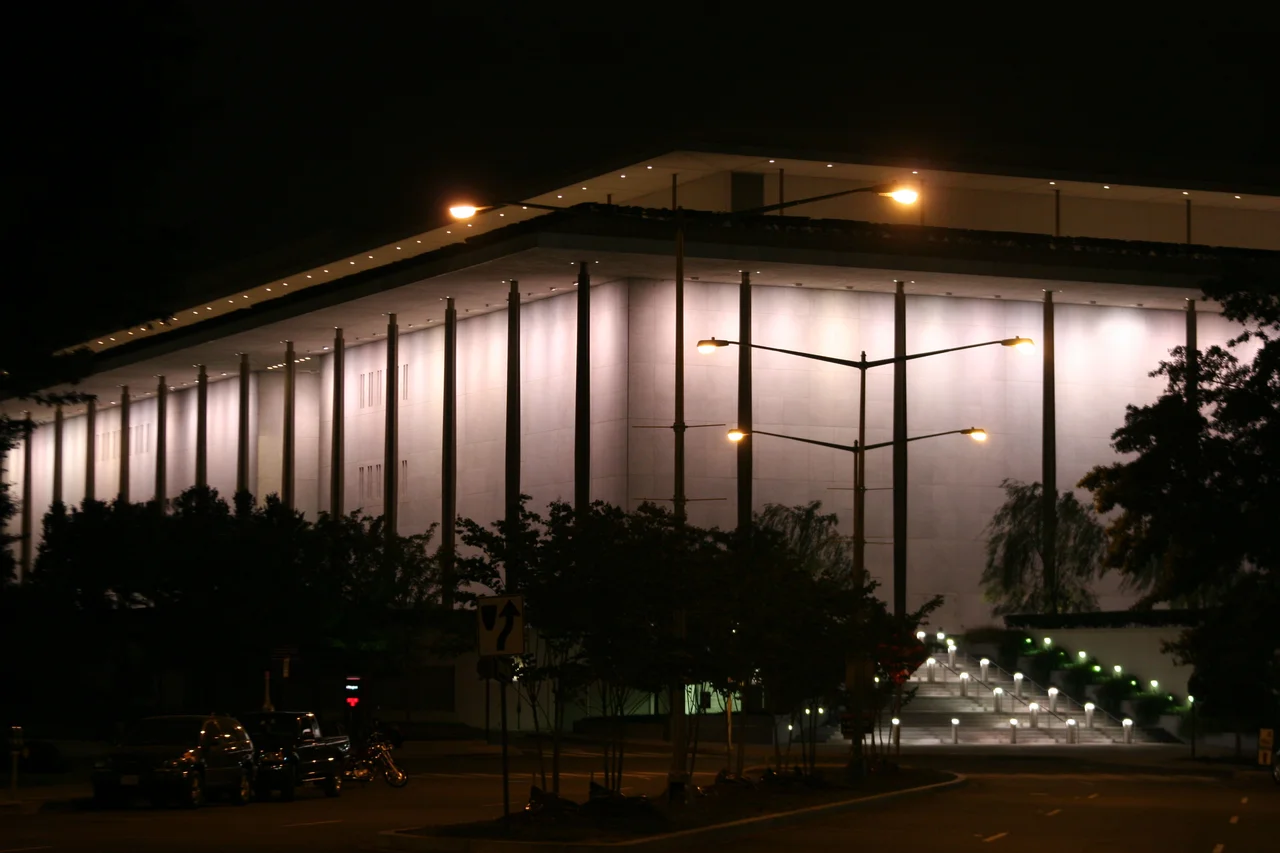

Kennedy Center
When the architects were drawing up the John F. Kennedy Center for the Performing Arts, they had to solve a peculiar problem: airplanes. Reagan National Airport sits two miles south on the same river. Helicopters thread the Potomac corridor daily. Anything built on this site would have to perform Beethoven under flight paths that carry hundreds of jets a day. Acoustician Cyril M. Harris took the obvious answer to its logical extreme. He built each auditorium twice - one shell inside another, with a layer of dead air between them. The Kennedy Center is a box inside a box, a marble fortress against sound. From the river, the silhouette is impossibly long: 630 feet of white marble, 100 feet tall, 300 feet wide. Sixteen hand-blown Orrefors crystal chandeliers from Sweden hang in the Grand Foyer. The Hadeland crystal chandeliers in the Concert Hall came from Norway. The whole building is a gift list from grieving nations made monument.
A Cultural Center That Took Thirty Years
The idea was older than the building by decades. In 1933, Eleanor Roosevelt floated the notion of a national arts center as a Depression-era jobs project for unemployed actors. Congress took up the proposal repeatedly through the 1930s, debating sites near the Capitol and Judiciary Square. Nothing happened. The arguments rolled on into the 1950s. On September 4, 1958, President Eisenhower finally signed the National Cultural Center Act, which mandated the structure but also stipulated that programming had to be paid for privately, not by taxpayers - a tension built into the foundation. Edward Durell Stone was hired as architect in 1959. By the time President Kennedy was assassinated in November 1963, fundraising had collected only $13 million toward a building that would cost $70 million to complete. The board then reframed the project entirely: it would become a living memorial to the murdered president. Congress renamed it the John F. Kennedy Center for the Performing Arts in 1964. The money started flowing.
Mass to Mark the Opening
Lyndon Johnson turned the first shovel on December 2, 1964. Excavation began a year later. The building rose slowly through the late 1960s, its design eventually approved over an earlier proposal that would have been more curved, more futuristic, more like the Watergate complex next door. Philadelphia contractor John McShain - the same firm that built the Pentagon and finished the Jefferson Memorial - did the construction work. The public got their first look on September 8, 1971, when 2,200 people filled the Opera House to hear the world premiere of Leonard Bernstein's Mass. Bernstein had been a Kennedy family friend. The piece itself was unconventional, mixing Catholic liturgy with rock and jazz, and the choice of it as the inaugural performance carried obvious weight. Four nights later, on September 9, the Concert Hall opened with the National Symphony Orchestra under Antal Doráti.
Three Halls and a Stage That Never Goes Dark
The center holds three primary venues. The Concert Hall, at the south end, seats 2,465 in an arrangement modeled on European halls like the Musikverein in Vienna - and serves as home of the National Symphony Orchestra. The Opera House, in the middle, seats roughly 2,347 and hosts the annual Kennedy Center Honors, the broadcast that has anchored American cultural December since 1978. The Eisenhower Theater, on the north side, seats about 1,161. Beyond these, the smaller Theater Lab has housed the whodunit Shear Madness continuously since August 1987 - one of the longest-running plays in American theater history. Since 1997, the Millennium Stage in the Grand Foyer has presented free performances every single day of the year - at 6 p.m. daily, noon on December 24. Over three million people have attended in the decades since, and tens of thousands of performances are archived on the center's website.
The 2025 Takeover
On February 10, 2025, President Donald Trump dismissed the Kennedy Center board of trustees and installed his own appointees. Two days later they elected him chairman. He named Richard Grenell interim executive director. Within weeks, the children's musical Finn was canceled. The national tour of Hamilton withdrew, followed by the play Eureka Day and artists including Rhiannon Giddens, Issa Rae, Renée Fleming, Shonda Rhimes, and Ben Folds. The American College Theatre Festival ended its 58-year partnership with the center. In May, the board quietly revised its bylaws to strip the 23 ex-officio members - cabinet secretaries, the Librarian of Congress, the mayor of D.C. - of their voting rights. On December 18, 2025, the remaining board voted to rename the building The Donald J. Trump and The John F. Kennedy Memorial Center for the Performing Arts. Workers added Trump's name to the facade the next day, despite a federal statute prohibiting plaques in public areas of the facility. Congresswoman Joyce Beatty, who said she had been muted during the vote, filed suit. Joe Kennedy III, John F. Kennedy's grandnephew, observed that the center was named by federal law and could no more be renamed than the Lincoln Memorial. On January 9, 2026, the Washington National Opera announced it was leaving. Composer Philip Glass withdrew the world premiere of his Symphony No. 15, titled Lincoln. The institution that had spent five decades as a national meeting ground entered an uncertain era.
The Terrace
Despite everything, the rooftop terrace is still open to the public, free of charge, from 10 a.m. to midnight when no private event has booked it. The view runs in all four directions. West to the Rosslyn skyline across the river in Arlington. South to the Potomac and the planes lifting off National Airport. North to the Watergate complex and Washington Harbor. East to the Lincoln Memorial and beyond. The Potomac flows steadily past below. The center's two German sculptures by Jürgen Weber - America and War or Peace, gifts from the West German government delivered in time for the 1971 opening - still stand at either end of the plaza, full of nude figures grappling with the heavy themes Weber assigned them. Don Quixote by Aurelio Teno, a gift from King Juan Carlos and Queen Sofia of Spain for the American Bicentennial, still occupies its corner near the entrance. The marble box on the river holds its acoustics. The flights still pass overhead.
From the Air
The Kennedy Center sits at 38.8956 N, 77.0556 W, on the east bank of the Potomac River in Foggy Bottom, immediately northwest of the Lincoln Memorial. Best viewed from 1,500 to 2,500 feet AGL. The long white marble box is unmistakable from the air; the Watergate complex sits directly to the north, the Lincoln Memorial about a half mile southeast. Reagan National (KDCA) lies two nautical miles south - flight paths along the Potomac River bring constant traffic over the building. The center sits inside the Washington Flight Restricted Zone; GA overflight prohibited. Note: this is the river segment used by the Potomac River VFR corridor for approved operations only.
Nearby Stories
- Gunston Hall 1.1 km away
- 2023 Baltimore Shooting 4.9 km away
- Battle of Middleburg 6.6 km away
- Crownsville Hospital Center 10 km away
- Battle of Loudoun Heights 13 km away
- First Battle of Rappahannock Station 20 km away
- Howard County, Maryland 21 km away
- Harriet Tubman Underground Railroad 50 km away