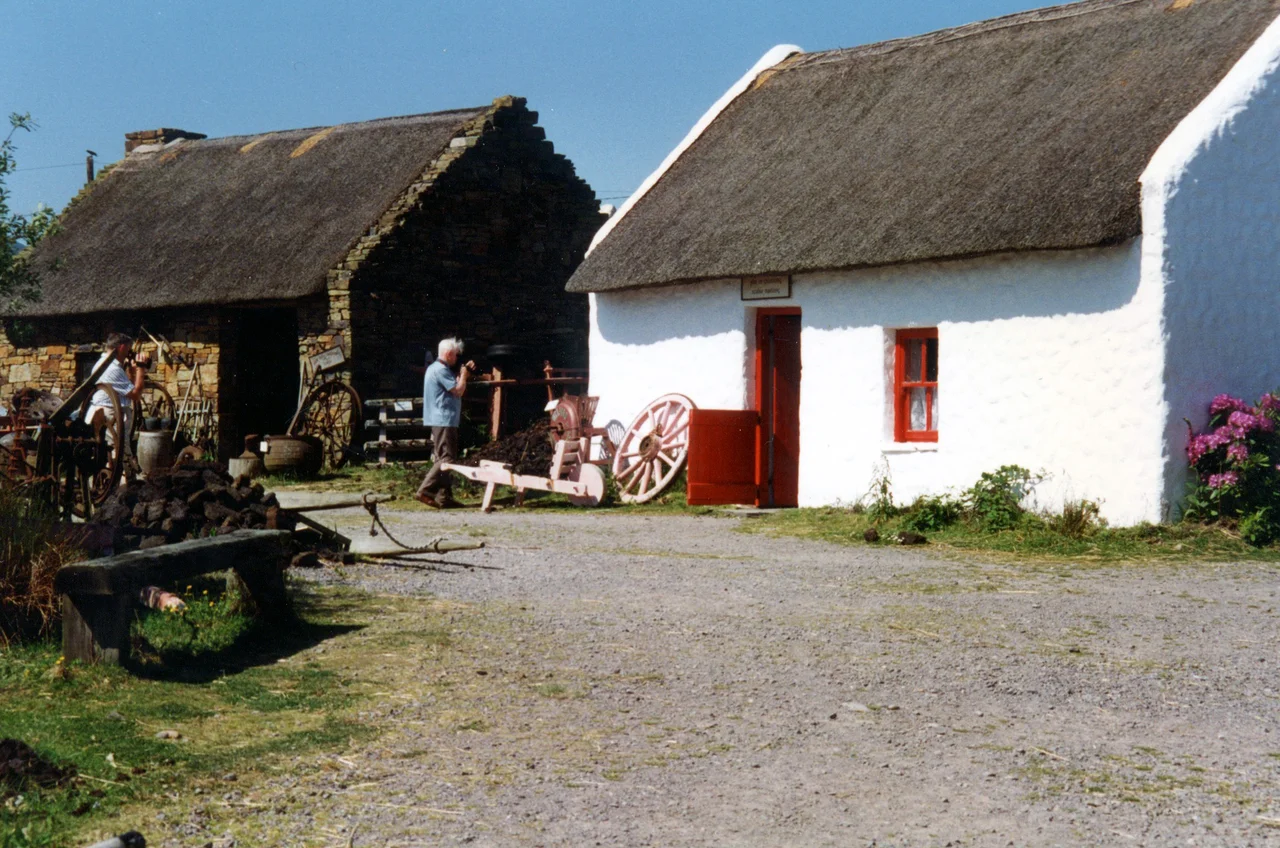

Kerry Bog Village
The Kerry Bog Pony almost went extinct. By the late twentieth century there were so few of the small, hardy ponies that had once worked the bogs of West Kerry — pulling carts of turf, carrying creels of seaweed up from the strand — that the breed was effectively gone, replaced by tractors and lorries and the long slow shift away from peat cutting. The founder of the Kerry Bog Village, an open-air museum on the Ring of Kerry, was one of the people who pulled the breed back. The village itself recreates the kind of nineteenth-century thatched cluster these ponies belonged to, with the cottages, the workshops, the smoking dark interiors, and the rough lanes between. It is a working portrait of a way of life that almost vanished alongside the animal that powered it.
A Village Reassembled
The Kerry Bog Village sits in west County Kerry along the Ring of Kerry, between the towns of Killorglin and Glenbeigh. It is an open-air museum, the kind where you do not look at exhibits inside glass cases but walk through a space that has been put back together at full scale. Cottages with whitewashed walls and thatched roofs line a short street. Inside, the rooms are dim and warm, with peat fires laid in stone hearths and the smell of turf smoke clinging to everything. The cottages are equipped as they would have been in the nineteenth century: rough furniture, oil lamps, a low chair pulled up to the fire, a churn standing in a corner. The setting recreates not a single building so much as a way of organising a working day, when a family's work happened across multiple buildings and the courtyard between them.
The Trades That Made the Bog Work
Reconstructed alongside the dwelling cottages are the working buildings of a village that ran on its own crafts. The thatcher's house holds the tools for bundling and pinning a roof. The turf-cutter's cottage shows the slane, the long-bladed spade that cut the wet peat into bricks. The blacksmith's forge, with its anvil and bellows, recreates the shop where iron tools were made and repaired. Each building tells a piece of how a nineteenth-century Kerry bog community fed and warmed and clothed itself, almost entirely from the land it stood on. Peat for the fire came up out of the ground by hand. Wool came off the sheep and into the spinning wheel. The bog gave food, fuel, and a stubborn living to anyone willing to do the work. The museum's operators describe it as the only one of its kind in Europe — a claim worth a small grain of salt, but true enough in its specifics: a combined recreation of bog architecture, working tools, and an attempt to save a native pony breed.
Saving the Kerry Bog Pony
The Kerry Bog Pony is a small, sturdy native breed, standing around 10 to 11 hands at the shoulder, with a thick double coat that lets it work outdoors through Kerry winters. For generations it was the bog horse of the southwest, hauling sleds of turf out of cuttings where heavier animals would have sunk, and small enough to fit between the strands of low stone walls. As the bog economy collapsed in the twentieth century, the breed nearly vanished; surveys in the 1990s could find only a handful of pure-bred animals. The Kerry Bog Village's founder played a part in identifying surviving ponies, building up a breeding registry, and convincing equine authorities to recognise the breed. The ponies on site today are visible reminders of why the village existed in the first place: cottages without their working animals are just buildings.
An Honest Stop on the Ring
The Ring of Kerry is one of the most heavily touristed routes in Ireland, and the museum sits squarely along its track. The Kerry Bog Village can be done in an hour: a slow walk down the recreated street, a turn through the cottages, a brief encounter with the ponies, and a stop at the small café. It will not pretend to be Skellig Michael or Killarney National Park, and that is part of what it gets right. It does not overstate. It does not turn nineteenth-century rural poverty into picturesque charm by leaving the discomfort out. The fires are real. The peat smell is real. The ponies are descendants of the animals that did the actual work. For a coach-tour stop between two villages, it offers something rarer than scenic photo opportunities: a working model of how a particular Kerry life was lived, and a small but real success story about saving an animal that almost did not make it through the century.
From the Air
The Kerry Bog Village sits at 52.074 N, 9.882 W, along the N70 Ring of Kerry road between Killorglin and Glenbeigh. From the air the museum reads as a small cluster of pale thatched roofs and outbuildings set just back from the road, with the dark expanse of nearby bogland and Caragh Lake visible to the south. Nearest airport is Kerry (EIKY) about 25 km north-east; Shannon (EINN) lies about 95 km north. Best viewing altitude is 1,500 to 3,000 ft. Expect typical Kerry weather: brisk cross-winds and rapidly building cloud over the Reeks just to the south-east.
Nearby Stories
- Inishtooskert 2.5 km away
- Staigue stone fort 5.6 km away
- Listowel 7.1 km away
- Castleisland 13 km away
- Ballyheigue Castle 13 km away
- Kealkill stone circle 15 km away
- RMS Carinthia (1925) 93 km away
- Sao Miguel 1951 km away