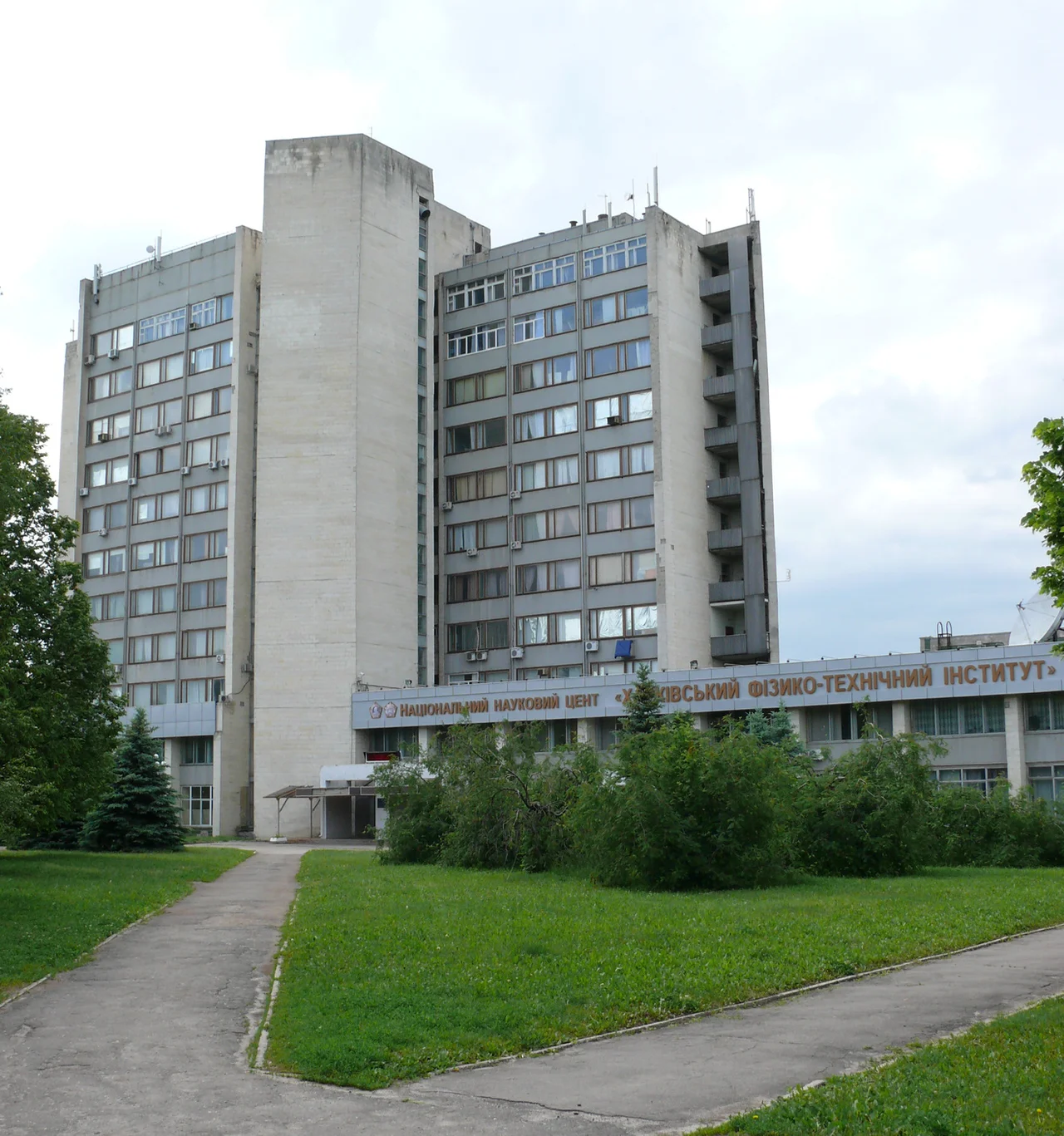

Kharkiv Institute of Physics and Technology
On 10 October 1932, in a cluster of laboratory buildings on the northern outskirts of Kharkiv, four physicists aimed a beam of accelerated particles at a target of lithium and watched a nucleus break apart. It was the first artificial splitting of an atomic nucleus performed in the Soviet Union, and it happened not in Moscow or Leningrad but here, in a leafy suburb called Piatykhatky where the streetcars still ran out to the edge of the fields. The men who did it - Anton Valter, Georgiy Latyshev, Cyril Sinelnikov, and Aleksandr Leipunskii - had built their apparatus almost from scratch. What they set in motion would outlast them by nearly a century.
A Laboratory Willed Into Existence
The institute was founded on 30 October 1928 at the urging of Abram Ioffe, the Leningrad physicist whose students would seed physics departments across the young Soviet Union. Ioffe wanted a second great center of research, and Soviet Ukraine gave him one. The People's Commissariat of Heavy Industry ran it, which tells you everything about the era's priorities: physics was not a luxury but an instrument of industrialization. And the institute delivered. Its researchers were among the first anywhere to liquefy hydrogen and helium in quantity, chilling matter toward absolute zero. They built one of the earliest triple-coordinate radar stations. They pioneered high-vacuum engineering that grew into an entire industry. In an age when Soviet science was often measured in slogans, Kharkiv measured itself in results, and the results were real.
The Cold and the Discovery
In 1931 a young physicist named Lev Shubnikov came to Kharkiv to lead a new low-temperature laboratory, and the cold he commanded there produced one of the institute's most enduring contributions to science. In 1935, working near the frontier of what refrigeration could achieve, Shubnikov and Yuri Rjabinin observed the strange behavior now known as type-II superconductivity - a class of materials that would, decades later, make possible everything from MRI machines to particle accelerators. Shubnikov was a gifted experimentalist and, by the accounts of those who knew him, a warm and generous colleague. He would not live to see how far his discovery reached. His laboratory operated only from 1931 to 1937, a span cut short by forces that had nothing to do with physics.
When the Terror Came
In 1937 and 1938, at the height of Stalin's Great Terror, the institute became the site of the so-called UPTI Affair. The secret police arrested three of its leading physicists - Lev Landau, Yuri Rumer, and Moisey Korets - on fabricated charges. Landau, one of the most brilliant theoretical minds of the century and a future Nobel laureate, was imprisoned for a year and released only after a fellow physicist personally vouched for him at enormous risk. Others were less fortunate. Lev Shubnikov, whose cold laboratory had made such history, was arrested in August 1937 and shot that November; he was thirty-six. The institute that had been built to advance human knowledge was made, for a time, to devour the people who advanced it. Their names are remembered here still, on plaques and in the classrooms of the physics faculty next door.
The Long Afterlife
The institute endured. It became the Soviet Union's Laboratory No. 1 for nuclear physics and carried out early conceptual work on a Soviet atomic bomb. Its alumni roster reads like a syllabus of twentieth-century physics: Igor Kurchatov, Evgeny Lifshitz, Boris Podolsky, Isaak Pomeranchuk, the Akhiezer brothers. Today, as the National Science Center Kharkiv Institute of Physics and Technology, the sprawling complex in Piatykhatky still houses institutes for plasma physics, condensed matter, and theoretical physics, and a neutron source facility guarded by Ukraine's 4th State Objects Protection Regiment. A place that once split its first atom by improvised means has spent a century proving that serious science can take root anywhere someone is willing to build it.
From the Air
The institute sits at 50.09°N, 36.25°E in the Piatykhatky district on Kharkiv's northern edge, a green campus of low research buildings backed by woodland. From a survey altitude of 3,000-5,000 feet the leafy suburban grid stands out against the surrounding fields; central Kharkiv and its river lie a few miles south. Nearest airport is Kharkiv International (UKHH).
Nearby Stories
- Giant Ukrainian Radio Telescope 12 km away
- Hryhorii Skovoroda Literary Memorial Museum 18 km away
- Borki Train Disaster 20 km away
- Hetman National Nature Park 61 km away
- Central Black Earth Nature Reserve 81 km away
- Second Battle of Kharkov 88 km away
- Poltava Governorate Zemstvo Building 95 km away
- Grace Darling 538 km away