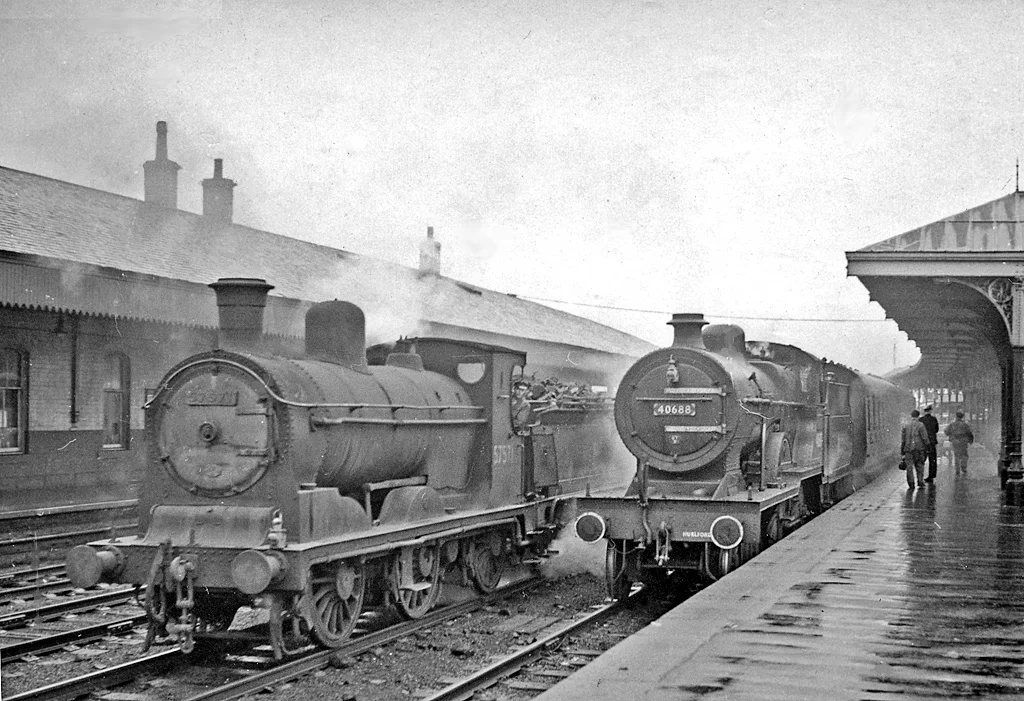

Kilmarnock Railway Station
Twenty-three masonry arches stride across the centre of Kilmarnock, lifting trains over the rooftops as though the town were something to be vaulted rather than visited. The viaduct went up between 1843 and 1850 to push the Glasgow line southward, and it has dictated the geometry of the town ever since. At night, the arches glow blue, part of a regeneration scheme that recast a piece of Victorian engineering as municipal sculpture. Beneath it, the station hums quietly with two trains an hour to Glasgow and a slower link south to Carlisle.
An Early Start
Kilmarnock's railway heritage goes back further than most. The Kilmarnock and Troon Railway opened on 6 July 1812 as a horse-drawn plateway, becoming the first passenger-conveying railway in Scotland. The current station, managed by ScotRail, sits on the Glasgow South Western Line and now functions as an Active Travel HUB with a waiting room, ticket office and step-free access to all platforms. Lift access reaches Platform 4. Information arrives via the usual mix of CIS displays, posters, automated announcements and help points. It is a working station rather than a heritage one, and that is the point. After more than two centuries of rail in this corner of Ayrshire, the trains still come and go on schedule.
The Viaduct Overhead
The viaduct's twenty-three arches dominate any walk through the town centre. Originally built to carry the Glasgow-to-Kilmarnock line onward south, the structure became the town's most recognisable engineering landmark. Recent regeneration work added blue lighting that has turned the arches into a focal point after dark, a feature considered a success of the broader Kilmarnock town centre renewal. The viaduct has not been without tragedy. In April 2012, after a man was seriously injured jumping forty feet from its top, safety barriers were upgraded along the parapet. It is a structure that has carried freight, passengers, light and shadow above the town for nearly two centuries.
The Box in the Vee
North of the platforms, in the wedge of land where the lines split, stands the present signal box. British Rail opened it on 12 April 1976, a plain brick building with an NX entrance-exit panel on its upper storey. It replaced four older mechanical boxes and simplified what had been a tangle of tracks into something manageable. On Christmas Day 2006, a suspected arson attack severely damaged the box, but it was back to full operation within weeks. The line northbound is partly single-track as far as Lochridge Junction near Stewarton, a bottleneck that until 2009 limited how often trains could run. A dynamic passing loop installed that year between Lugton and Stewarton, in effect a partial redoubling, allowed services to step up to a half-hourly frequency from the December 2009 timetable change.
The Clock That Couldn't
Outside the station once stood a clock operated jointly by East Ayrshire Council and ScotRail. It received an expensive 2008 upgrade, then a 2011 grant from the Railway Heritage Trust for a further regeneration scheme completed in March 2012. The clock had problems regardless. In December 2022, following a full cabinet meeting, East Ayrshire Council announced the clock would be removed and the area landscaped "with immediate effect" because of continuous technical difficulties that kept defeating both the timekeeping and its LED lighting. Sometimes a small object becomes a small saga. The clock that was supposed to mark the hours for travellers ended up marking the limits of municipal patience.
Today's Service
Kilmarnock today operates as a regional junction with surprisingly broad reach. Monday to Saturday brings two trains per hour to Glasgow Central, journey time forty to fifty minutes. Nine daily trains run south, six continuing to Carlisle and two terminating at Dumfries, mostly on a two-hour interval with extras at peak times. Westbound services run every two hours to Ayr, most continuing to Girvan, with two daily reaching Stranraer. Sunday service drops to one northbound train per hour to Glasgow and just two southbound trains to Carlisle. During the storms of 2015-16, when the Lamington Viaduct on the West Coast Main Line was severely damaged, Virgin Trains rerouted Carlisle-to-Glasgow services through Kilmarnock until repairs reopened the WCML on 22 February 2016.
From the Air
The station sits at 55.61°N, 4.50°W, in the centre of Kilmarnock. Recommended viewing altitude 2,000-3,500 feet, with the twenty-three-arch viaduct providing an unmistakable east-west line through town. Nearest airports: Glasgow Prestwick (EGPK) about 11 nm southwest and Glasgow (EGPF) about 22 nm north. The Glasgow South Western Line traces north toward Lugton and south toward Dumfries and Carlisle, marking the rail corridor through Ayrshire.
Nearby Stories
- Clydebank 0.4 km away
- Dunoon 5.5 km away
- HMS Dasher (D37) 6.1 km away
- New Lanark 6.3 km away
- Falkirk Wheel 11 km away
- Drumlanrig Castle 11 km away
- Ailsa Craig 18 km away
- Maybole Castle 18 km away