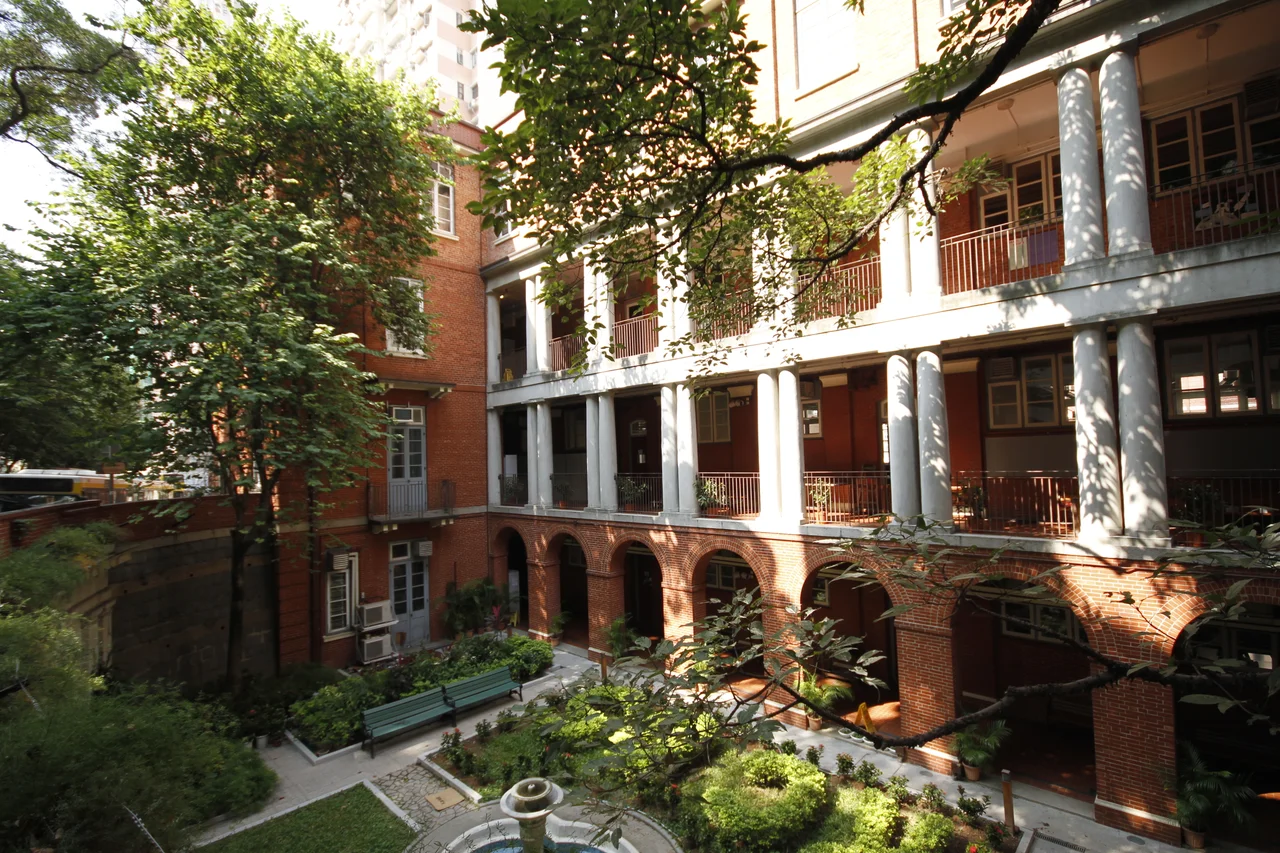

King's College, Hong Kong
In December 1941, Japanese soldiers turned the classrooms of King's College into a stable for military mules and horses. The school's principal was sent to Stanley Prison. Two teachers were taken as prisoners of war; one was later dispatched to a labor camp in Japan. When the Japanese Army finally withdrew in 1945, looters stripped the building bare in the two weeks that followed, leaving what the school's own records describe as nothing but 'an empty red brick skeleton.' That a school could survive this — could not merely rebuild but go on to produce a Chief Executive of Hong Kong, the creator of the Hang Seng Index, and the scientist known as the 'father of OLED' — says something about the particular resilience that becomes possible when an institution is rooted in more than its buildings.
Before the College: Sixty-Nine Years of Becoming
The school that became King's College did not begin at Bonham Road. It started in 1857 as West Point School, a free village school near the West Point Police Station in what was then a modest settlement on the western edge of Hong Kong Island. In 1872 it was renamed Saiyingpun School and relocated; by 1879 it had moved again, to 35–41 Third Street. The first Principal after the relocation, Mr. Fung Fu, had been educated in the United States and was, by 1905, moonlighting as a translator for the China Daily newspaper — a publication founded by Chen Shao-bai, a close friend of Sun Yat Sen. History had a habit of brushing against this school. By 1906, enrollment had reached 490 students, and the campus on High Street could no longer contain them. In 1921, the government reserved HK$50,000 for a new building on Bonham Road. Construction began in 1923 and completed in 1926, and the school was given a new name to honor the reigning monarch: King George V.
The Building That Time Has Not Taken
The 1926 Hong Kong Administrative Report described the new King's College as 'one of the finest and most modern of school buildings' — 29 classrooms, laboratories for physics and chemistry, an art room, a library, a museum, a swimming pool, a gymnasium, and covered playground. The building was designed in neo-classical style, its three wings arranged around a central courtyard in the manner of English collegiate architecture. Red brick and grey granite columns define the exterior; Roman arched colonnades run along the ground-floor facade. The most distinctive feature is the circular entrance porch at the corner of Bonham Road and Western Street, where granite coupled columns with Ionic capitals support a groin vault — an architectural detail that, the building's heritage listing notes, is rarely found in other Hong Kong school buildings. Declared a monument by the Antiquities and Monuments Office on 2 December 2011, the building stands as one of the few surviving pre-war government school structures in the city.
Occupation, Ruins, and Return
The Pacific War reached Hong Kong on 8 December 1941, the day after Pearl Harbor. The school had been converted into a first aid station before the fall. Then, on Christmas Day, Hong Kong surrendered. The Japanese Army commandeered King's College as a mule stable. When liberation came in August 1945, it came too late to prevent the looting that followed the Japanese withdrawal. What remained was the shell of a great building and the memory of what had happened inside it. Some former teachers and alumni revived school operations within months. By September 1950, the rebuilt first floor was open again, operating initially as a primary school — King's College Primary School — sharing its premises with Northcote Training College. In 1951, the government authorized a full restoration. In September of that year, King's College reopened as a secondary school, with something significant: for the first time in its history, it admitted girls.
A School That Shaped a City
The list of King's College alumni reads like a compressed history of modern Hong Kong. Ching W. Tang, who studied here in the 1950s, went on to invent organic light-emitting diodes — OLED technology now found in virtually every smartphone screen. Leung Chun Ying served as Chief Executive of Hong Kong from 2012 to 2017. Stanley Kwan created the Hang Seng Index, the barometer of Hong Kong's financial markets. Li Kwan Ha became the first Chinese Commissioner of the Royal Hong Kong Police; Hui Ki On was the last. Sir Harry Fang is recognized as the 'father of rehabilitation medicine' in Asia. Sir Sze-yuen Chung was an industrialist and politician who served on Hong Kong's Executive Council for decades. The school's four student houses are named after four former principals: Morris, Kay, Wallington, and Ferguson — including Wallington, who was imprisoned at Stanley, and Ferguson, who led the revival after the war.
Crimson Brick, Living Institution
Walk past 63A Bonham Road today and the building is impossible to miss. Traffic spirals around its south wing; the arched colonnades are visible from the road. Inside the courtyard, a Bauhinia tree grows in the northern corner. The goldfish pond that was once a fountain still occupies the garden. A time capsule was buried there in April 1986. The school has approximately 1,200 students. It continues to prepare students for Hong Kong's Diploma of Secondary Education examinations, and its alumni association maintains records of a history that stretches back 169 years. The building declared a monument is also, still, a working school — perhaps the most honest kind of heritage preservation, where the past is not museumified but inhabited.
From the Air
King's College sits at 22.2844°N, 114.14°E on the upper slopes of Hong Kong Island's Mid-Levels district, near the junction of Bonham Road and Western Street. From altitude the red-brick quadrangle is visible against the dense residential terracing of the hillside. Victoria Peak rises to the southwest; the harbor and Kowloon lie to the north. Nearest major airport is VHHH (Hong Kong International Airport) at Chek Lap Kok, approximately 25 km to the west. Recommended viewing altitude 2,000–3,000 feet on an approach from the north offers a clear perspective on the Mid-Levels topography.
Nearby Stories
- Lok Ma Chau Loop 2.3 km away
- Portas do Cerco 2.3 km away
- Kweilin Incident 17 km away
- Wanshan Archipelago Campaign 34 km away
- Nanxiong Formation 115 km away
- Battle of Nanpeng Island 148 km away
- Heyuan 169 km away
- Cape Maobitou 632 km away