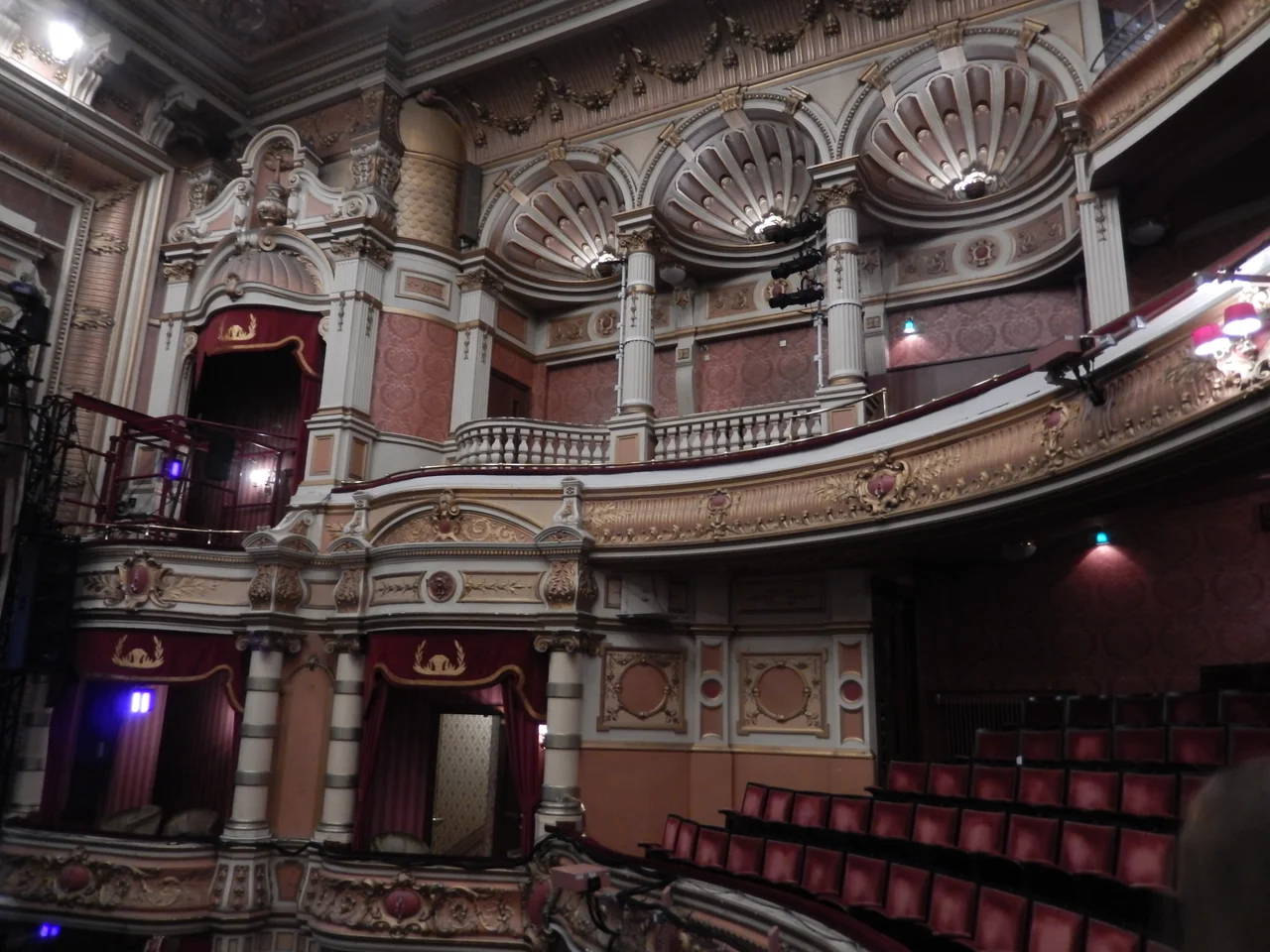

King's Theatre, Glasgow
Billy Connolly once said that performing at the King's Theatre in Glasgow felt like standing inside a wedding cake. He meant the auditorium - the red and white marble, the plasterwork cherubs flanking a crown above the proscenium, the K/T monogram, the gilt curtain, the four tiered levels of seating fanning back from the stage. Frank Matcham, the great British theatre architect, built almost two hundred theatres in his career. The King's, which opened on 12 September 1904 at the corner of Bath Street and Elmbank Street in Glasgow's Charing Cross district, is one of his finest survivors.
How to Build a Theatre in 1904
The King's Theatre was commissioned by Howard & Wyndham Ltd, the theatrical company chaired by Bailie Michael Simons. It cost a little over £50,000 to build - serious money in Edwardian Glasgow. Matcham used the corner site cleverly: a longer Bath Street elevation for the main entrance, scenery dock and stage door, with a shorter Elmbank Street face for the Gallery entrance and fire exits. The facades are a mix of Baroque and Art Nouveau in red Dumfriesshire sandstone, with a pair of two-storey pavilions topped by ball finials. Originally a female statue stood on top of each pavilion. Both were removed during the Second World War for safekeeping. Both were subsequently lost and have never been found. An ornate iron canopy made by the Saracen Foundry in Possilpark once wrapped the front of the building. It too vanished by the Second World War - possibly melted down for munitions.
Cantilevered Sight-Lines
Inside, the King's seats 1,785 across four levels - Stalls, Grand Circle, Upper Circle and Gallery. Matcham was a pioneer of cantilever construction, suspending the seating tiers without the supporting pillars that blocked sight-lines in earlier theatres. The result was a Victorian audience experience updated for the Edwardian age. The class segregation of the period is still visible in the architecture: the Stalls and Grand Circle are reached through the main foyer with its barrel-vaulted ceiling and bands of red and white marble; the Upper Circle has its own stairwell to the left of the main entrance; the Gallery has a separate entrance on Elmbank Street. Each level was originally for a different income bracket, and the decoration becomes plainer as you climb. Above the proscenium, an elaborate design of cherubs flanks a crown and the King's Theatre monogram. The safety curtain carries a painted design of drapes, with a projection screen framed at the centre. Three domed alcoves run along either side of the Upper Circle. Historic Environment Scotland calls it "an important example of an Edwardian theatre" and made it a Category A listed building in December 1970.
The Half Past Eight Show
Through the 1930s, Glasgow's theatres traditionally closed in the summer when residents headed to the coast for their holidays. Then in 1933, Howard & Wyndham's managing director A. Stewart Cruikshank tried an experiment - a quality summer variety show to compete with the seaside acts. The show started at 8:30pm, changed weekly, and was titled, with admirable lack of imagination, the Half Past Eight Show. It opened on 5 June 1933. The crowds came. Dave Willis, the top-billed comedian, ran for a record 31 weeks - a streak that still stands in variety history. As the format expanded, changes became fortnightly to let more people see each show. When Howard & Wyndham acquired the larger Alhambra in 1954 to compensate for selling the Theatre Royal to STV, the Half Past Eight Show moved with them. The King's settled into musical plays, drama, and from the 1960s onward, the annual pantomime.
A Stage With Pedigree
The list of names who have performed at the King's reads like a roll call of 20th-century theatre. Laurence Olivier. Sarah Bernhardt. Katharine Hepburn. Tyrone Power. Ray Walston. Anna Pavlova, the great Russian ballerina, was greatly popular here in the years before 1914. The Jackson Five and Dolly Parton appeared at a Royal Variety Performance in the late 1970s. The annual pantomime has run since 1971, growing into a 70-performance run that stretches from late November to mid-January. Stanley Baxter performed at the King's panto through the 1980s in Cinderella, which he both wrote and directed, and returned for his final stage appearance in 1991. Gerard Kelly was the lead comic for twenty years until his death in 2010, just after starring in that year's Aladdin. Elaine C. Smith has been a regular since 1996, often taking the dame role - traditionally played by a man, but rewritten here for her. The 2025/2026 production is The Little Mermaid.
The Theatre Today
Glasgow Corporation bought the King's in 1967 from Howard & Wyndham as television and colour cinema were closing theatres across Britain. The deal saved the building, and today the theatre is operated by ATG Entertainment under lease from Glasgow City Council, which owns it. A major restoration began in 2009 ahead of the 2014 Commonwealth Games: the Stalls and Grand Circle were reseated with improved legroom, new carpet was laid, the orchestra pit got a new railing, air conditioning was prepared. The exterior was floodlit with coloured lights in 2004 after a 1950s canopy was removed and stone-cleaning revealed the original red sandstone. The disused box at Upper Circle level, with its elaborate domed canopy, still sits above the auditorium - a small reminder of how many lives have passed through this building since the wedding cake first opened its doors in 1904.
From the Air
King's Theatre Glasgow sits at 55.8651 N, 4.2687 W on the corner of Bath Street and Elmbank Street in the Charing Cross area of Glasgow's city centre, immediately east of the M8 motorway. From the air, look for the central grid of Glasgow's commercial heart bounded by the M8, with the theatre tucked among offices and hotels near the motorway's east flank. Glasgow International Airport (EGPF) is about 6 nautical miles west and Glasgow Prestwick (EGPK) is 28 nautical miles south-west. Charing Cross railway station is the closest, with St George's Cross subway station a short walk north. Recommended viewing altitude: 2,000-4,000 feet to see the theatre in context with Glasgow's grid and the surrounding Charing Cross complex.
Nearby Stories
- Mauchline 3.6 km away
- Shotts 4.2 km away
- HMS Ulysses (1917) 7.7 km away
- Rothesay Castle 8.8 km away
- Inchcailloch 10 km away
- Strachur 14 km away
- Battle of Dollar 16 km away
- Crawford Castle 16 km away