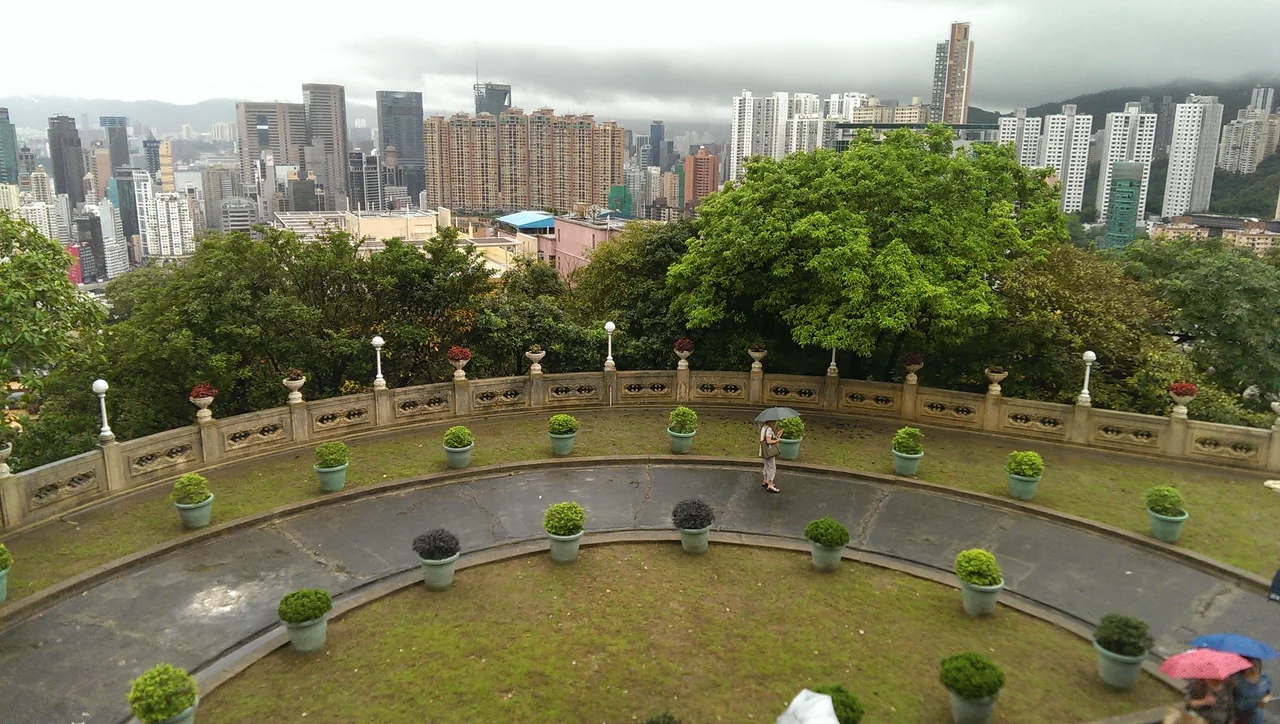

King Yin Lei
On 11 September 2007, dump trucks arrived at 45 Stubbs Road. Workers removed parts of the roof. Three Chinese characters on the front gate plaque were chiselled off one by one. When photographs of the demolition appeared in the Hong Kong media, the public reaction was swift enough that the government declared the site a proposed monument and ordered a work stoppage — all within days. It was a close thing. King Yin Lei, a 1937 mansion that fused Chinese architectural tradition with a British architect's sensibility, had survived seventy years on a hillside above Happy Valley only to nearly vanish in an afternoon. The story of how it was saved, and what it took to get there, says as much about Hong Kong's complicated relationship with its own heritage as the building itself.
A British Architect, Chinese Roof Tiles
The mansion was designed by A. R. Fenton-Raven, a British architect, and built between 1936 and 1937. It sits on a 50,650-square-foot site above Happy Valley Racecourse, on the upper slopes of the Mid-Levels. What Fenton-Raven created was a synthesis that Hong Kong's heritage authorities would later classify as Chinese Renaissance style: a three-storey building of red brick and green glazed roof tiles, the sweeping upturned eaves of Chinese palace architecture married to a Western building program. The compound includes not just the main house but a private garden planted with penjing — the Chinese art of container-grown miniature trees and landscapes — along with pavilions, terraces, and a wraparound veranda that allows views across the harbor. Inside, a central courtyard is open to the sky, the three-sided veranda visible on the first floor above.
Years of Neglect and Near Loss
The property was offered for sale in early 2004. Heritage advocates saw what was coming. The Conservancy Association of Hong Kong wrote to the Secretary for Home Affairs, Patrick Ho, in April 2004, formally requesting that the government declare King Yin Lei a monument under the Antiquities and Monuments Ordinance. The government declined to act, reasoning that the mansion was private property and that declaring it a monument would require paying substantial compensation to the owner — potentially tens of millions of dollars — for restricting its development potential. The owner eventually indicated that the building would not be sold, temporarily. But the issue was not resolved, and the threat remained. When the September 2007 demolition began, it confirmed what advocates had feared: without formal protection, the building was always one ownership decision away from disappearing.
The Campaign That Changed the Outcome
The work stoppage ordered in September 2007 bought time. On 25 January 2008, the government reached a preliminary agreement with the owner: King Yin Lei's entire site would be surrendered to the government after restoration, and in return the owner would receive an adjacent slope site of similar size for development, subject to a plot ratio of 0.5 and a height limit of three storeys. Conservation work ran from 2008 to December 2010. The roof alone required about 50,000 glazed tiles, sourced from Guangdong Province, to restore. Secretary for Development Carrie Lam later acknowledged that the government had been 'insensitive' in failing to respond to the owner's earlier inquiries about preservation. It was, by official admission, a near miss.
A Monument That Cannot Be Bought
King Yin Lei's designation as a declared monument carries a specific consequence: it cannot be altered for commercial re-use. Free timed-session tickets are distributed in advance for public visits. The mansion is not a hotel, not a restaurant, not a boutique. It is preserved as itself — a house, maintained as a house, open for people to walk through and understand as a house. In June 2022, the Tianda Institute, a think tank, was selected from 18 applicants to operate the site as a learning center for Chinese culture, history, and environmental studies, with plans for a tea studio annexe and a restaurant serving Indian and Chinese cuisine. The building had been featured in films over the years, including Enter the Dragon. Its green tiled rooflines, swept upward at the corners, remain one of the most photographed facades in the Mid-Levels.
What the Rooflines Remember
Stand below the compound on Stubbs Road and look up: the green glazed tiles catch the light differently than anything else on the hillside. Against the grey and white of the surrounding apartment towers, they read almost as an anachronism — except that they were here first, and the towers came after. The 50,000 replacement tiles were fired in Guangdong to match what Fenton-Raven specified in 1936. The penjing garden has been tended. The wraparound veranda still looks across toward Victoria Harbour. In a city that has demolished and rebuilt itself at extraordinary speed, King Yin Lei stands as evidence that preservation is not simply sentiment. It is the decision, made consciously and at cost, that some things are worth keeping exactly as they were — right down to the curve of a roofline above Happy Valley, above the racecourse, above a harbor that keeps changing below.
From the Air
King Yin Lei is located at 22.2667°N, 114.181°E in the Mid-Levels district of Hong Kong Island, above Happy Valley Racecourse. The mansion's distinctive green-tiled rooflines are identifiable from lower-altitude overflights of Hong Kong Island. Victoria Peak rises to the west-southwest; Happy Valley Racecourse is visible immediately to the north. VHHH (Hong Kong International Airport) is approximately 30 km to the west. Recommended viewing altitude 1,500–2,500 feet on approach from the harbor side provides perspective on the mansion's hillside position within the dense Mid-Levels urban fabric.
Nearby Stories
- Lok Ma Chau Loop 2.3 km away
- Portas do Cerco 2.3 km away
- Kweilin Incident 17 km away
- Wanshan Archipelago Campaign 34 km away
- Nanxiong Formation 115 km away
- Battle of Nanpeng Island 148 km away
- Heyuan 169 km away
- Cape Maobitou 632 km away