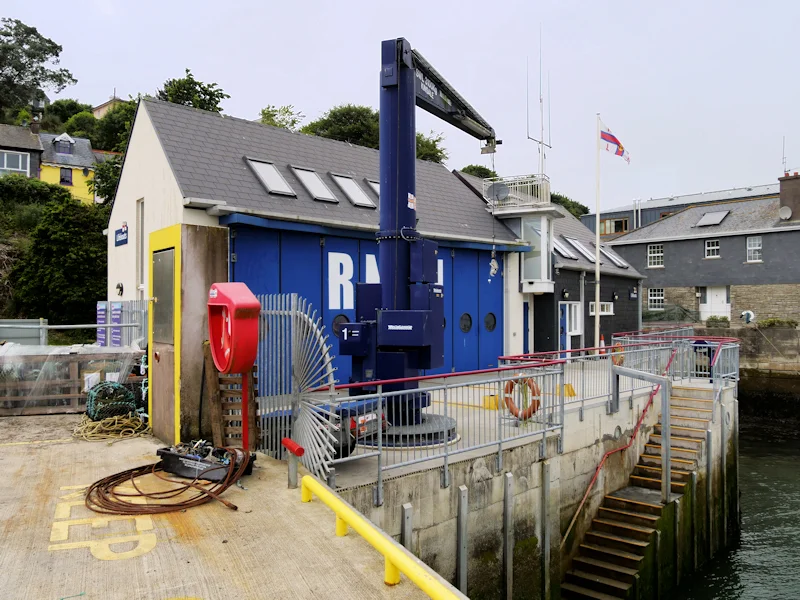

Kinsale Lifeboat Station
Read the name painted on the hull and you do not quite believe it. Miss Sally Anne (Baggy) II, Never Fear, Baggy's Here. Twelve words on a thirty-foot inflatable rescue boat, the longest name in the entire Royal National Lifeboat Institution fleet. The boat works out of Adams Quay in Kinsale, and behind the cheerful joke of its name is a woman who paid for it, the cancer she lived with, and the people she wanted saved when she could no longer save herself.
Two Lifeboats, Two Centuries Apart
A lifeboat first sat at Kinsale in 1818 and stopped operating in 1824. No log of services survives. After that the town went without an RNLI boat for nearly two centuries, even though medals continued to be awarded for rescues here. At four in the morning on 13 January 1826, the brig Eliza wrecked on Sandycove Island. A boy was lost. Lieutenant Garrett Barry of the coastguard rowed out twice with five men and saved the rest of the crew, earning the silver medal of what would become the RNLI. Forty years later, in 1866, the brigantine Anna ran onto a sunken rock at Hangman's Point. The coastguard boatman Patrick Mackell waded into the surf, got a line aboard, and brought five crew off. He too received a silver medal. Then Kinsale waited another 137 years for its own lifeboat to return.
The Last Atlantic 75
In 2002 the RNLI announced that an inshore station would open at Kinsale. Volunteers trained at the Inshore Lifeboat Centre in Cowes on the Isle of Wight, and the first boat - Vera Skilton, B-705, one of the earliest Atlantic 75 hulls built in 1994 - arrived for service. The station went officially operational at 8 pm on 11 July 2003. A few months later it received B-796, the very last Atlantic 75 the RNLI would ever build, named Miss Sally Anne (Baggy) at Cowes on 5 November 2003. A purpose-built lifeboat station opened on Adams Quay in 2009, complete with crew facilities, a training room, retail outlet, boat storage, and a Schat davit to lower the boat down to the water. Total cost: 1,280,000 pounds.
The Jump
At six in the evening on 10 April 2016, crew member Matthew Teehan saw helm Nick Searls running through Kinsale. Teehan would later say, you wouldn't often see Nicky running. The lifeboat was launched ten minutes later and was on scene in five more. The fishing trawler Sean Anthony, with three Portuguese fishermen aboard, had been driven onto rocks at the harbour mouth in a force 8 to 9 gale. The lifeboat could not get close enough. The three men had a choice no one wants: jump into the cold Atlantic in life jackets, or stay with the breaking trawler. They jumped, one by one. The lifeboat crew picked them up and brought them ashore. The BBC's Saving Lives at Sea series filmed the rescue for its second season. All three Portuguese fishermen lived.
Sally Anne Odell
Sally Anne Odell was born in Banstead, Surrey in 1936. She never married and had no children. When her father died, she inherited a sum she did not need to keep, so she went to the RNLI and asked how she could help. The institution offered her the chance to buy the last lifeboat being built at Cowes. She named it Miss Sally Anne (Baggy) - the nickname was a self-deprecating joke about the colostomy bag she carried after bowel cancer surgery. She used to tell people, better a bag than a box. She also happened to be a relative of Kay Odell, who had taken what is believed to be the last photograph of RMS Titanic departing Cobh in 1912, so the Cork coast already mattered to her family. She asked that her boat be stationed at Kinsale. The crew called her Godmother. When she died in 2017, she left 350,000 euros to fund the next boat. Her instructions for its name read like her: build it good, save lives, and give the crew something to laugh about every time they painted it. Miss Sally Anne (Baggy) II, Never Fear, Baggy's Here arrived in 2018, and on summer mornings you can still see it tied at the quay, ready.
From the Air
Kinsale Lifeboat Station sits at 51.70004 N, 8.51779 W, on Adams Quay near the town centre. Cork Airport (EICK) lies 18 km to the north. The town of Kinsale wraps around the inner harbour and is visible from the air as a tight cluster of houses on the north bank of the River Bandon's wide estuary. Best viewed at 1,500 to 2,500 ft AGL with Charles Fort and James Fort visible on the headlands flanking the harbour mouth to the south.
Nearby Stories
- Ballycotton 8.7 km away
- West Cork 8.8 km away
- Cloghan Castle, Lough Hyne 11 km away
- Mourne Abbey 12 km away
- The Sinking of the Lusitania: The Torpedo That Changed the War 12 km away
- Headford Ambush 14 km away
- Lismore Castle 16 km away
- SM U-27 101 km away