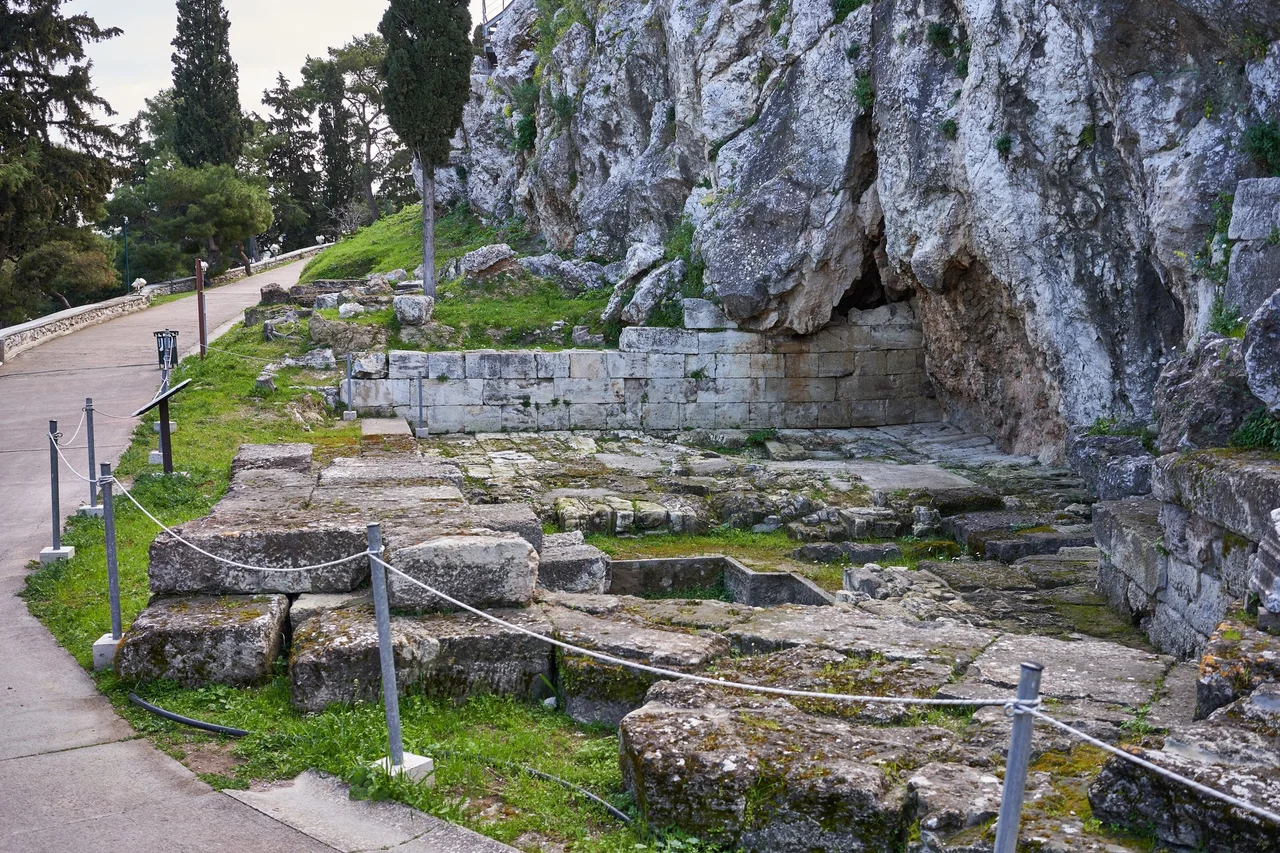

Klepsydra (Acropolis)
Water has been trickling out of the northwest slope of the Acropolis since before Athens had a name. Long before the Parthenon, before democracy, before the first temple crowned the rock, people climbed to this shaded fold in the cliff to drink. The Greeks called the spring Klepsydra - the 'water-thief' - because the flow seemed to vanish and return, swallowed by the limestone and given back. For most of human history in this place, the great marble monuments above were the newcomers. The spring was already old.
The Water-Thief and the Nymph
The name carries a mystery. An ancient lexicographer named Hesychius recorded that Klepsydra 'is a fountain which was formerly called Empedo.' Scholars later untangled the two: Empedo was the spring itself - and also the name of its guardian, an Attic nymph, the kind of minor deity the Greeks attached to every wild source of water. Klepsydra was the name for the water once the builders captured it in a fountain house. The spring runs through the city's literature like a thread: Aristophanes joked about it, Plutarch mentioned it, and the tireless traveler Pausanias noted it among the wonders of Athens. To drink here was to drink from something the gods were thought to keep an eye on.
Built into a Cave
Sometime around 470 BCE the Athenians turned the raw spring into architecture. They paved a court, sank a well, and raised a covered well-house against the cliff, with stone-cut steps climbing toward the Propylaea above. When American archaeologists excavated the site between 1936 and 1940, they discovered something the builders had hidden: the fountain house was set into a natural cave that had collapsed in antiquity. Pottery shards pinned the construction date - not earlier than 475 to 470 BCE, the very years Athens was rebuilding after the Persians had razed the city. A people picking up the pieces of catastrophe still found the labor to honor a spring, capping it in cut stone and steps.
A Siege Decided by Thirst
For a place defined by water, the Klepsydra's most dramatic moment came when the water ran out. During the centuries of Ottoman rule the well fell into neglect and silted up, its memory fading. When Greek revolutionaries laid siege to the Acropolis in 1822, the Turkish garrison holed up on the rock had no reliable spring to sustain them. They surrendered, defeated as much by thirst as by guns. A source that had quenched the city for millennia changed history one last time by no longer flowing - a reminder that on a fortress hill, the deepest weapon is the one underground.
Rediscovering the Source
The spring nearly slipped out of memory entirely. It took the eighteenth-century antiquarians James 'Athenian' Stuart and Nicholas Revett to match the free-flowing trickle on the cliff face with the Klepsydra of the old texts. In 1835 the Greek archaeologist Kyriakos Pittakis rediscovered the source and left the first written account of the modern site. Excavation followed in waves - Émile Burnouf in 1874, Panagiotis Kavvadias uncovering the paved court in 1897, and finally the Americans laying the whole fountain house bare. Today the paved court sits quietly below the Peripatos path, easy to walk past, its draw well still ringed by ancient stone. Most visitors climb straight for the temples overhead and never notice the oldest reason anyone came to this rock at all.
From the Air
The Klepsydra lies on the northwest slope of the Acropolis of Athens, at roughly 37.972°N, 23.725°E, just below the Propylaea gateway and along the Peripatos path that rings the sacred rock. From the air the Acropolis itself is the navigational anchor - a pale limestone plateau crowned by the Parthenon in the heart of central Athens. Athens International Airport (LGAV) sits about 30 km east-southeast. The slope is in shadow for much of the day, so the spring's setting reads best at midday in the clear Attic light, with the Ancient Agora spreading northwest and Piraeus and the Saronic Gulf glinting to the southwest.
Nearby Stories
- Great Sand Beach 5 km away
- Battle of Delium 7.7 km away
- Tower of Aliartos 9 km away
- HMHS Britannic 10 km away
- Saronic Gulf 15 km away
- Sousaki Volcano 17 km away
- Sanctuary of Apollo Maleatas 24 km away
- Skyros 66 km away