
Knocknaheeny
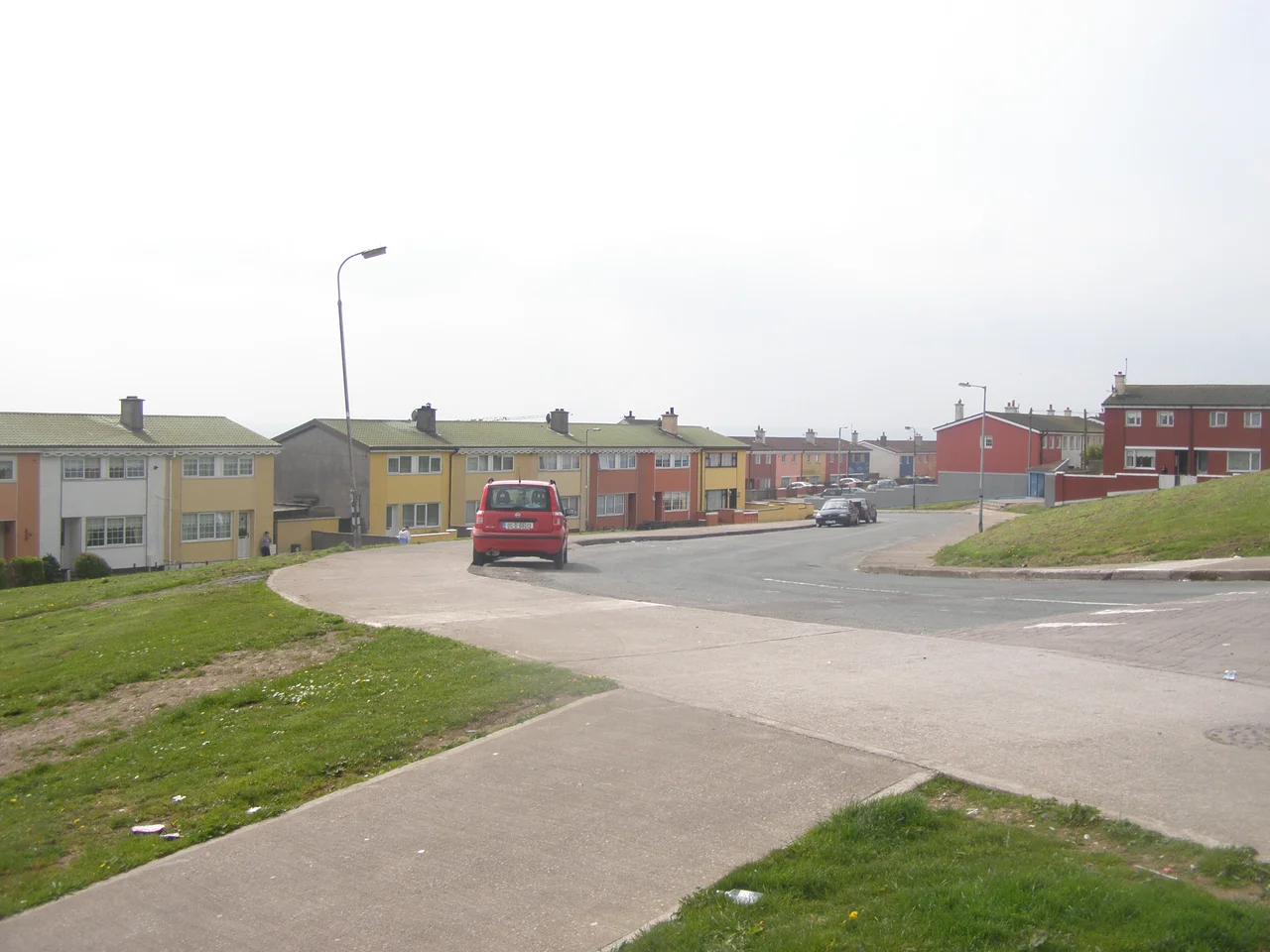
Knocknaheeny is two stories told at the same time on the same hill. One is a council housing estate of terraced redbrick streets, built quickly in the 1970s to rehouse families from Cork's older neighbourhoods, never given the shops or community centres it needed, allowed to wear out over forty years. The other is the European headquarters of Apple Inc., employing about 5,000 people on the same hilltop. Both communities are tied together by a single proposed road, by complicated land deals, and by the awkward modern question of what happens when one of the world's wealthiest companies wants to expand through a working-class neighbourhood that has been waiting most of its life for its own regeneration.
Hill of Friday
Cnoc na hAoine means Hill of Friday. Some say the name refers to Good Friday and the hill on which Christ was crucified - a Christian gloss layered onto an older Gaelic placename. Others read aoine as rushes, the marsh plant, and translate the hill more literally. Either way, the names on this northern ridge of Cork follow a pattern: Knocknacullen is the Hill of Holly, Knockfree is the Hill of Heather, Shanakiel means Old Wood or Foxes Wood. The neighbourhood crest holds these names together with three stars representing Knocknaheeny, Hollyhill and Knocknacullen, beneath a windmill, a swallow and the area's distinctive water tower. The water tower - listed in the National Inventory of Architectural Heritage as "a striking landmark visible from several points around the city" - sits on the highest ground in north Cork and supplies water to Knocknaheeny, Churchfield and Hollyhill. From its base, on a clear day, you can see all the way to the harbour.
The estates
Cork Corporation began building on the hill in the early 1970s, rehousing families from older parts of the city: Churchfield, Farranree, Gurranabraher. Terraced council houses went up at speed; St. Mary's on the Hill primary school followed, granted extensions to handle classrooms that overflowed. Scoil Mhic Shuibhne - now Terence MacSwiney Community College - opened in 1979 as the first mixed VEC school in Cork, and at its peak in the 1990s held over 800 students. By the late 1980s the population was young, the demand for school places intense, and the basic infrastructure of an instant neighbourhood was still being added in retrospect. The Celtic Tiger boom of the late 1990s gave some families the means to move out to newer estates in the county; school enrolments dropped, settled, then drifted lower. Some streets fell into neglect. Around 4,500 people still called the area home in 2009, in houses that the city would soon decide to knock down.
Apple, the road, and the regeneration
Apple opened in Cork in 1980 - one of the earliest American tech investments in Ireland - and the European headquarters has been on the Hollyhill side of Knocknaheeny ever since. Through expansions over four decades it has grown into a 5,000-person operation. In the early 21st century, Cork City Council unveiled a plan to demolish much of Knocknaheeny and rebuild it in phases. The same plan envisaged a new road through what had been residential streets, partly to serve Apple's expanding campus. Locals raised questions about the council's relationship with Apple Inc. The proposed road would cut through houses, and the proposed land purchases included part of an old pilgrimage route and a section of the road circling the neighbourhood. The first phase of rehousing began in 2014. Council-owned and privately owned houses were both demolished; residents who had bought their homes from the city sometimes stayed put through the demolition of their neighbours' homes, waiting for alternative housing the council had promised. New homes have since gone up at the Reservoir - known locally as the Rezza - and along Nash's Boreen, with further phases at Hollyhill Lane and the Shanakiel Development on Blarney Road.
Who Knocknaheeny is
Knocknaheeny has produced more people than most outsiders would guess. The athlete Mark Carroll, Irish 5,000-metre record holder and one of the most accomplished middle-distance runners Ireland has ever produced, came from these streets. So did Denise O'Sullivan, capped over a hundred times for the Republic of Ireland women's football team. Tomas Mulcahy hurled for Cork. James Leonard co-hosts The Two Norries podcast, a hit show on Cork life and class that has done as much as any single voice to talk publicly about what it actually means to grow up on a council estate on the northside. St Vincent's GAA was founded in 1943 and now serves Knocknaheeny along with Blarney Street, Sunday's Well, Gurranabraher and Churchfield. The football clubs - Knocknaheeny Celtic, Central Rovers, Grattan United - play in the Cork leagues. Knocknaheeny is part of the Dail constituency of Cork North-Central, with a political profile that has always tilted left. The community survives the regeneration of its own streets, watching the cranes turn, waiting to see what comes next.
From the Air
Knocknaheeny sits at 51.9065 N, 8.5085 W on the high ground 2 km north of central Cork. The distinctive landmark from the air is the water tower at the top of the hill, visible across the harbour basin. Apple's European headquarters occupies the Hollyhill industrial estate immediately west of the residential area - a large rectangular complex with the company's name on the roof. The terraced housing of Knocknaheeny falls away east and south down the hillside toward the city. Cork Airport (EICK) is 9 km south. Recommended viewing 1,500-3,000 ft AGL. In clear weather the contrast between the dense suburban housing grid and the open Apple campus is the most striking visual feature of north Cork.
Nearby Stories
- Ballyvourney 1.6 km away
- Castlemartyr 3.9 km away
- Ballybeg Priory 4.1 km away
- Kilbrittain 5.2 km away
- Shanbally Castle 10 km away
- Skibbereen 17 km away
- Castleisland 22 km away
- SM U-27 118 km away