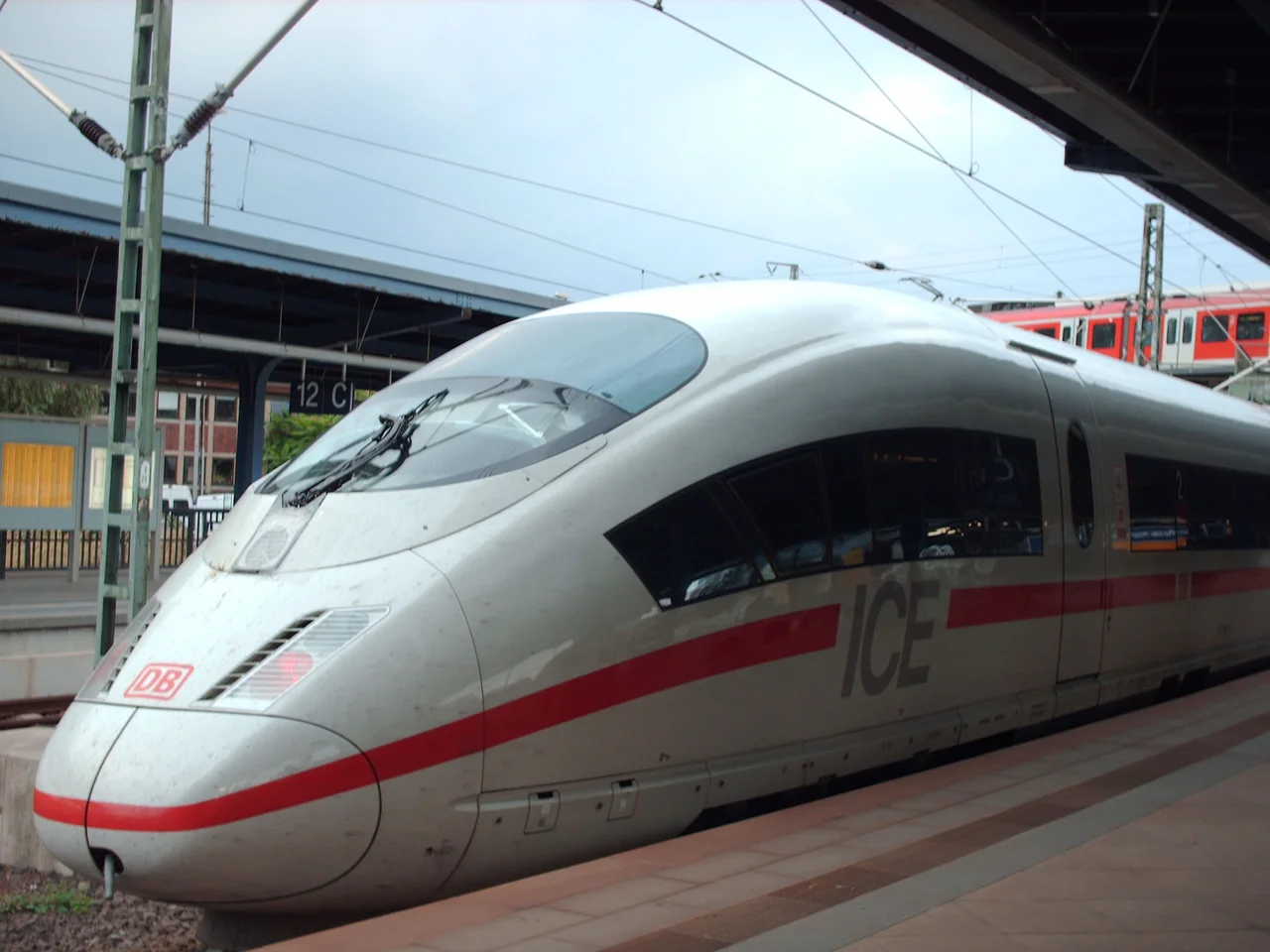

Köln Messe/Deutz Station
Cross the Hohenzollern Bridge from Cologne Cathedral and you arrive at a station Colognians still call Düx, in their old dialect. Officially it is Köln Messe/Deutz - Messe meaning trade fair, after the conference complex that pushed for the renaming in 2004. Today high-speed Intercity-Express trains pull in at the lower level, sparing themselves the bottleneck reverse at the Hauptbahnhof across the river. The station handles fair-goers, commuters, Lanxess Arena concert crowds. It also handles, every day, the memory of what happened on the same platforms between October 1941 and October 1944.
The Mouse Trap and the Floating Bridge
Deutz had been the eastern terminus of a railway since December 20, 1845, when the Cologne-Minden line opened a station here pointing toward Berlin. For fourteen years there was no permanent bridge across the Rhine - just a steam ferry shuttling between the lines. In 1859 the first permanent Rhine crossing since Roman times opened: the Cathedral Bridge, nicknamed Muusfall in Kölsch, the Mouse Trap, for the way the truss work caged the tracks. Before the Mouse Trap there had been a floating bridge, a roadway of pontoons that bobbed where the Deutz Suspension Bridge now stands. Two competing railway companies, the Cologne-Minden and the Bergisch-Märkische, built rival stations on the east bank. Nationalization in 1882 ended the rivalry. By 1913 both were demolished and replaced by the unified station that survives, in renovated form, today.
A Station Built in 1913
The current Köln Messe/Deutz opened on November 11, 1913, eight months before the First World War. The reception building was designed by architect Hugo Röttcher - a three-wing structure with a central dome, fronted by Ottoplatz, the squared forecourt now on Cologne's monuments register. The original train shed had three iron-and-glass spans that arched over the platforms. They were destroyed in the Second World War bombing of Cologne and never rebuilt. The replacements are utilitarian concrete canopies. If you stand on platform 7 today and look at the modesty of the roof above you, you are looking at the architectural memory of what was bombed away.
The Deportations
During the Nazi period, almost every Jew remaining in Cologne was deported from the lower level of Deutz station. The first transport left in October 1941. The last known movement was on October 1, 1944, bound for the Theresienstadt concentration camp. The trade fair halls beside the station were used as a transit camp - a holding pen for people about to be loaded into freight cars. The geography is brutal in its convenience. The fair complex offered enclosed space for sorting and processing. The station provided rails going east. Cologne's Jewish community had numbered roughly 20,000 in 1933. By the end of the war, almost none remained. The platforms now serve fair-goers headed to Photokina or the dental-supply convention. The trains roll in and out. Most passengers do not know.
The ICE Decision
By the late 1980s, Cologne was planning its share of the new German high-speed rail network. The Hauptbahnhof, jammed between the cathedral and the Rhine, could not absorb the traffic. From 1988 onward, planners floated using Deutz station as an ICE terminal that would let trains bypass the cramped main station. In 1996 the decision became official: Deutz would be rebuilt for the new line to Frankfurt. The lower-level platforms, Köln Messe/Deutz tief, were closed for a year in 2006-07 and rebuilt. ICE 10 (Berlin to Cologne/Bonn Airport) and ICE 41 (Essen to Munich) now call here instead of the Hauptbahnhof. An international architectural competition in 1999 generated 57 proposals for the larger reshaping of the station; the more ambitious ideas - including an 800-meter covered moving walkway connecting Deutz to the Hauptbahnhof - were quietly abandoned for cost.
Three Stations in One
Today Köln Messe/Deutz is really three interlocking stations. The upper level has six platform tracks on three platforms for east-west trains crossing the Hohenzollern Bridge. The lower level handles ICE and regional services running north-south, bypassing the Hauptbahnhof entirely. The adjacent S-Bahn platform, built between 1985 and 1990 along with the third set of double tracks on the Hohenzollern Bridge, carries the local Rhine-Ruhr network. And below the long-distance tracks runs the Stadtbahn Deutz/Messe stop on Cologne's tram-subway, connecting via a shopping corridor to Deutz/LANXESSarena. Three transport networks stacked vertically on a small east-bank footprint, all converging on a building that opened the year before the world fell apart for the first time and was a key node in the second collapse as well.
From the Air
50.94N 6.97E. The station sits on the east bank of the Rhine in Cologne's Deutz district, directly across the Hohenzollern Bridge from the cathedral. Nearest airport: Cologne/Bonn (EDDK), 12 km southeast. From the air the station's domed central building, the trade fair complex directly to the north, and the Lanxess Arena to the southeast are clear landmarks. The Hohenzollern Bridge with its triple rail tracks runs west to the Hauptbahnhof.
Nearby Stories
- Diamond Interchange: How a Simple Idea Reshapes Towns Like Julich 2.8 km away
- Dusseldorf-Unterbach 6.1 km away
- Baumwollspinnerei Ermen & Engels 11 km away
- RAF Bruggen 15 km away
- Hagen Open-air Museum 21 km away
- Belgium 130 km away
- Marcinelle Mining Disaster 173 km away
- Zwingenberg Castle 178 km away