
Kolnisches Stadtmuseum
On a June day in 2017, water poured through the upper floor of the Zeughaus, Cologne's seventeenth-century armoury, where the city museum had lived since 1958. The damage was bad enough to close both floors. The exhibits came down. The doors closed. And the Kolnisches Stadtmuseum - guardian of 350,000 objects telling 1,200 years of Cologne's story - became a museum without a home. It took almost seven years to find a new one. The replacement, when it finally opened on March 22, 2024, was the strangest answer the city's planners could have devised: a former fashion house called Franz Sauer, 750 square meters, with five mezzanines wrapped around a central staircase.
Founded in an Armoury
The municipal museum was a late arrival by German standards. Cologne's first universal museum, the Wallraf-Richartz, had opened in 1827 from Ferdinand Franz Wallraf's collection. The city had armoury treasures and assorted antiquities scattered across the Council Tower and the City Library. But it took until April 1, 1926, for the city council to decide that Cologne needed its own dedicated history museum. The founding director, Wilhelm Ewald, drew up a sweeping plan covering everything from prehistory to the present. Konrad Adenauer, then Lord Mayor, lobbied for provincial funding. By 1936 the museum had opened in Deutz under a new name - Haus der Rheinischen Heimat - with Gauleiter Josef Grohe and Joseph Goebbels at the inauguration. The Nazis had absorbed the project; the museum's volkisch local-history framing fit their propaganda needs uncomfortably well.
The Director Who Stayed Out
Wilhelm Ewald remained director through twelve years of Nazi rule and held the post until 1950, past retirement age. The cultural scientist Karin Hieke, in her 2016 dissertation, noted something rare: Ewald was the only Cologne museum director who never joined the NSDAP. He was confirmed in office immediately in 1945, when most of his colleagues across the city were undergoing denazification scrutiny. Among the circumstantial evidence Hieke cites for Ewald's system-critical stance is that he saved the museum's Judaica collection from destruction. The objects survived because one man with no party card decided they would. This is not heroism on a scale that demands a monument. It is the smaller, harder kind, made in a building that had been politically captured but where one curator quietly disagreed.
Into the Zeughaus
The Zeughaus, built between 1594 and 1606, burned down to its foundation walls and vaulted arches during the war. After the federal government transferred it to the city, it was rebuilt enough to host a 1956 exhibition for the 77th Katholikentag. The museum opened in the renovated armoury on January 11, 1958, modern by the standards of its time. It would stay there for 59 years. In 1980 the museum hosted a touring Tutankhamun exhibition that drew 1.3 million visitors - still the institution's all-time attendance record. The permanent exhibition was never fundamentally reorganized. It got patched, supplemented with Nazi-period content in the 1980s, and continued accumulating the city's everyday objects: 16th-century pistols, a swastika flag thought to have hung in Cologne Cathedral, the space glove worn by Cologne astronaut Reinhold Ewald on the 1997 Mir mission.
A Decade of Plans That Fell Through
When Lord Mayor Jurgen Roters announced in March 2014 that the museum would move to a new building at Roncalliplatz beside the cathedral, the dream was a New Historical Centre uniting the Stadtmuseum, the Cathedral Construction Archive, and the Roman-Germanic Museum's expanded administration. A 2016 architectural competition picked the Berlin office of Volker Staab. The city and the cathedral chapter formed a joint company in April 2020 to push the project forward. Then, in February 2024, just before the construction decision, the cathedral chapter pulled out. Costs had grown too high. The Roncalliplatz dream collapsed. As of spring 2024, the future of the permanent location remained open.
Museum in the Fashion House
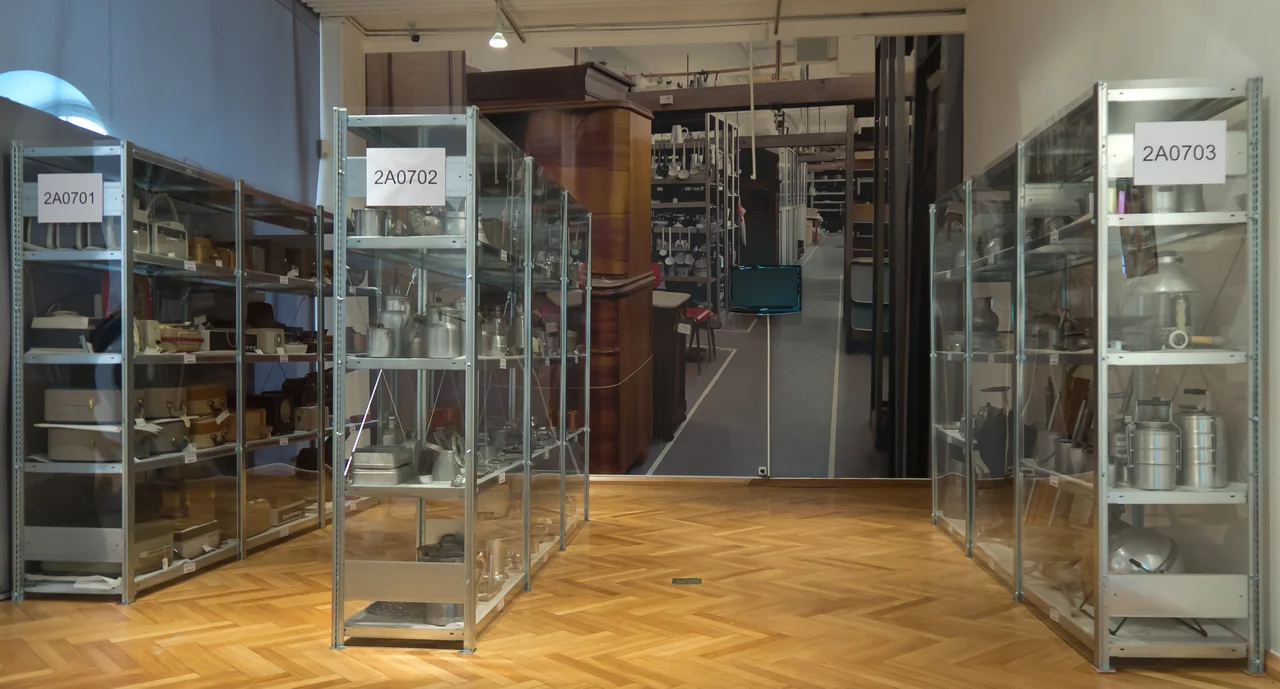
The interim is the present. Of 350,000 objects, only about 700 can be shown in the Sauer building. The curators abandoned chronological storytelling entirely. Instead, the five mezzanines pose questions: What do we love? What frightens us? What connects us? Objects from across centuries answer each question side by side - the city seal of 1269 next to migration stories collected from contemporary Colognians, the charter of 1396 beside memorabilia donated by present-day residents. The wall showcases hold headgear, a wink at the fashion house the building used to be. Tactile paving, Braille labels, audio guides, wheelchair-accessible cases: the accessibility is exhaustive. The historic city model still anchors the Room of City History, where augmented reality lets visitors fast-forward through twelve centuries in thirty minutes. It is the smallest the museum has ever been. And it is, for the first time in a long while, open.
From the Air
50.94N 6.95E. The Sauer building sits in Cologne's Innenstadt, between the Minorite Church and Kolumba museum, just west of Cologne Cathedral. Nearest airport: Cologne/Bonn (EDDK), 15 km southeast. From the air the Innenstadt grid and the cathedral's twin spires are the orienting landmarks; the museum building itself is a 1980s mezzanine structure indistinguishable from neighbors on Minoritenstrasse without ground-level context.
Nearby Stories
- Diamond Interchange: How a Simple Idea Reshapes Towns Like Julich 2.8 km away
- Dusseldorf-Unterbach 6.1 km away
- Baumwollspinnerei Ermen & Engels 11 km away
- RAF Bruggen 15 km away
- Hagen Open-air Museum 21 km away
- Belgium 130 km away
- Marcinelle Mining Disaster 173 km away
- Zwingenberg Castle 178 km away