
Kolumba
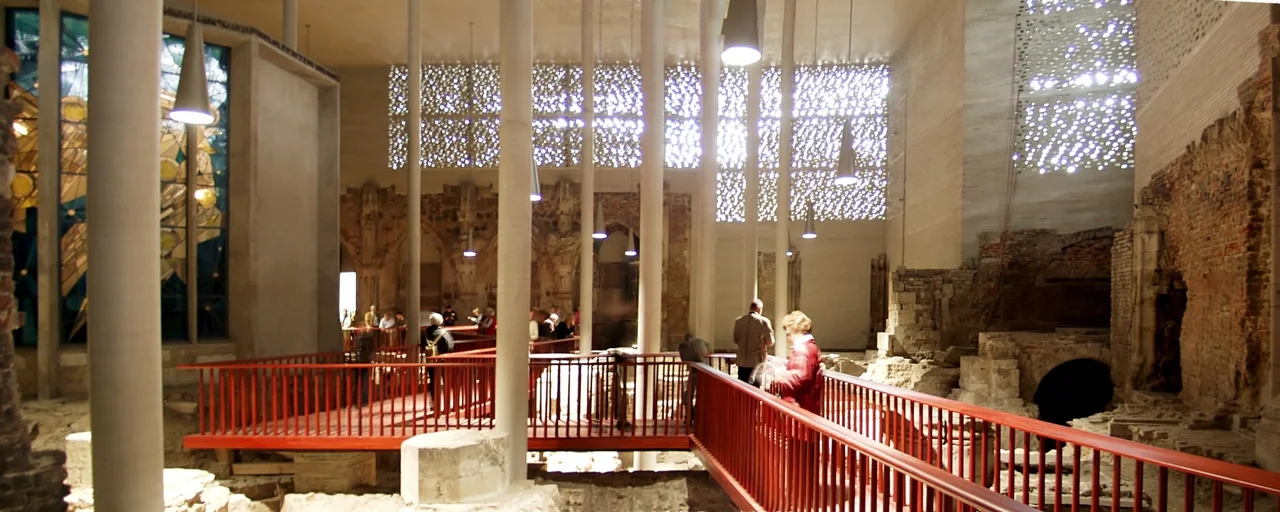
Stand inside the lower hall of the Kolumba museum and look up. Above you, a wall of light grey brick rises to a height most architecture cannot afford. The brick is pierced - not regularly, not as windows, but as a scatter of small openings, as though the wall remembered being something more porous and was now porous again. Daylight comes through in slanting needles. Below you are the foundations of a Romanesque church the Allied bombers destroyed on the night of June 28-29, 1943. Peter Zumthor's building does not cover those foundations. It does not even quite contain them. It hovers over them, a cloak of fired brick around a wound that the city of Cologne decided to keep open.
What the Bombs Left
St. Kolumba was one of Cologne's oldest parish churches, founded in the Romanesque period, rebuilt in Gothic style across the medieval centuries. The bombing of Cologne destroyed most of the city center and gutted the church. By 1950 a small chapel had risen on the rubble - the Madonna of the Ruins, designed by the Cologne architect Gottfried Bohm, who would later win the Pritzker Prize. The chapel was built around a surviving wooden Madonna figure that locals had found in the wreckage. For decades it stood alone on the bombsite, a small late-modern building among gothic remains, the city's grief made compact and quiet. The Archdiocese of Cologne took over the diocesan art museum in 1989, and in 1997 ran a competition to give the museum a permanent home. Zumthor's Atelier won.
The Brick That Was Invented for This
Zumthor needed a brick that would harmonize with the Romanesque rubble walls below and the postwar concrete blocks beside them - and that did not exist. He had it manufactured. The result, known now as Kolumba stones, is long, narrow, light grey, fired with a slow-burn texture that catches daylight differently than industrial brick. The masons who laid the walls did so with mortar joints calibrated to the proportions of the brick, producing a surface that reads from a distance as one continuous skin and from close up as 240,000 individual decisions. The pierced sections of the wall - the cloak of small openings that ventilate and light the excavation hall - were achieved by leaving bricks out in a calculated pattern. The building was consecrated by Cardinal Joachim Meisner on September 15, 2007.
Sixteen Rooms, No Labels
Above the excavation hall, sixteen exhibition rooms unfold across upper floors with no signage, no chronology, and no separation between permanent and temporary collections. The Kolumba calls itself a living museum. Late Antiquity Coptic textiles share rooms with Joseph Beuys. Stefan Lochner's fifteenth-century Madonna with the Violet sits in dialogue with Agnes Martin's grids. The 12th-century Rhenish-Mosan ivory crucifix - 53 centimeters of corpus Christi acquired in 1999 - is shown in rooms with works by Louise Bourgeois and Rebecca Horn. Each room has its own daylight: tall windows, slatted shutters, oculi cut into ceilings. Artificial light is avoided. Each year on September 14 - the Feast of the Exaltation of the Holy Cross - the entire museum closes for two weeks, and the collection is reinstalled. The visitor who came last year cannot retrace last year's route.
Spiritual Verticality
Zumthor wrote a book called Atmospheres about how buildings produce feeling, and the Kolumba is its built argument. The material palette is austere: light grey plaster, Jura limestone floors, terrazzo, steel fittings, wood and leather furniture, silk and leather curtains. The reading room is paneled in mahogany. The acoustics are calibrated so that footsteps on the limestone do not echo aggressively, so that voices drop instinctively. Zumthor called the effect spiritual verticality - the slow extension of attention upward, prompted by walls that climb, light that descends, and floors that yield underfoot. Visitors who have come for the Lochner Madonna find themselves standing still in rooms with no labels and no obvious purpose, paying attention because the room has asked them to.
Two Buildings, One Continuum
Walk down to the lower hall and you walk across a wooden zigzag bridge over the excavated foundations. The Romanesque walls, the Gothic walls, the postwar concrete blocks, and Zumthor's brick are all visible at once. The Bohm chapel from 1950 is still there, integrated as a working space within the museum's geography rather than partitioned off as a relic. The architecture's argument is that destruction and reconstruction are not separate events - they are continuous. The bombs of 1943 are part of the building's program. So is the choice, in 1950, to rebuild small and quiet. So is Zumthor's decision in 2007 to leave the ruins visible rather than seal them. The Kolumba won the DAM Prize for Architecture in Germany in 2008, the Brick Award the same year, and was named Museum of the Year in 2013. The honors confirm what walking the rooms tells you immediately: this is one of the most considered buildings of the twenty-first century.
From the Air
50.94N 6.95E. The Kolumba sits in Cologne's Innenstadt, two blocks south of the cathedral on Kolumbastrasse. Nearest airport: Cologne/Bonn (EDDK), 15 km southeast. From the air the building's pierced brick mass reads as a long pale rectangle in the dense Innenstadt grid, near the cathedral's twin spires. The Rhine runs east of the cathedral.
Nearby Stories
- Diamond Interchange: How a Simple Idea Reshapes Towns Like Julich 2.8 km away
- Dusseldorf-Unterbach 6.1 km away
- Baumwollspinnerei Ermen & Engels 11 km away
- RAF Bruggen 15 km away
- Hagen Open-air Museum 21 km away
- Belgium 130 km away
- Marcinelle Mining Disaster 173 km away
- Zwingenberg Castle 178 km away