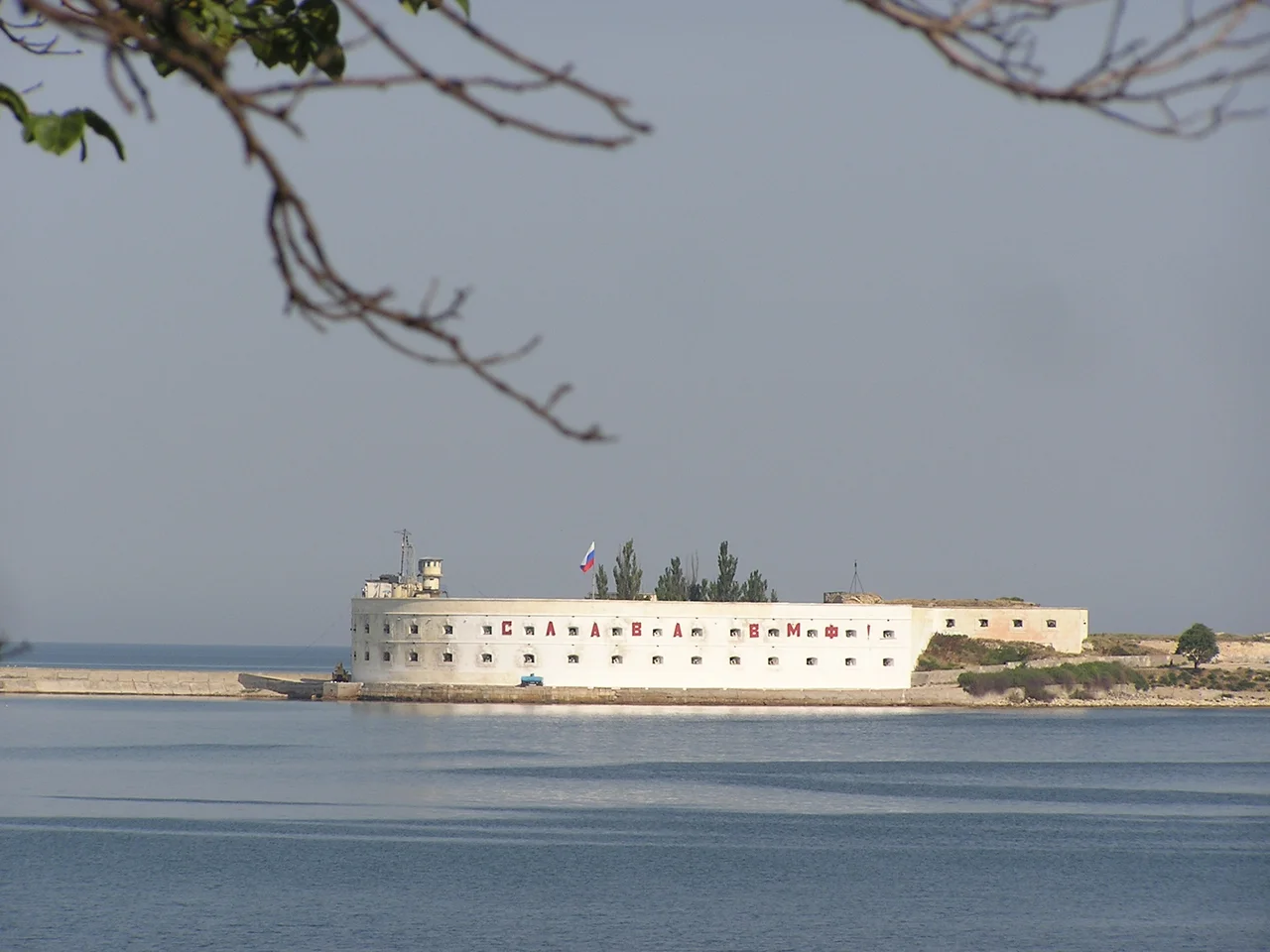

Konstantin Battery
Walk toward the entrance and the fort is already deciding how you might die. The gates of the Konstantin Battery were laid out as a trap, a narrow throat between two doors, ringed by loopholes so that any attacker who forced the first gate stepped into a corridor of gunfire. This is architecture built with cold purpose. The battery curves along the northern lip of Sevastopol Bay in a low horseshoe of especially hard local stone, and for nearly two centuries it has watched over the single stretch of water that any fleet must cross to reach the harbor.
A Bluff on a Summer Night
The fort's story begins with a bluff. Even after the Ottoman Empire renounced its claim to Crimea in the 1774 Treaty of Kucuk Kaynarca, Ottoman warships still cruised these waters as if they owned them. The Russian general Alexander Suvorov meant to end that. On the night of 15 June 1778, with ten Ottoman ships anchored offshore and watching, his men threw up earthen fortifications at the very mouth of the bay, planted where their guns could reach the fleet. The message was unmistakable, and it worked. In 1794, again on Suvorov's orders, a sturdier two-tier stone-and-earth battery replaced the earthworks, designed by the military engineer Francois Sainte de Wollant, who was also raising the young port of Sevastopol itself.
Stone Against Steam
By the 1830s, artillery had outgrown de Wollant's fort, so it was demolished and rebuilt as a modern stone casemate battery, shaped like the horseshoe that stands today, with a barracks folded inside its walls. It was completed in 1840 and named for Grand Duke Konstantin Pavlovich, a younger brother of Tsar Alexander I. The test came with the Crimean War. In 1854, British and French warships bombarded the fort, and in 1855 it traded fire again during the Battle of Kinburn. Along its seaward face the battery bristled with forty-three heavy guns, twenty-seven mounted in the open on the roof and the rest firing from the casemates below, throwing shot at a new age of steam-driven navies probing the bay.
The Order to Hold
The fort's hardest days came in the Second World War. In the summer of 1942, as German forces closed the siege around Sevastopol, the Konstantin Battery became one of four strongholds in the north of the city ordered to hold to the last man, a phrase that in that place, in that summer, meant exactly what it said. For five days, from 5 to 10 June, its defenders obeyed that order. They were not a single unit but a gathering of whoever could fight: men of the 178th Engineering Battalion of the Black Sea Fleet, gunners fallen back from the coastal batteries, and soldiers of the 95th Infantry Division, holding a fortress by then a full century old against a modern army. The stone endured, as it had endured every navy that dared the bay before it. Ordinary men made that old stone matter one last time, buying the city days with the thickness of walls their great-grandfathers' age had raised.
The Horseshoe Today
The fort has finally been allowed to rest. After nearly two centuries as a working fortress, the Konstantin Battery now holds a far quieter garrison than any it knew in war. It houses a museum run by the Russian Geographical Society, and visitors walk in peace along the low curved walls and through the very gates that were designed to become a killing zone, past loopholes that once framed a field of fire and now frame only the view. From the roof, where twenty-seven guns once stood in the open, the whole sweep of the harbor mouth opens out, the same water the fort was built to command. It is a strange thing to stand inside architecture built so deliberately for death and feel only the sea breeze and the quiet. The horseshoe of pale stone keeps its long watch over the bay, but the watch, at last, is a peaceful one.
From the Air
Fort Constantine sits at 44.627 N, 33.512 E, on the north side of the narrow mouth of Sevastopol Bay. From 1,500 to 2,500 feet its low white horseshoe is easy to spot at the harbor entrance, directly across the channel from the city and its seafront. The nearest airport is Belbek (UKFB) just north; Simferopol (UKFF) lies northeast.
Nearby Stories
- 1988 Black Sea Bumping Incident 5.4 km away
- Battle of the Alma 7.5 km away
- Yalta 8 km away
- Russian Battleship Ekaterina II 10 km away
- Akmesdzhyt Friday Mosque 12 km away
- Soviet Hospital Ship Armenia 15 km away
- KaZantip 52 km away
- Januarius MacGahan 338 km away