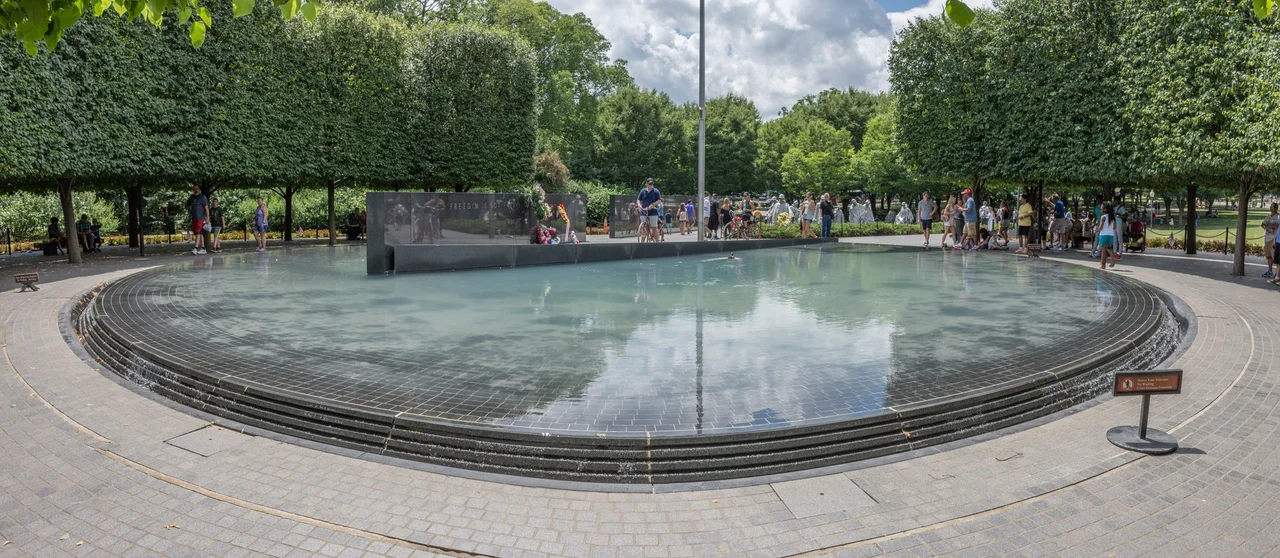

Korean War Veterans Memorial
Walk past the Lincoln Memorial on a damp morning and you can come upon them by surprise. Nineteen stainless steel figures, slightly larger than life, fanning out across a triangular field of granite and juniper. They are dressed in ponchos against weather you cannot see. They are moving forward, but warily - heads turned slightly, weapons at the ready, eyes scanning ground that does not exist. Sculptor Frank Gaylord posed them as a platoon on patrol through the kind of Korean terrain that the survivors would never quite stop walking through. To their right rises a wall of polished black granite, and there a strange thing happens: the wall mirrors the soldiers, and the mirror produces nineteen more. There are now thirty-eight figures in the field. The number is not an accident. The 38th parallel was the line that divided Korea. The war lasted thirty-eight months.
The Forgotten War Remembered
Congress authorized the memorial through Public Law 99-572 on April 20, 1986 - more than three decades after the armistice that ended fighting on July 27, 1953. The design process was its own war. A team from Pennsylvania State University won the original competition, then withdrew when the Commission of Fine Arts demanded changes; they sued, and lost, over the modifications. Cooper-Lecky Architects eventually took over and coordinated the final design among multiple collaborators. President George H.W. Bush turned the first earth on Flag Day, June 14, 1992. Three years later, on July 27, 1995 - the forty-second anniversary of the armistice - President Bill Clinton and South Korean President Kim Young Sam dedicated the memorial together. The Korean War had spent four decades being called the Forgotten War. The memorial was the country's late, official refusal to keep forgetting.
The Column
Frank Gaylord's nineteen steel figures, collectively titled The Column, weigh nearly a thousand pounds apiece and stand between seven feet tall. Fourteen are U.S. Army. Three are Marines. One is a Navy hospital corpsman. One is an Air Force forward air observer. They are dressed in full combat gear and carry rifles, radios, supplies. Gaylord posed them as if breaking through brush on a cold patrol, each figure caught in the middle of forward motion. Strips of granite run between them, and juniper bushes punctuate the gaps - the planting calls up the rugged terrain of Korea, the high hills and broken ground where so much of the fighting happened. In 2010 the Court of Appeals ruled that Gaylord retained intellectual property rights to his sculpture and that a 37-cent postage stamp using his soldiers' image required compensation. By 2013 he was awarded $684,844 in damages. The Postal Service had stamped his soldiers without asking.
The Mural Wall and the Reflection
To one side of the field rises a wall 164 feet long and 8 inches thick - more than 100 tons of highly polished Academy Black granite quarried in California. Artist Louis Nelson sandblasted more than 2,500 archival photographs onto its surface: faces, equipment, ships, planes, support personnel from every branch and theater. The wall is not narrative. It is dense, photographic, almost geological in its layering. From certain angles, the polished surface picks up the nineteen steel soldiers walking past and doubles them. Thirty-eight figures appear on patrol. Thirty-eight months. Thirty-eighth parallel. The mathematics of remembrance are exact.
Pool of Remembrance
Beyond the field of soldiers, a 30-foot circular pool, lined in black granite, sits ringed by linden trees pruned into a barrel shape that lets sunlight reflect off the water. Three Rose of Sharon hibiscus bushes - the national flower of South Korea - bloom on the south side. Engraved nearby are the casualty figures. Americans killed in the Korean theater: 36,634 by the 2022 revision, with another 2,835 non-battle deaths in theater. Wounded: 103,284. Captured: 7,140. Missing: 8,177. Beside each American number is the United Nations number. The plaque speaks for the country: Our nation honors her sons and daughters who answered the call to defend a country they never knew and a people they never met. Another granite wall carries an older phrase, inlaid in silver: Freedom Is Not Free.
The Wall of Remembrance
For decades, the memorial had no names. The Korean War Veterans Memorial Foundation lobbied Congress for years to change that - over the objections of the National Park Service, which worried about adding to the original design. In 2016, Congress passed the Korean War Veterans Memorial Wall of Remembrance Act, requiring the addition. In summer 2022, on a re-dedication day, the Wall of Remembrance opened: long slabs of black granite engraved with the names of 36,634 Americans who died in the Korean theater, along with 7,174 South Koreans who served alongside U.S. forces in the Korean Augmentation to the United States Army, the KATUSA program. The $22 million cost was funded mostly by the South Korean Ministry of Patriots and Veterans Affairs. Korea - the country those Americans had never known and whose people they had never met before they fought there - was paying to name them, one by one.
From the Air
The Korean War Veterans Memorial sits at 38.8878 N, 77.0472 W, in West Potomac Park immediately southeast of the Lincoln Memorial and south of the Reflecting Pool. Best viewed from 1,500 to 2,500 feet AGL. The triangular layout of the field, distinct from the rectangular geometry of nearby monuments, is the easiest visual identifier from the air. Reagan National (KDCA) lies about two nautical miles south. The site sits inside the Washington Flight Restricted Zone; GA overflight prohibited. Aerial views require approved operations or vantage from beyond the FRZ. Best photographed mid-morning when sunlight angles onto the polished granite wall.
Nearby Stories
- Gunston Hall 1.1 km away
- 2023 Baltimore Shooting 4.9 km away
- Battle of Middleburg 6.6 km away
- Crownsville Hospital Center 10 km away
- Battle of Loudoun Heights 13 km away
- First Battle of Rappahannock Station 20 km away
- Howard County, Maryland 21 km away
- Harriet Tubman Underground Railroad 50 km away