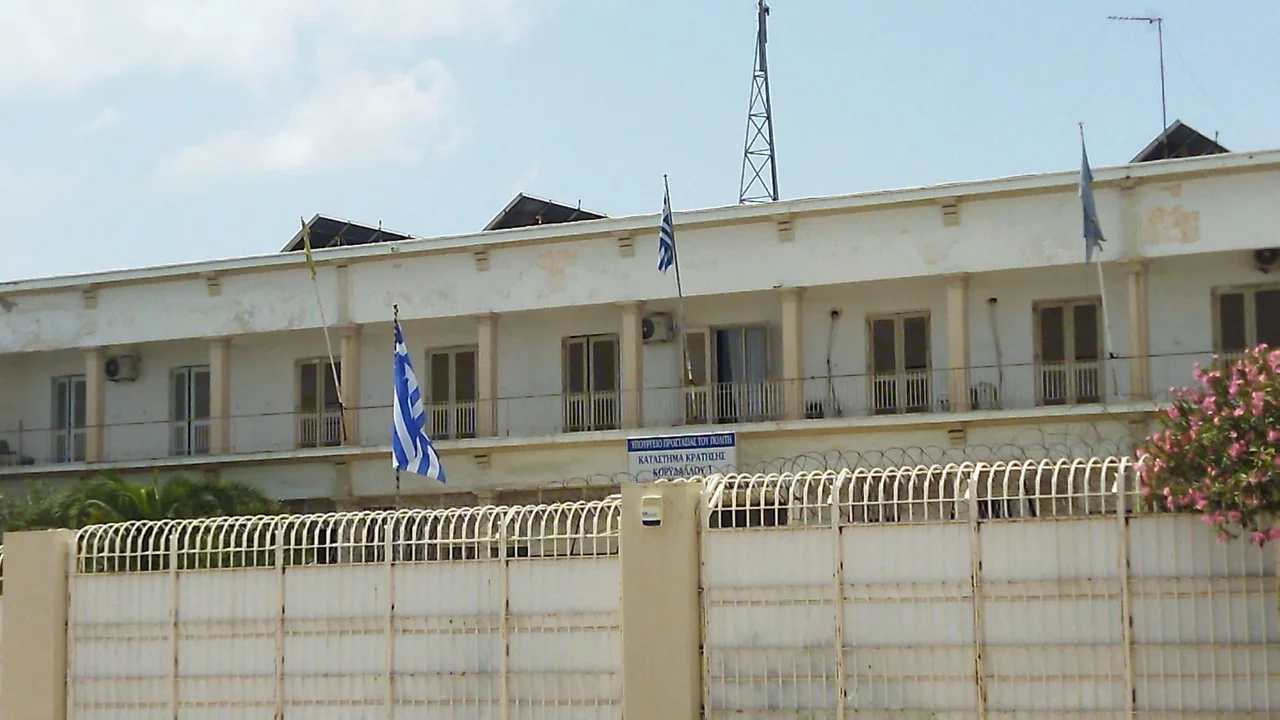

Korydallos Prison
In a basement courtroom beneath Greece's largest prison, the men who had ruled the country sat in the dock. It was 1975, a year after the collapse of the military junta, and the colonels who had seized Greece in a 1967 coup were now defendants inside the very system they had tried to crush. Korydallos Prison, in the Piraeus suburb of the same name, was built to hold prisoners. But its most enduring role has been as a stage where the Greek state confronts its own darkest chapters - dictatorship, terrorism, and the hard question of how a democracy treats the people it locks away.
The Junta on Trial
When the Colonels' regime fell in 1974, the restored democracy faced a choice: forgive the dictatorship or judge it. It chose to judge. The junta trials of 1975 convened in Korydallos's special basement court, and the leaders of the coup were convicted for their roles in seizing and holding power. The reckoning lingered for decades inside these walls. Nikolaos Dertilis, the last junta member still imprisoned, died here in 2013 at the age of 94 - the final living thread of a regime that the trial had formally consigned to history. Few prisons anywhere can claim to have housed the architects of a fallen government and then watched the last of them grow old behind their bars.
A Roster of the Notorious
Korydallos became the place Greece sent the people it considered most dangerous. Members of the leftist urban guerrilla groups - Revolutionary Organization 17 November, Revolutionary Struggle, and the Conspiracy of Fire Nuclei - have served sentences here. So, in pre-trial detention during 2013 and 2014, did leading figures of the far-right Golden Dawn organization, later convicted as a criminal group. The prison has held activists too: Sarah Mardini, the Syrian refugee and rescue volunteer, spent 106 days here in pre-trial detention in 2018 before her case drew international attention. Across the political spectrum, Korydallos has been where the Greek state holds those it sees as threats to it - a single complex containing wildly opposed ideologies under the same roof.
Escapes and Standoffs
Twice, a robber named Vasilis Paleokostas escaped by helicopter - in June 2006 and again in February 2009 - lifted out of the yard in a rented aircraft, an audacity that earned him the nickname the 'Greek Robin Hood' and made Korydallos a byword for porous security. The prison has also been the site of collective protest from within. In 1990, inmates seized the entire complex for 28 days, a standoff over conditions and justice reform that ended only when officials conceded many of their demands. A larger riot in November 1995 saw prisoners control the prison for several days. These were not only acts of defiance but acts of negotiation - people with little power forcing the system to listen.
The Question of Conditions
For all its notoriety, the most persistent story at Korydallos is a quieter one about how human beings are treated inside it. Amnesty International and the Council of Europe's anti-torture committee have repeatedly raised alarm over overcrowding and conditions. A 2007 inspection found the prison's hospital and psychiatric clinic operating with aging infrastructure, severe staff shortages, and inadequate hygiene. The women's section was moved to Thiva beginning in 2008 after years of complaints; two of its wings were finally demolished by 2017, clearing ground meant to become a public park. Behind every headline-grabbing inmate are thousands of ordinary prisoners whose daily reality - cramped, under-resourced, often in poor health - is the part of Korydallos's story that rarely makes the news but matters most.
From the Air
Korydallos Prison stands in the Korydallos district of Piraeus, in the western reaches of greater Athens, at roughly 37.982°N, 23.647°E. From the air the complex reads as a walled institutional block in dense suburban surroundings, with the port city of Piraeus and the Saronic Gulf to the south and the Athens basin spreading east toward the Acropolis. Athens International Airport (LGAV) lies about 35 km to the east-southeast across the metropolitan sprawl. The flat western Attic light is strong year-round; the site is best identified by its perimeter walls and the cleared ground to the south where the former women's wings once stood.
Nearby Stories
- Great Sand Beach 5 km away
- Battle of Delium 7.7 km away
- Tower of Aliartos 9 km away
- HMHS Britannic 10 km away
- Saronic Gulf 15 km away
- Sousaki Volcano 17 km away
- Sanctuary of Apollo Maleatas 24 km away
- Skyros 66 km away