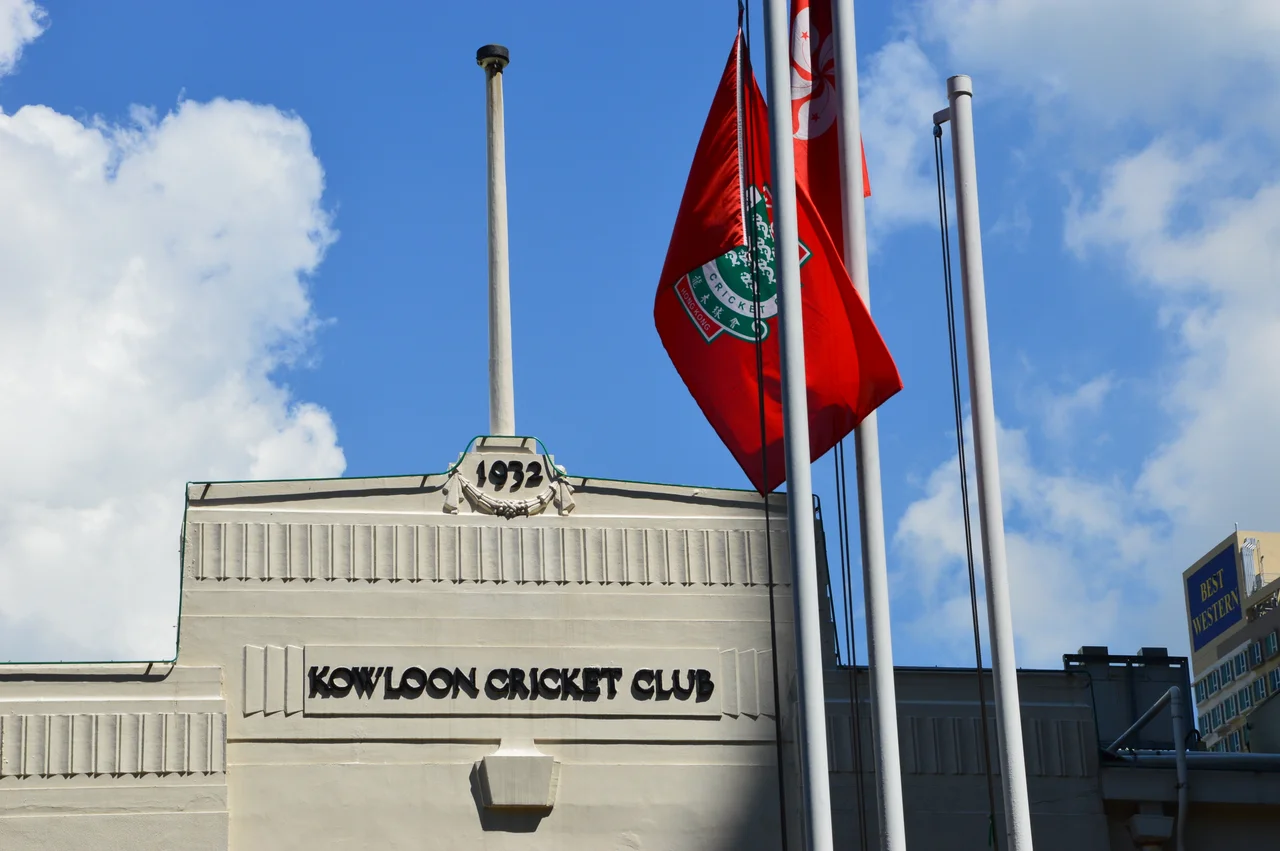

Kowloon Cricket Club
The foundation stone was laid on 18 January 1908 by Sir Hormusjee Naorojee Mody — a Parsi philanthropist from Bombay whose generosity built so much of early Hong Kong that the city has never quite stopped honoring him. Mody received an engraved silver trowel for the occasion, a small trophy for a large act of faith. He was betting that cricket would take root on this peninsula, that the sound of bat meeting ball would carry across the government land in King's Park for generations. Over a century later, on Cox's Road in Kowloon, it still does.
An October Founding
The Kowloon Cricket Club was established on 4 October 1904, three and a half years before Mody laid that stone. From the start it competed in a crowded field — Hong Kong may have been a small colonial outpost, but it took its cricket seriously. The KCC went up against the Hong Kong Cricket Club, the Craigengower Cricket Club, the Parsee Cricket Club, and teams from the Royal Engineers, the Army Ordnance Corps, and the Civil Service. Soldiers from the Royal Army Medical Corps and HMS Tamar, the Royal Navy shore base, played alongside KCC members in the South China Morning Post Shield. There was a colonial social dimension to all of this, of course — the clubs sorted by regiment, ethnicity, and class in the way that British colonial sport reliably did. But cricket was also the medium through which different communities in Hong Kong met each other on level ground, or tried to.
The Governor and the Trowel
The Kowloon Cricket Club Pavilion opened on 11 July 1908, with Governor Sir Frederick Lugard doing the honors. Lugard would go on to serve as Governor-General of Nigeria and write the foundational text of British indirect rule, becoming one of the most influential — and contested — figures in the history of British colonialism. In Kowloon that morning, he was simply cutting a ribbon. The man who funded the pavilion, Sir Hormusjee Mody, was 71 years old and approaching the end of a long life built on opium trading and philanthropy in roughly equal measure. He had already donated the land and buildings for what became Hong Kong University. The silver trowel he received at the KCC was a modest token compared to his broader legacy, but it pointed to something real: the club he helped build was a genuine institution, not merely a weekend pastime.
War, Silence, and Return
In December 1941, Japanese forces swept through Hong Kong in a battle that lasted eighteen days. The colony fell on Christmas Day. For the next four years, the city endured occupation: internment camps, food shortages, forced labor, and the systematic dismantling of the colonial life that had existed before. The Kowloon Cricket Club did not operate between 1941 and 1946. That five-year gap stands in the record as a quiet marker of everything the occupation erased. When the club reopened after the war, it competed for the Hancock Memorial Shield — a competition that itself carries the weight of remembrance in its name. Cricket resumed because the people who played it returned, or the next generation took it up, or both.
Sixes and the Modern Game
Since 1992, the KCC has hosted the Hong Kong Cricket Sixes — a fast-format tournament that trades the slow burn of test cricket for concentrated, theatrical six-a-side play. The Sixes became a fixture on Cox's Road, drawing teams and crowds in the years when Hong Kong's cricket scene was growing rather than just maintaining. The KCC also has a full-size bowling green alongside its cricket pitch, making it one of the few places in Kowloon where both disciplines share a boundary. The club remains members-only, a social institution as much as a sporting one, occupying a green pocket of King's Park in a city where green pockets are perpetually under pressure. The sound of bat on ball still carries.
From the Air
The Kowloon Cricket Club sits at approximately 22.30°N, 114.17°E, in the King's Park area of Kowloon. From the air, the green cricket pitch stands out against the dense urban fabric of Tsim Sha Tsui and Yau Ma Tei. Hong Kong International Airport (VHHH) is on Lantau Island, about 28 km to the west. At 1,500–3,000 feet, the pitch is visible from the north as one of the few large open green spaces on the peninsula. The Kowloon hills — particularly Lion Rock — provide the northern backdrop at altitude.
Nearby Stories
- Lok Ma Chau Loop 2.3 km away
- Portas do Cerco 2.3 km away
- Kweilin Incident 17 km away
- Wanshan Archipelago Campaign 34 km away
- Nanxiong Formation 115 km away
- Battle of Nanpeng Island 148 km away
- Heyuan 169 km away
- Cape Maobitou 632 km away