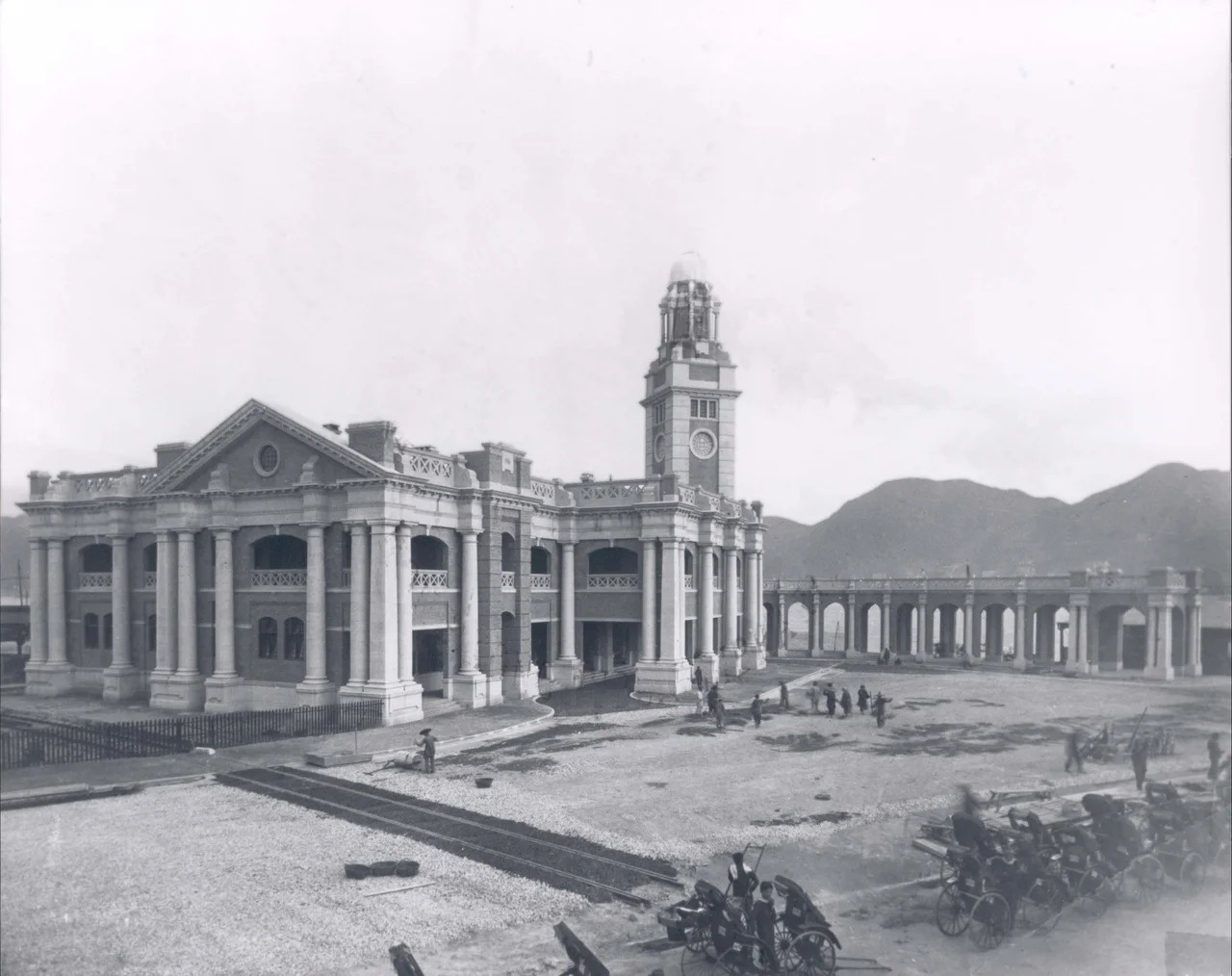

Kowloon Railway Station (KCR) & Clock Tower
In February 1978, a petition with 15,000 signatures arrived at Buckingham Palace. The signatories were asking Queen Elizabeth II to intervene in a planning dispute in her colony of Hong Kong — to save a red-brick railway station from the wrecking ball. Royal intervention never came. The building came down. But one piece was spared: the Clock Tower, standing still on the Tsim Sha Tsui waterfront, its bell finally returned to its tower in September 2010 after decades in storage at a rail depot. It is the last fragment of a terminus that once marked the end of the line between two worlds.
Iron Rails to Canton
Regular passenger service between Kowloon and Canton (today's Guangzhou) began on 1 October 1910, though it started from a temporary timber structure near the old Salisbury Road Post Office. The permanent station came later: architect Arthur Benison Hubback — the same man who designed Kuala Lumpur's railway station — drew up plans for a proper terminus, and construction began on 1 March 1914 on land reclaimed from Victoria Harbour. Two years almost to the day later, on 1 March 1916, the building was complete. Its official opening followed on 28 March 1916. The result was a two-storey, L-shaped terminal in Edwardian Classical Revival style: a steel frame clad in red brick, with white granite columns, architraves, and pediments climbing the facade. At its corner stood the clock tower that would one day outlast the rest.
The Fight to Save It
By 1970, the station was sixty years old and the colonial government had its eye on the site for redevelopment. Letters went to the Colonial Secretary — from the Kowloon Residents' Association in 1970, from the Tsim Sha Tsui Neighbourhood and Welfare Association in 1975 and again in 1977. The Heritage Society escalated, petitioning Governor Murray MacLehose directly in July 1977. The Government rejected the petition and dismissed calls for an independent inquiry. Undeterred, the Heritage Society gathered signatures and sent that file of 15,000 names to the Queen in February 1978, hoping royal intervention might succeed where official channels had failed. It did not. The station was demolished, replaced eventually by the Hong Kong Cultural Centre, which opened in 1989 on the same reclaimed ground. The KCR terminus relocated north to Hung Hom in 1975.
What the Wreckers Left
Demolition did not erase everything. Six stone pillars from the station building were salvaged and relocated to the Urban Council Centenary Garden in Tsim Sha Tsui East, where they still stand as architectural orphans. The clock tower itself was left in place — a lone monument on the waterfront promenade, declared a protected monument by the Hong Kong government. For decades, its bell sat in exile at the East Rail depot at Ho Tung Lau, separated from the tower it was built to ring. Then, in September 2010, the bell was brought home. Today it hangs again where it always belonged, above the Tsim Sha Tsui waterfront, measuring time on a site that has otherwise been entirely transformed around it.
A Tower Without a Station
The Clock Tower today is one of Hong Kong's most photographed landmarks — a 44-metre-tall red-brick and granite remnant of Edwardian ambition, flanked now by the Cultural Centre and the Museum of Art, with the Star Ferry pier a short walk away. Ferries still cross the harbour; the railway still runs, though from Hung Hom and eventually from the West Kowloon terminus opened in 2018. Tourists photograph the tower against the harbor light. Few know that Hongkongers once petitioned a queen to save what the tower belonged to, or that 15,000 of them cared enough to sign their names to the cause. The tower stands as a monument to both the station that was lost and the people who tried, and failed, to keep it.
From the Air
The Clock Tower stands at approximately 22.2939°N, 114.1700°E on the Tsim Sha Tsui waterfront. From the air, it is identifiable as a lone red-brick spire immediately south of the Hong Kong Cultural Centre, right on the Victoria Harbour edge. The Star Ferry pier is a few hundred metres to the west. Recommended viewing altitude: 1,500–3,000 feet for the full harbour panorama with Tsim Sha Tsui in the foreground and Hong Kong Island across the water. Primary nearby airport: Hong Kong International (VHHH), approximately 30 km to the west-southwest on Lantai Island. The former Kai Tak Airport site is approximately 4 km to the northeast.
Nearby Stories
- Lok Ma Chau Loop 2.3 km away
- Portas do Cerco 2.3 km away
- Kweilin Incident 17 km away
- Wanshan Archipelago Campaign 34 km away
- Nanxiong Formation 115 km away
- Battle of Nanpeng Island 148 km away
- Heyuan 169 km away
- Cape Maobitou 632 km away