.jpg)
Kreeger Museum
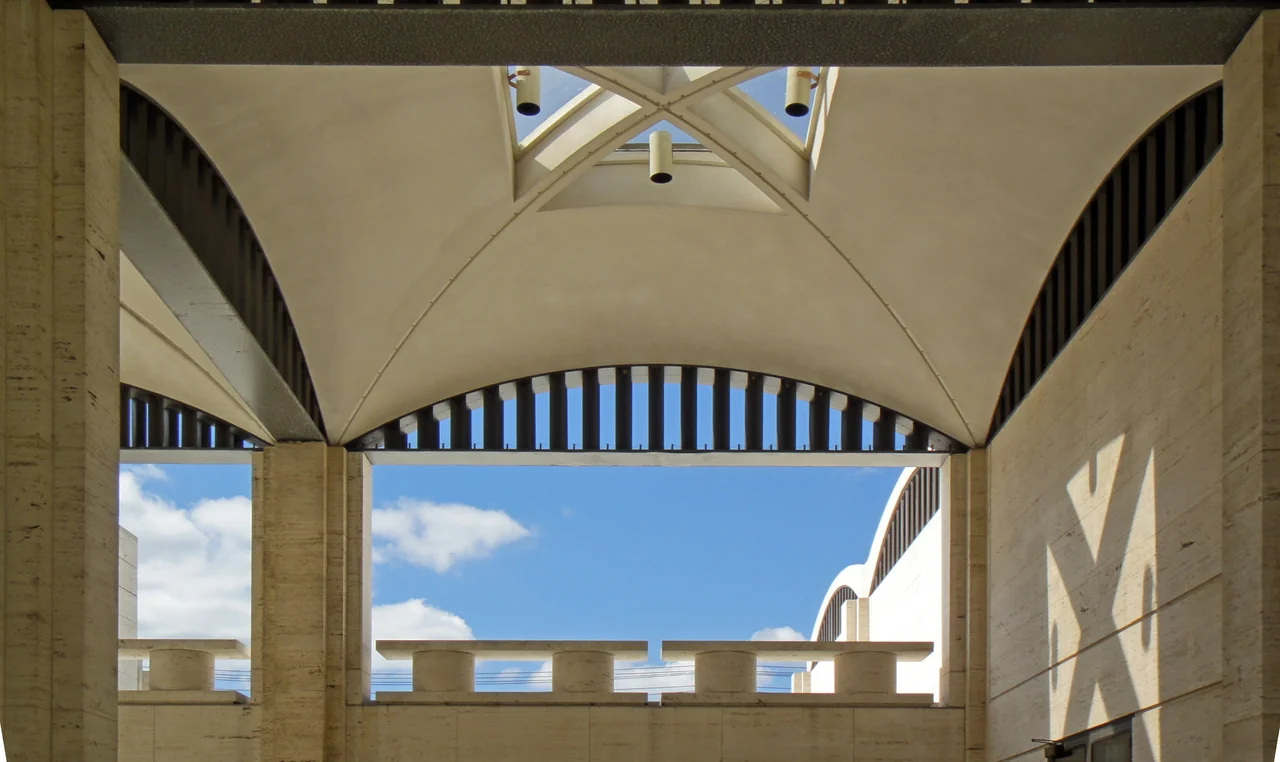
Philip Johnson got an unusual commission in 1963. Build a house, his client said. But build it so that one day, when we are gone, the house can become a museum. The client was David Lloyd Kreeger, an insurance executive who had helped build GEICO into a corporate giant and used the money to assemble one of the country's quieter great art collections. Johnson, who would later win the inaugural Pritzker Prize in 1979, had spent the late 1950s collaborating with Mies van der Rohe on the Seagram Building. Now, on five and a half wooded acres in Northwest Washington, he was asked to design something that would live two lives: home first, gallery later. He responded with a Roman villa of his own invention - 900 tonnes of hand-selected Italian travertine wrapped around a grid of twenty-two-foot cubes, each capped with a slender vault, all of it hidden from Foxhall Road behind a 435-foot wall of rough-hewn stone.
The Cube as Unit
Johnson designed the building around a single module: a cube measuring twenty-two feet on each side. The cubes could be combined, opened, or stacked, but each module remained the same dimensions, lit the same way, capped by the same slim vault. The result was a 24,000-square-foot building with seventeen concrete domes forming a distinctive roof line, all covered with synthetic rubberized waterproofing. Inside, the largest space - The Great Hall - rises two stories to twenty-five feet, topped by three vaulted domes that work as a natural acoustic amplification system. The Kreegers were music lovers; chamber and piano concerts thrived in that room. Richard Foster, Johnson's partner, traveled twice to the Italian quarries to oversee the hand-selection of travertine slabs and supervise their labeling. The travertine itself was an unusual choice for a modernist - the stone is essentially young limestone, the kind used by ancient Romans and Washington's neoclassical government architects, both of whom Mies van der Rohe-influenced modernists generally avoided. Johnson did not care.
House for Two Lives
Construction ran from 1966 to 1969. The Kreegers moved in 1967 and lived in the house until 1990 - twenty-three years of bedrooms doubling as galleries, sculpture terraces shared with reflecting pools, dinner parties held among Monets. Carmen and David Lloyd Kreeger had been buying art since 1952, and they continued through 1988, building toward the museum the house would become. They specified that art galleries should not invade private spaces but should be adjacent to them, free-flowing where the family rooms were contained. The walls of the gallery spaces were covered with cream carpet to blend with the natural travertine and allow paintings to be rotated easily. The floors throughout most of the house are oiled brown chevron wood, warm against the stone. On June 1, 1994, the Kreeger Museum opened to the public. The house had completed its first life and begun its second.
Monet, Nine Times
The collection runs from the 1850s to the present, with particular density around Impressionism and the early twentieth century. There are nine Monets - paintings spanning the cliffs at Pourville in 1882, Springtime at Giverny in 1886, fog rising off the Seine near Giverny in 1897. There are nine Picassos, tracing his career from early periods to late. There are five Rodins. The nineteenth century brings Corot, Daubigny, Fantin-Latour, Van Gogh. The Impressionists and Post-Impressionists include Renoir, Sisley, Cézanne, Degas, Pissarro. Twentieth-century Europeans include Munch, Beckmann, Dubuffet, Kandinsky, Chagall, Braque, Léger, Bonnard, Delvaux, Ensor, Miró. American artists include Calder, Gorky, Clyfford Still, Frank Stella, Helen Frankenthaler, Joan Mitchell, Anne Truitt, Rosenquist. Local Washington Color School painters - Gene Davis, Thomas Downing, Sam Gilliam - are well represented. African and Asian works appear throughout the museum, integrated rather than segregated.
The Sculpture Outside
Beyond the travertine walls, the grounds carry the collection outward. The Sculpture Terrace holds works by Jean Arp, Aristide Maillol, Jacques Lipchitz, Henry Moore, Isamu Noguchi, and Francesco Somaini - a roster of mid-century European modernists arranged among the trees. The Reflecting Pool Terrace shows John L. Dreyfuss's Inventions, six large-scale pieces in dialogue with the water. The Sculpture Garden expands the outdoor exhibition into wooded paths, featuring George Rickey, Lucien Wercollier, and Washington-area artists including Kendall Buster, Carol Brown Goldberg, Dalya Luttwak, and Foon Sham. Maillol's Pomona stands among the lindens. Rodin's Athlete sits inside. The walls are arranged to dissolve the distinction between interior and grounds wherever possible - glass replacing stone wherever the wooded views invited it in.
Quiet on Foxhall
The Kreeger Museum receives fewer visitors than the Smithsonians on the Mall, and the building seems content with that. Located up Foxhall Road in one of Washington's quietest residential neighborhoods, with no Metro stop nearby, the museum requires intention. The 435-foot travertine wall along the street keeps the house invisible to casual traffic. The grounds buffer the building from its neighbors. Inside, visitors walking from one cube to the next describe an unusual calm - the architect's gift, Johnson's biographers have suggested, of having spent his career thinking about how people move through space. Same module, same clerestory light, same tent-like vault sheltering both intimate and public rooms. The house exists for the art and the art exists for the house, with no clear line between them - which was, of course, the original commission.
From the Air
The Kreeger Museum sits at 38.9218 N, 77.0891 W, on Foxhall Road in Northwest Washington's residential Foxhall neighborhood, about three miles northwest of the National Mall. Best viewed from 2,000 to 3,500 feet AGL. The distinctive seventeen-dome travertine roof is the easiest visual identifier from the air, set among wooded grounds. Reagan National (KDCA) lies four nautical miles south; Dulles (KIAD) is twenty miles west. The site sits inside the Washington Flight Restricted Zone; GA overflight prohibited. Aerial views require approved operations or vantage from beyond the FRZ. The wooded surroundings produce attractive seasonal contrast in autumn.
Nearby Stories
- Gunston Hall 1.1 km away
- 2023 Baltimore Shooting 4.9 km away
- Battle of Middleburg 6.6 km away
- Crownsville Hospital Center 10 km away
- Battle of Loudoun Heights 13 km away
- First Battle of Rappahannock Station 20 km away
- Howard County, Maryland 21 km away
- Harriet Tubman Underground Railroad 50 km away