.jpg)
Kritios Boy
Shift your weight onto one leg. Feel your hip rise on that side, your spine curve gently to compensate, one shoulder drop. You have just done something no statue in the world did before roughly 480 BC. The marble youth known as the Kritios Boy was the first to do it too - the first sculpture from antiquity to stand the way a living body actually stands. For three centuries before him, Greek statues had stood like fence posts, rigid and symmetrical, frozen mid-stride with both feet flat and a fixed smile. Then this boy relaxed, and an entire era of art relaxed with him.
The Weight That Changed Everything
The technical name is contrapposto - Italian for 'counter-poise' - and the Kritios Boy is the earliest known example of it in stone. It sounds like a small thing. It is not. When the sculptor lifted the boy's weight onto one leg, he triggered a chain reaction down the whole body: the pelvis tilts up on the engaged side, the relaxed hip drops, the spine bends into a soft S-curve, and the shoulders dip to balance the hips. Nothing here is invented for effect. It is simply what bodies do. By observing that and carving it, the artist swapped the geometry of the old Archaic style for the living logic of anatomy, and every great sculptor who followed - Praxiteles, Lysippos, and the makers of Rome's marbles - built on what this boy first made possible.
Buried by an Invasion
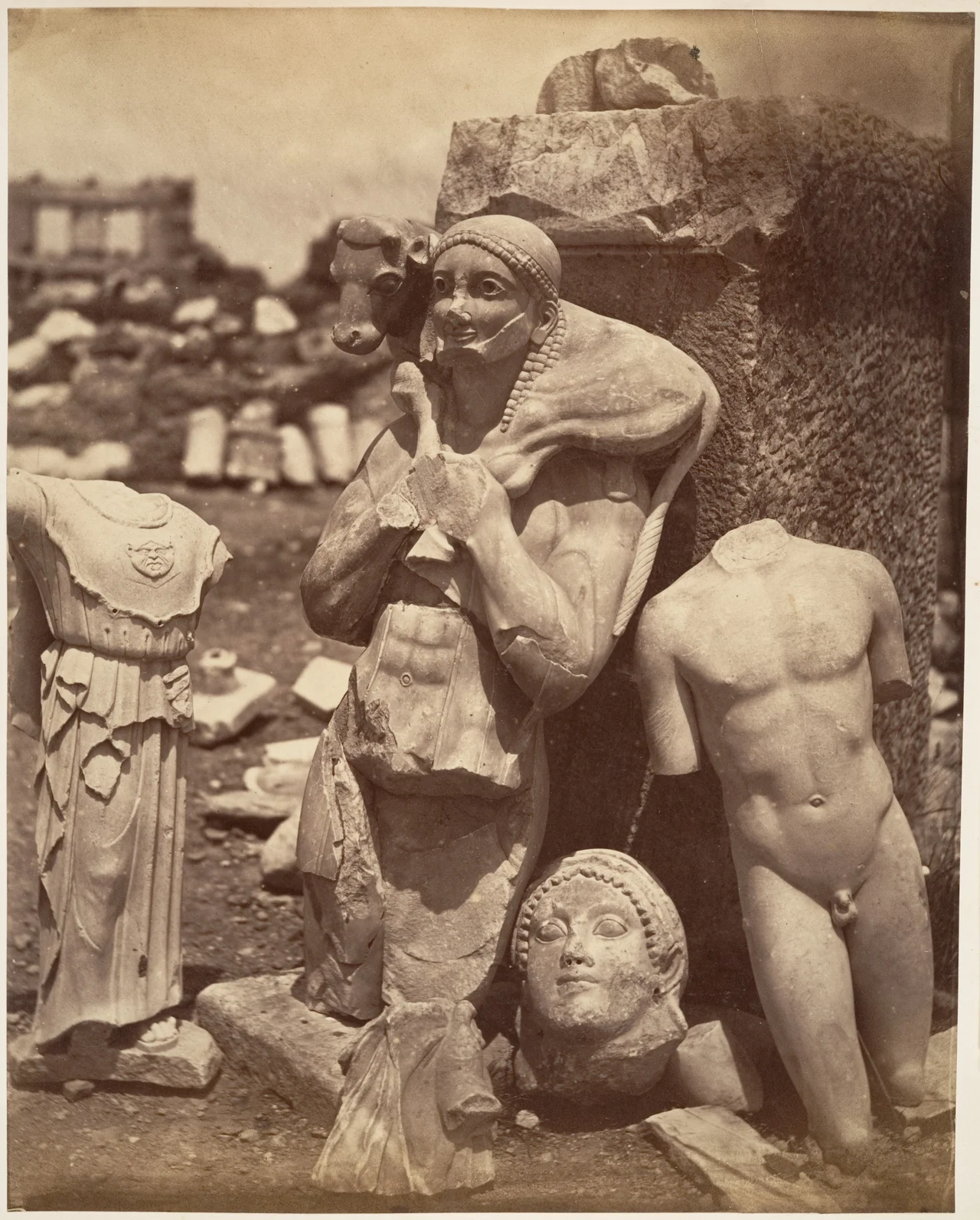
The boy survived because Athens was sacked. In 480 BC the Persian army stormed the Acropolis and smashed its sacred sculptures. When the Athenians returned, they could not simply discard objects dedicated to the gods, so they buried the wreckage in ceremonial pits archaeologists now call the Perserschutt - the 'Persian rubble.' The Kritios Boy went into the ground there, and that catastrophe became his preservation. His torso surfaced in 1865 during work on the old Acropolis museum's foundations. His head turned up twenty-three years later, between the museum and the Acropolis south wall. Reunited, the two fragments anchor his date precisely, because the destruction layer they came from has a name and a year carved into history.
A Face That Stopped Smiling
Look closely and you notice what is missing: the smile. For generations the Archaic kouroi - the stiff standing youths of the seventh and sixth centuries BC - wore an enigmatic upturned grin, a convention as fixed as their posture. The Kritios Boy's mouth is calm and serious, the lips carved with quiet realism rather than formula. His ribcage swells slightly, as if caught in the act of breathing. His hips are narrower, his musculature rendered with what one observer called the 'unforced lifelike accuracy of flesh and bone.' This grave, watchful composure is the signature of the Severe style, the brief transitional moment between Archaic stiffness and full Classical naturalism. The art historian Kenneth Clark called this figure 'the first beautiful nude in art.'
Standing Where He Fell
Today the boy stands in the Acropolis Museum, only steps from the rock where he was buried and unearthed. He is roughly life-size, missing his feet - which is partly why he carries the name Kritios at all, since the attribution to the sculptor Kritios rests on slender, much-debated evidence. The name hardly matters. What matters is the threshold he marks. Walk past him and you walk past the exact instant when Western sculpture stopped imitating posts and started imitating people. Everything after - the contrapposto of Renaissance Davids, the easy stance of a thousand museum marbles - traces back to one Athenian youth who simply shifted his weight.
From the Air
The Kritios Boy resides in the Acropolis Museum on the southeast slope of the Acropolis, Athens, at roughly 37.969°N, 23.728°E - within a few hundred meters of the Parthenon's iconic silhouette. The whole sacred rock is unmistakable from the air, crowning central Athens. Athens International Airport (LGAV) lies about 30 km east-southeast; the small Athens regional fields and the dense urban grid frame the approach. Best appreciated at low altitude in the clear, hard light typical of Attic summers, with the Saronic Gulf glinting to the southwest.
Nearby Stories
- Great Sand Beach 5 km away
- Battle of Delium 7.7 km away
- Tower of Aliartos 9 km away
- HMHS Britannic 10 km away
- Saronic Gulf 15 km away
- Sousaki Volcano 17 km away
- Sanctuary of Apollo Maleatas 24 km away
- Skyros 66 km away