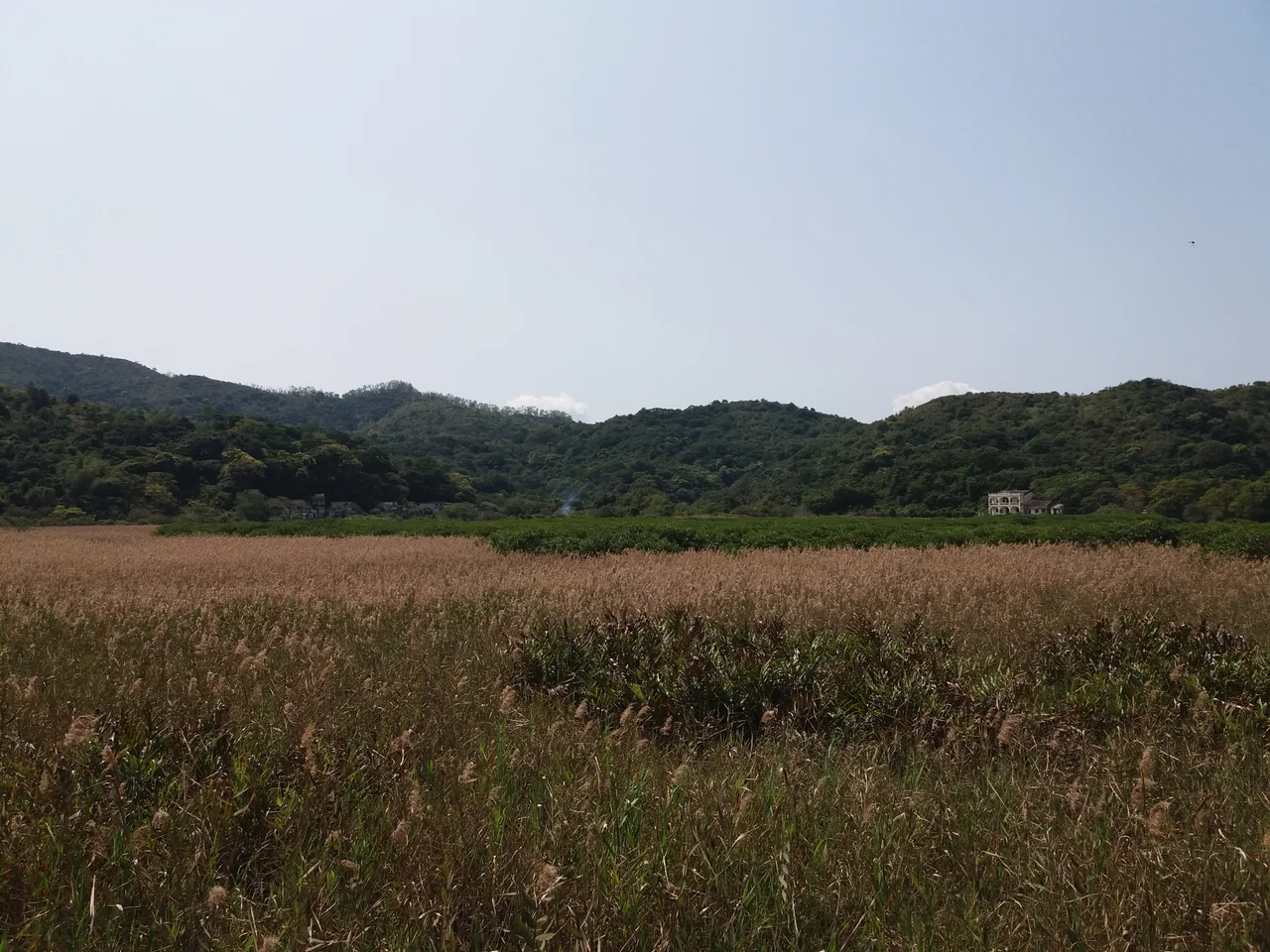

Kuk Po
Getting to Kuk Po requires a permit, a ferry ride across Starling Inlet, and a willingness to arrive somewhere that has been deliberately hard to reach for most of its history. The cluster of small Hakka villages tucked along the south shore of the inlet, opposite Sha Tau Kok, sits inside Hong Kong's Frontier Closed Area — a restricted buffer zone that has, unintentionally, preserved the place in amber. The houses are mostly empty now, the schoolhouse quiet, the fields reverting to reed. But the ancestral halls still stand, and on the first and fifteenth of the lunar month, descendants make the trip back to burn incense and tend the offerings, keeping faith with a settlement that has outlasted every prediction of its disappearance.
Emptied and Repopulated: Three Centuries of Displacement
The story of Kuk Po begins not with arrival but with forced departure. In 1662, the Kangxi Emperor of the Qing dynasty ordered all coastal inhabitants to evacuate fifty li inland — an attempt to deny resources to Ming loyalists holding out at sea. Two years later, a second order pushed people further still. It was not until 1669 that the evacuation was rescinded, and the emptied coastal villages could be reoccupied. The emperor offered financial assistance to encourage resettlement, which likely explains why newcomers arrived in Kuk Po alongside returning families. The original inhabitants are believed to have been the Cheung clan, who later relocated to nearby Fung Hang but retained ownership of much of the land. Over the following centuries, seven clans — Sung, Lee, Ho, Tsang, Cheng, Ng and Yeung — spread across the cluster of smaller hamlets that make up Kuk Po, each speaking Hakka rather than Cantonese, each tied to farming and fishing along the inlet.
The Schoolmaster Who Came Back
In 1928, a schoolhouse went up in Kuk Po — an unusual institution for such a remote place, built in a style inspired by the Guangzhou Military Academy School. The connection was personal. Sung Miau On, who had studied at that very school in Guangzhou, came to Kuk Po and recognized his clanspeople among the villagers. He stayed, became the local headmaster, and made the school work. For decades it served children from across the surrounding hamlets, some of whom crossed the bay by boat each morning to attend. By the early 1990s only a handful of students remained, making the same crossing to sit in the same classrooms with a last headmaster, Mr. Ho, and a couple of teachers. The school finally closed as the rural population dispersed to Hong Kong's urban centre. The building itself has been listed as a Grade III historic building, along with the Hip Tin Temple next door and several ancestral halls in the oldest walled village, Kuk Po Lo Wai.
The Difficulty of Getting There
Access to Kuk Po has never been simple, and remains deliberately complicated. Because Sha Tau Kok lies within the Frontier Closed Area, visitors must obtain a permit through the Shek Chung O border crossing before they can approach. Even then, the most practical route is a ferry across Starling Inlet to the pier at Kuk Po Hoi Ha. A footpath leads from the school to Luk Keng — a forty-minute walk through country park terrain — but most people who still make the journey arrive by boat. Hikers can reach Kuk Po through Plover Cove Country Park, which fringes the valley to the south, and a small stall near the old school opens on Sundays, run by indigenous Kuk Po residents who have not entirely let go of the place. That Sunday stall, serving walkers and occasional weekend visitors, is in some ways the most remarkable thing about Kuk Po: evidence that people are still here, still invested, even as the houses empty and the grass grows higher.
What Remains
The villages of Kuk Po are not entirely abandoned — they are in a state that resists easy labels. Structurally, the oldest settlement, Kuk Po Lo Wai, was a Hakka walled village, and its ancestral halls for the Yeung, Li, Ho and Sung clans, along with a watchtower and old village houses, have all been assessed by Hong Kong's Antiquities Advisory Board. Several hold Grade III status. The Hip Tin Temple and Kai Choi School together form a listed complex. The Reed fields around the villages turn golden in autumn. In 1911, the census recorded 247 people in Kuk Po Lo Wai (140 of them male) and 126 in Kuk Po San Wai. Today the permanent population is negligible, but the community's relationship with the place continues: not as residence, but as ancestral obligation, kept alive in ferry crossings and incense smoke.
From the Air
Kuk Po sits at approximately 22.53°N, 114.24°E on the northeastern edge of Hong Kong's New Territories, along the south shore of Starling Inlet (Sha Tau Kok Hoi). From the air, look for the inlet's distinctive elongated shape running roughly east–west, with the green ridgelines of Plover Cove Country Park to the south and the developed town of Sha Tau Kok visible on the opposite (Shenzhen) shore to the north. The village cluster is small and largely hidden by vegetation at low altitude. Nearest airport is Hong Kong International (VHHH), approximately 45 km to the southwest. Approach from the south at 2,000–3,000 feet for a clear view of the inlet and the green-covered peninsula where the villages nestle. Visibility is best in winter and spring before the summer haze builds.
Nearby Stories
- Hong Kong Disneyland 4.1 km away
- Mount Guanyin (Dongguan) 7 km away
- 2024 Lixinsha Bridge Collapse 7.4 km away
- Portas do Cerco 12 km away
- Lotus Hill 15 km away
- Nanxiong Formation 78 km away
- Heyuan 130 km away
- Checheng Fu'an Temple 629 km away