
Kuranda
Getting to Kuranda is half the point. You can drive the highway up from Cairns in forty minutes, but almost nobody does - not the first time. Instead you climb the mountain the slow way, swaying behind a heritage train as it threads tunnels blasted into the gorge wall, or floating silently over the treetops in a gondola. Either way you rise from tropical coast into cool rainforest and step off at a village that has built its whole identity around being arrived at. By midday the streets are packed; by half past three, when the last train pulls out, the crowds drain away and the rainforest closes back in around the place it never really left.
Sixty Thousand Years of Country
Long before it was a tourist village, this rainforest was - and remains - the Country of the Djabugay and Buluwai peoples, who have lived in the Kuranda region for tens of thousands of years. Their presence here is not a historical footnote but a continuous thread; their creation stories, centred on the ancestral being Buda-dji the carpet snake, are written into the rivers and ranges around the town. The forest that day-trippers admire from a gondola is ancestral ground, named and known in detail long before any railway surveyor arrived. To understand Kuranda is to understand that the spectacular landscape it sells was someone's home for two thousand generations, and still is.
A Railway Carved by Hand
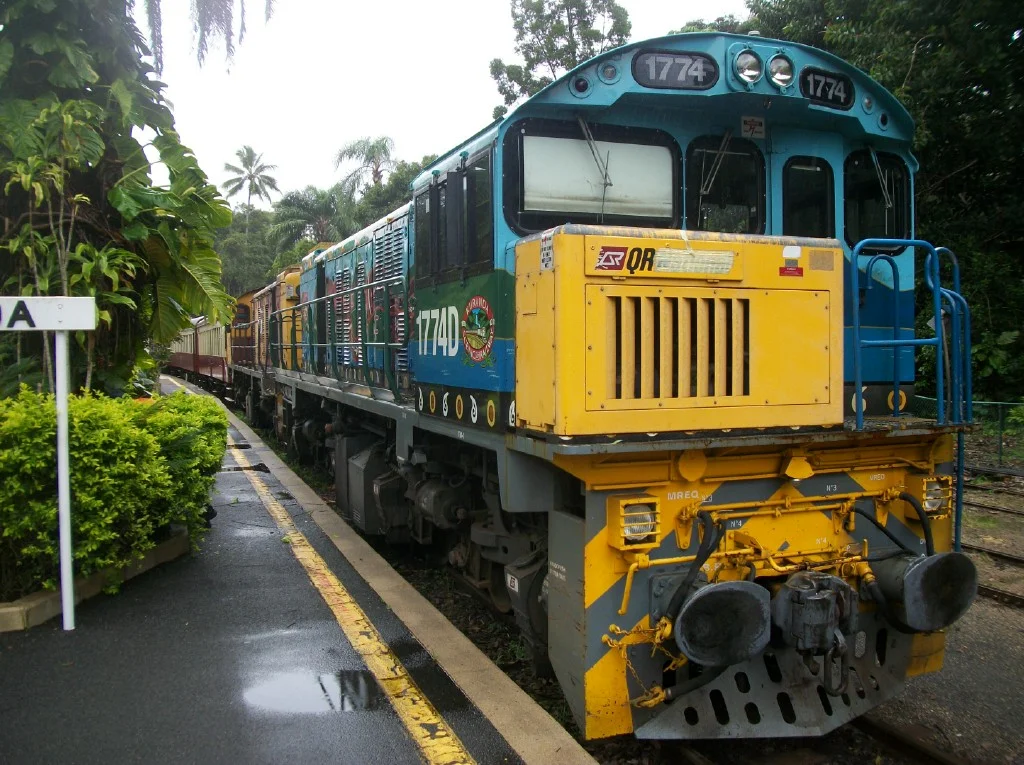
The Kuranda Scenic Railway is the reason the village exists in its modern form, and it remains one of the great railway journeys anywhere. Built to service the goldfields and tin mines of the tableland, construction began in 1887 and the line reached Kuranda in 1891. Crews carved fifteen tunnels and threw thirty-seven bridges across the gorge by hand, working on slopes so steep and unstable that the project cost lives. The graceful Kuranda railway station, draped in tropical plants, was added in 1915 and is often called the prettiest in Australia. Today two trains a day make the leisurely ninety-minute climb, 328 metres up and 34 kilometres out from Cairns, past Barron Falls and through rainforest the workers once fought through inch by inch.
A Gondola Over the Canopy
The other way up is newer and stranger: the Skyrail Rainforest Cableway, opened in 1995, which carries you in a six-person gondola high above the forest between Smithfield and Kuranda. The contrast is the whole appeal - the railway burrows through the gorge while the cableway glides over the canopy, two different ways of crossing the same World Heritage rainforest. Many visitors do exactly that, riding the train up in the morning and the Skyrail down in the afternoon (or the reverse), turning the journey itself into the main event. Both stop at Barron Falls, so the gorge's centrepiece gets seen from two angles. Kuranda, in the middle, is where the two methods meet.
Market Town in the Trees
Kuranda's markets are its beating heart, and they began with a counter-cultural impulse. In 1978 a group of local artists and craftspeople set up the Original Rainforest Markets, and the village has been a maker's town ever since. Today the markets run daily, crammed with crafts, art, food and local produce in lanes shaded by rainforest. They open at nine and most stalls close when the last train leaves, giving the village its peculiar daily rhythm of arrival, crowd and quiet. The wildlife attractions cluster at the village's northern end - the Australian Butterfly Sanctuary, opened in 1987, where huge electric-blue Ulysses butterflies drift through a rainforest aviary, and Birdworld, a family-run walk-through habitat going since 1980.
The Quiet After the Crowds
There is a Kuranda most day-trippers never see. The streets are hilly and barely a kilometre end to end, easy to walk if the crowds let you, but the place reveals itself only when the trains and gondolas stop running. The buses empty, the stalls fold up, and the village settles back into the rainforest that surrounds it on every side. The forest does not respect the tourist timetable. After dark it fills with the sounds of a Wet Tropics night - frogs, possums, the rustle of things moving in the canopy - and the village in the rainforest becomes, briefly, just a small town in an extraordinarily old forest, exactly as its name suggests.
From the Air
Kuranda sits at roughly 16.82°S, 145.64°E, perched on the edge of the Atherton Tableland about 25 km northwest of Cairns and immediately above Barron Gorge. From the air it appears as a small cleared settlement amid dense rainforest at the tableland's eastern rim, with the Barron River, the railway line and the Skyrail cableway all converging nearby. Cairns Airport (YBCS / CNS) lies about 15 km east-southeast at sea level, so the climb from coast to tableland is dramatic and quick. Cloud frequently caps the escarpment, and the wet season (roughly November-April) brings heavy rain and low visibility over the ranges; clear, calm mornings give the best views of the gorge and falls below the village.
Nearby Stories
- HMS Mermaid (1817) 17 km away
- Rocky Creek World War Two Hospital Complex 32 km away
- Mount Mulligan Mine Disaster 36 km away
- Mbabaram language 38 km away
- Nuggety Gully Water Race and Chinese Camp 67 km away
- Cyclone Yasi 113 km away
- Kapa Kapa Trail 760 km away