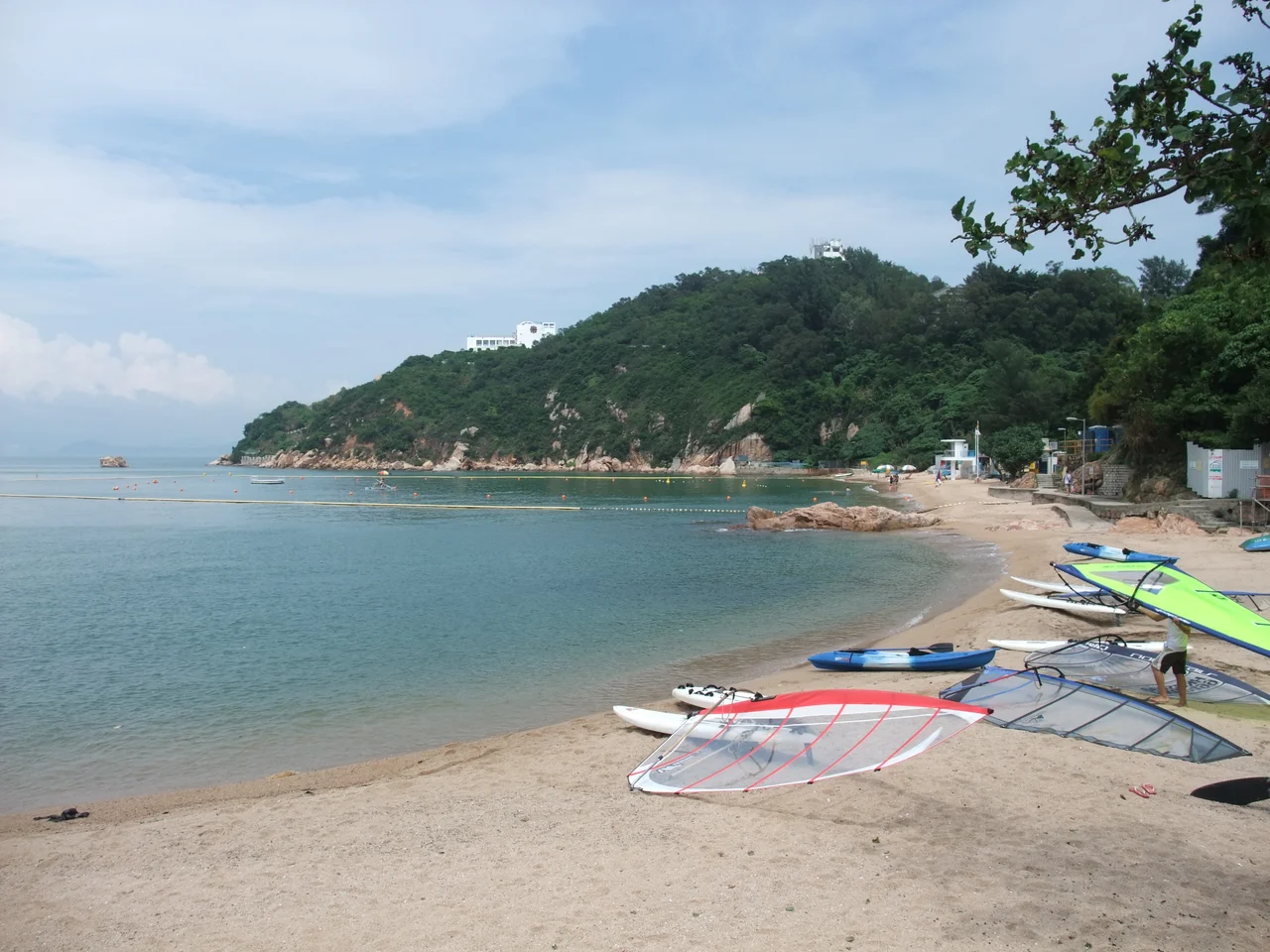

Kwun Yam Beach
On the sheltered east coast of Cheung Chau, a hundred-metre crescent of white sand takes its name not from geography but from devotion. Kwun Yam — the Goddess of Mercy, the bodhisattva Avalokiteśvara — watches over this bay, and the name has carried its quiet blessing since before the beach was ever gazetted. Most visitors know it by its other name: Afternoon Beach, so called because the eastern exposure means the sun reaches it later in the day. Come late morning, though, and the light on the water is clear and the sand is unhurried, a pocket of stillness that belongs to a different Hong Kong than the tower-packed skyline across the harbour.
A Shore Named for the Goddess of Mercy
Kwun Yam is one of the most beloved figures in Chinese religious life — the bodhisattva of compassion, known across East Asia under many names. That a small beach on a ferry-island off Hong Kong carries her name is not unusual; temples and landmarks dedicated to her dot the coastline of southern China. What is unusual is how quietly this particular strip of sand holds its distinction. The beach was gazetted in 1971, bringing it under Hong Kong's Leisure and Cultural Services Department, which has since maintained changing rooms, showers, a water sports centre, and a light refreshment kiosk along its length. At a hundred metres, it is the smaller of Cheung Chau's two official beaches — the larger Tung Wan Beach wraps around the island's western side — but what it lacks in size it compensates in calm. The Environmental Protection Department has rated the water here Grade 1, the highest quality classification for Hong Kong's gazetted beaches.
The Windsurfer Who Changed Everything
In August 1996, in the waters off Savannah, Georgia, a Hong Kong windsurfer named Lee Lai-shan crossed the finish line first and made history. She became Hong Kong's first-ever Olympic gold medallist, winning the Mistral boardsailing class in conditions that suited her aggressive, technical style. The achievement sent a wave of pride through a city that was barely a year away from handover to China, and the celebrations were enormous. Back home, Lee's connection to Cheung Chau and to Kwun Yam Beach became part of the story. The beach and its water sports centre had served as a home base for her training, and after the Games it became a tourist landmark in its own right — a place where visitors could stand at the edge of the South China Sea and feel, in some small way, proximate to that gold.
Cheung Chau's Quieter Shore
Cheung Chau is an island of contrasts. Its main village is dense and labyrinthine, its streets too narrow for cars, its harbour packed with fishing junks and tourist ferries arriving from Central Pier. But the island's east coast runs quieter. Kwun Yam Beach sits along Kwun Yam Wan — the bay that shares the goddess's name — facing open water toward the Soko Islands and beyond. On weekend afternoons, families spread out along the sand and children wade in the shallows; on weekday mornings, the beach can be almost empty. The water sports centre keeps the windsurfing tradition alive. It is the kind of beach that rewards a longer ferry journey rather than a rushed excursion, a reminder that Hong Kong's islands have their own pace, distinct from the urgency of the mainland shore.
The Island Beyond the Harbour
Getting to Kwun Yam Beach requires intention. Cheung Chau is about forty minutes by ferry from Central, reachable only by boat — no bridge, no tunnel, no MTR extension reaches it. The ferry ride itself is part of the experience: the city skyline recedes, the container ships of the western anchorage slide past, and the island's distinctive dumbbell silhouette comes into focus. Once ashore, the beach is a short walk from the ferry terminal, passing through the village's narrow lanes. Hire a bicycle at the pier, and the east coast road opens up in minutes. The island has no motor vehicles registered to non-residents, so the roads are quiet. At the beach, the South China Sea stretches eastward without interruption. Kwun Yam presides somewhere above it all, the goddess of compassion looking seaward, as she has for as long as anyone has thought to name a shore in her honor.
From the Air
Kwun Yam Beach sits at 22.207°N, 114.034°E on the east coast of Cheung Chau island, roughly 25 km southwest of Kowloon. From the air, Cheung Chau's distinctive dumbbell shape — two headlands joined by a narrow isthmus — is easy to identify. The beach is on the eastern (left) side of the island when approaching from the north. The nearest major airport is Hong Kong International Airport (VHHH) on Lantau Island, approximately 17 km to the northwest. A recommended viewing altitude of 1,500–3,000 feet gives a clear perspective of the island's layout and the surrounding Pearl River Estuary waters.
Nearby Stories
- Lok Ma Chau Loop 2.3 km away
- Portas do Cerco 2.3 km away
- Kweilin Incident 17 km away
- Wanshan Archipelago Campaign 34 km away
- Nanxiong Formation 115 km away
- Battle of Nanpeng Island 148 km away
- Heyuan 169 km away
- Cape Maobitou 632 km away