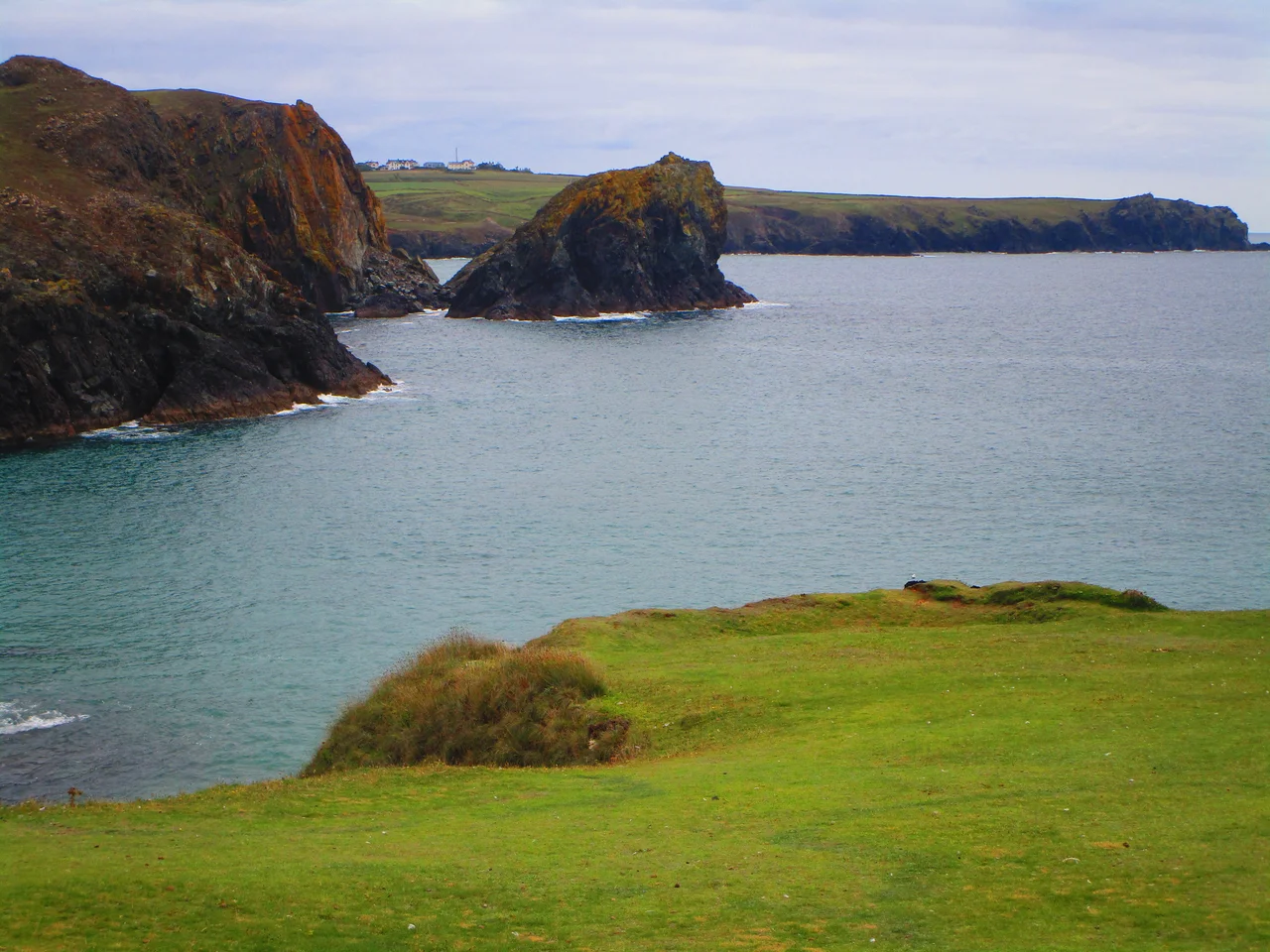

Kynance Cove
The name comes from Cornish: kynans, the foot of a steep-sided valley. Step over the cliff edge above Kynance and the name makes itself plain. Below, a green-and-cream chasm opens onto a horseshoe of pale sand, four serpentine stacks rising from it like the broken vertebrae of some Devonian beast. The water between them is impossibly turquoise. Queen Victoria and Prince Albert came here. So did Tennyson and Swinburne. The BBC has called it one of the most beautiful stretches of coastline in the South West. None of them mention the smell of the sea, but you remember it.
A Beach With a Geological CV
About 375 million years ago, the rock that would become Kynance was sitting roughly 10 km below the Earth's surface, baking under heat and pressure that turned a magnesium- and iron-rich rock called peridotite into something stranger: serpentinite. It surfaced as part of an ocean ridge 30 degrees south of the equator, then began a slow drift northward across the Rheic Ocean. About 250 million years ago the rock crossed the equator. Less than 100 million years ago it cleared the Tropic of Cancer. By the start of the last Ice Age, it had reached 50 degrees north and stopped, and visitors began walking on it. Kynance's particular trick is that it has two kinds of serpentine on display side by side. The coarse, flecked stuff under your boots near the car park is bastite. The fine, banded rock in the stacks themselves - The Bishop, Gull Rock, Asparagus Island, Steeple Rock - is tremolite, squeezed at higher pressure deeper in the crust. Geologists come to Kynance the way pilgrims used to come to Lourdes.
The Devil's Bellows
Asparagus Island is the largest of the stacks and the noisiest. At about half tide, if the swell is right, a hole on its flank starts to breathe. The sea has tunnelled along a fault deep inside the rock, and as waves slap into one end of the tunnel air punches out the other in a low, snorting roar. Locals call it the Devil's Bellows. For a long time people assumed the island was once joined to the mainland by a sand bridge, a tombolo washed away by storms. The actual answer is older and odder: when the sand is stripped back by a winter gale, a rocky ridge appears that has probably been there for more than 100,000 years, dating from a time when sea levels stood higher and the bridge was the seabed. Walk out to the island at low tide and you are walking over a piece of paleo-coastline.
Royal Visits, Rare Moths
Kynance came into vogue in the early Victorian era as part of a wider passion for the picturesque - cliffs, light, weather, the works. Alfred Tennyson made the journey. Algernon Swinburne came down to write. Queen Victoria and Prince Albert visited too, lending the cove the cachet that turned it into one of Cornwall's first celebrity beaches. The wildlife list reads less famously but more strangely. In 2008, Kynance was among the sites recording Porter's rustic, Athetis hospes, during a major influx of the species — a migrant moth from southern Europe first noted in Britain in Cornwall in 1978 but rarely seen since. The cove tends to attract things that travel a long way to arrive.
Hollywood on the Lizard
If the turquoise water and dragon-tooth stacks feel cinematic, that is because they keep ending up on screens. Kynance has stood in for Ross Poldark's Nampara in the 2015 Poldark series, for an island in the 2015 production of Agatha Christie's And Then There Were None, and for the Devil's Foot in the 1980s Sherlock Holmes adaptation. HBO used the cove as a Velaryon camp across seasons 1 and 2 of House of the Dragon. Filming for the new Harry Potter television series came here in 2025. And anyone watching Star Wars: The Last Jedi has seen Kynance: additional shots for the planet Ahch-To were filmed against these cliffs. The place is so unmistakably itself that filmmakers keep using it to play somewhere else.
From the Air
Kynance Cove is at 49.974 degrees north, 5.23 degrees west, on the west side of the Lizard Peninsula about 3 km north of Lizard Point. From the air the cove is a small bright-sand horseshoe with four dark serpentine stacks just offshore. Nearest commercial airport is Newquay (EGHQ), 65 km north. RNAS Culdrose (EGDR, military) is 13 km northeast; expect helicopter traffic. Best viewed 1,500 to 3,500 feet in clear conditions; the colour of the water carries furthest mid-morning with the sun behind you.
Nearby Stories
- Logan Rock 3.6 km away
- Polperro 7.4 km away
- Great Wheal Charlotte 10 km away
- Battle of Plymouth (1652) 26 km away
- SS Irma (1905) 30 km away
- Black Swan Project 75 km away
- HMS Affray 77 km away
- 1979 Fastnet Race 100 km away