
Kypseli
In the 1960s, to live in Kypseli was to have arrived. The cafes along Fokionos Negri buzzed until late, theaters and cinemas crowded the side streets, and the apartment buildings going up here were the most fashionable in Athens - clean Bauhaus lines and Art Deco curves that announced you belonged to the new urban middle class. Walk those same streets now and the story is more tangled. The grand facades are still there, some immaculate and some peeling, and the neighborhood that was once Athens's showpiece has lived several lives in a single century.
From Country Estates to Apartment Blocks
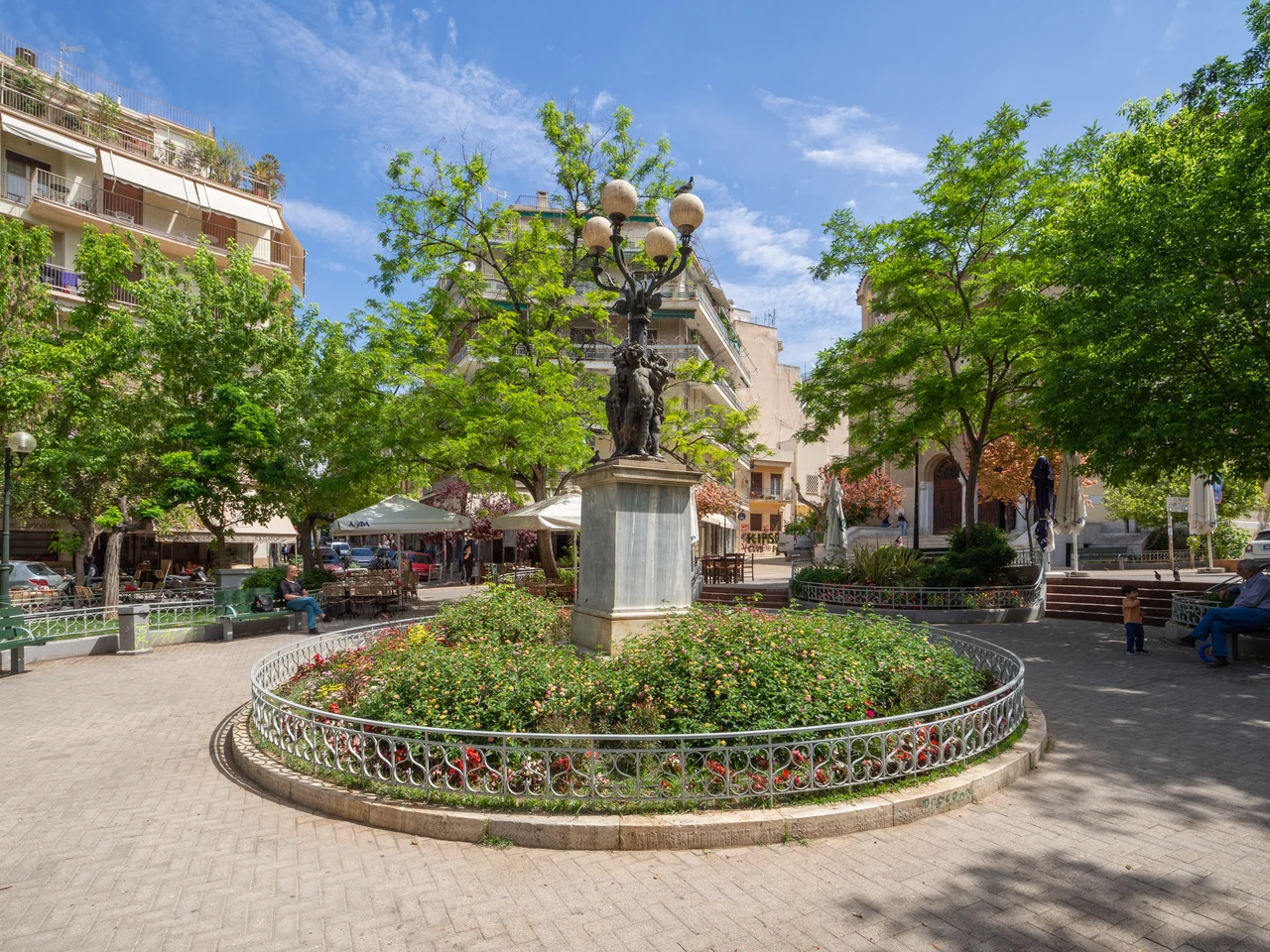
Kypseli began as open country. Until 1908, when the engineer Athanasios Georgiadis first surveyed and platted it, this was a rural fringe of estates and country houses east of Patission Street. One of those houses belonged to Konstantinos Kanaris, the fire-ship captain of the Greek War of Independence who later served as prime minister; he lived and died here, and a statue of him still stands in Kypselis Square. The transformation came fast in the 1930s. Family homes and the first modern apartment buildings in Athens rose side by side, and the neighborhood urbanized in step with elegant Kolonaki. Green spaces - the great Pedion Areos park to the south, the leafy run of Fokionos Negri - made it desirable, and the middle and upper-middle classes moved in.
The Architecture of Ambition
Kypseli is, quietly, a museum of twentieth-century Greek architecture. The earliest houses wore neoclassical and eclectic dress, but from the 1930s the city's appetite turned international - modernism, the Bauhaus, Art Deco. Architects built tall for the era, apartment blocks of large units rarely topping six storeys, their balconies stacked like drawers. In 1937 the dictator Ioannis Metaxas inaugurated the neighborhood's municipal market on Fokionos Negri, designed by Alexandros Metaxas, and the ground-floor shops turned the street into a destination. Names like the Lanaras condominium of 1938 and the artist couple Tonis and Ioanna Spiteris's 1955 home and atelier still punctuate the blocks - a built record of a city imagining its modern self.
Decline and Reinvention
Fashion moved on. Beginning in the 1980s, many longtime residents decamped for the greener northern suburbs, and the elegant buildings began to empty. In the decades that followed, immigrants arriving in Athens settled into the basements and smaller flats, drawn by cheap rents in a central location, and Kypseli became one of the city's most genuinely multinational quarters. Real estate values slid even as the bones of the place stayed handsome - the better apartments along Fokionos Negri still command a premium. The neighborhood that the postwar middle class had abandoned became, by accident, a crossroads where Athens's older grandeur and its newer arrivals share the same staircases.
Life Along Fokionos Negri
The heart of it all is still that one pedestrianized street. Fokionos Negri runs like a green spine through the district, a promenade lined with cafes and shaded by trees, where the rhythms of neighborhood life play out as they have for generations - the morning coffee, the evening stroll, children spilling into the linear park down its middle. Kypseli holds onto its institutions too, among them the athletic club Panellinios, founded back in 1891. The neighborhood is dense, layered, and unpolished, roughly 100,000 people packed into the sixth municipal district. It is not the manicured Athens of postcards. It is something more interesting: a real place, mid-reinvention, wearing all its eras at once.
From the Air
Kypseli sits in central Athens just northeast of the city core, centered around 38.000°N, 23.739°E. It is bounded by Patission Street to the west, the Tourkovounia hills to the east, Galatsi to the north, and the green expanse of Pedion Areos park to the south - the park being the clearest landmark from the air, a notable patch of green in the dense urban grid. The Acropolis lies a couple of kilometers southwest for orientation. Athens International Airport (LGAV) is about 30 km east-southeast. The tightly packed apartment blocks read best in raking morning or late-afternoon light, when the balconied facades cast long shadows across the narrow streets.
Nearby Stories
- Great Sand Beach 5 km away
- Battle of Delium 7.7 km away
- Tower of Aliartos 9 km away
- HMHS Britannic 10 km away
- Saronic Gulf 15 km away
- Sousaki Volcano 17 km away
- Sanctuary of Apollo Maleatas 24 km away
- Skyros 66 km away