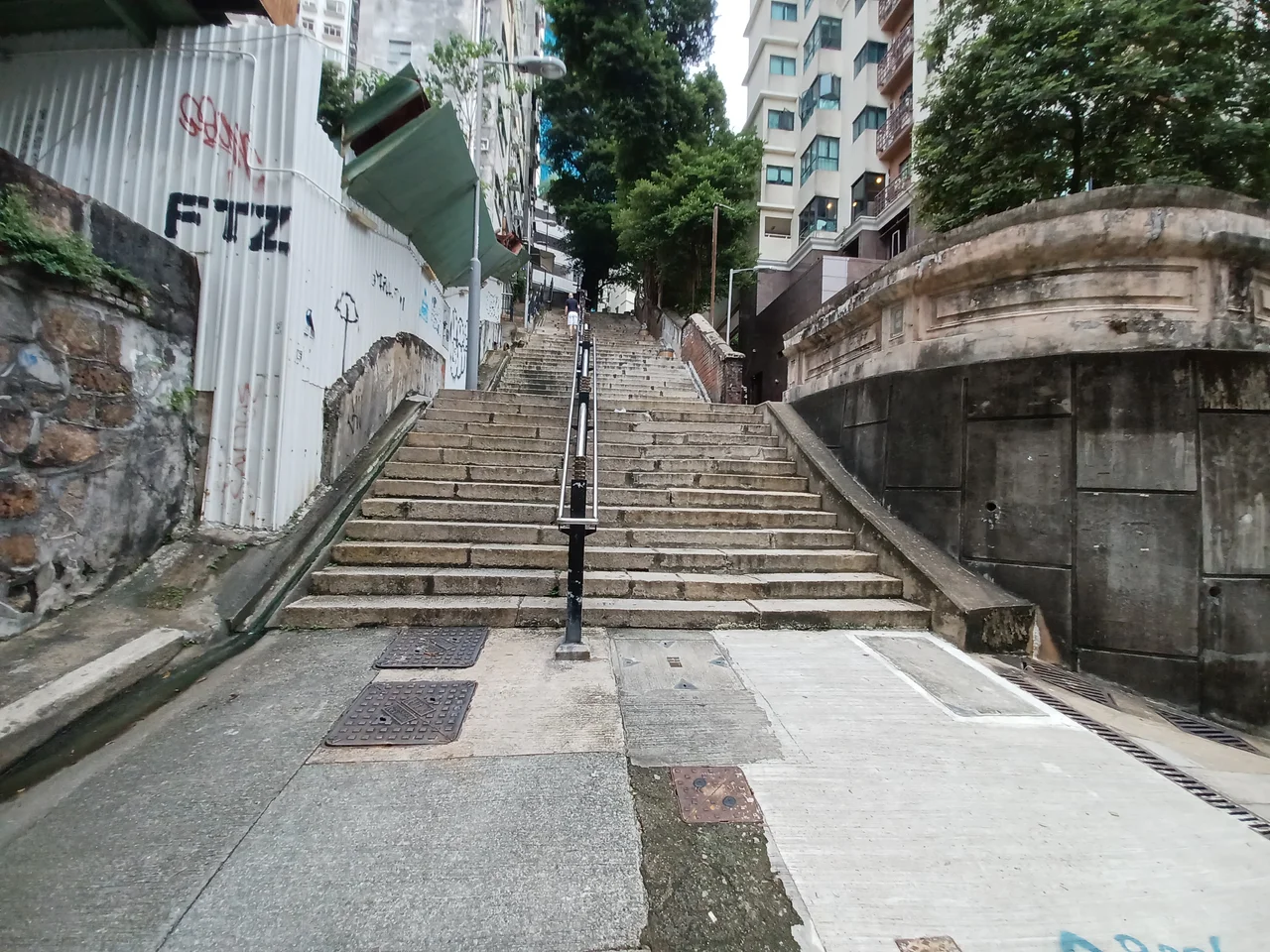

Ladder Street
The name describes exactly what it is, and that directness is part of the appeal. Ladder Street rises in a straight vertical line through Sheung Wan, granite slab by granite slab, like a ladder laid against the Hong Kong hillside. Where other streets in the Central and Western District twist and negotiate with the terrain, Ladder Street simply climbs — no switchbacks, no compromise. It was built that way between 1841 and 1850, in the first decade of British Hong Kong, when the new colonial administration needed to move goods and people up from the waterfront to the residential terraces forming above. The name first appeared on a plan of Victoria dated 1856, and it has not changed since. Nearly two centuries later, neither has the street's fundamental nature.
Granite and Rainwater
The street is made of granite slabs mixed with concrete paving — the granite the original colonial builders quarried from Hong Kong's own hillsides, the concrete the pragmatic additions of later eras. Metal railings run down the centre, a concession to the steepness. Open drainage channels flank both sides, carrying away the torrential rain that Hong Kong's typhoon seasons deliver. Old sections of stone retaining walls line the edges, their moss-darkened faces a calendar of the city's growth. There is nothing decorative about any of this engineering; it is infrastructure built to last, and it has lasted. In recognition of that, Hong Kong's Antiquities Advisory Board has graded Ladder Street a Grade I historic building — the highest classification, applied to structures of outstanding merit. A plan once circulated to install an escalator alongside it, echoing the famous Central-Mid-Levels escalator a few blocks away, but the proposal was eventually scrapped over heritage concerns.
Hollywood Road and the Neighborhood Above
About halfway up, Ladder Street crosses Hollywood Road — not the Californian boulevard, but its Hong Kong namesake, named for the holly trees that once grew on these slopes before the British cleared them for settlement. Hollywood Road is famous today for its antique shops, its galleries, and the Man Mo Temple that anchors its eastern end. The crossing of these two historic streets is a node of old Hong Kong: the Chinese YMCA of Hong Kong's Bridges Street Centre stands at the corner of Bridges Street and Ladder Street nearby, a reminder that the neighborhood above the waterfront has always been a place where different communities overlapped. Climb higher and the residential lanes multiply, the city growing quieter and more domestic with each step.
The World of Suzie Wong and After
Ladder Street appeared on screen in 1960, in the film adaptation of Richard Mason's novel The World of Suzie Wong. The story centers on a Hong Kong bar girl and an American artist, and the film used the city's actual streets as backdrop — Ladder Street among them, its stepped profile giving the cinematography an unmistakably Hong Kong texture. Decades later, in 2004, a Hong Kong independent director named Chun-Yue Lam chose Ladder Street as a central location and metaphor in The Cat of Hollywood, a suspense film in which the street's relentless descent became an image for decline. Two very different films, two very different eras, the same stone steps. That a stairway should carry this kind of symbolic weight says something about how deeply Ladder Street is embedded in the city's imagination.
Climbing It Today
Ladder Street is not a tourist attraction in the formal sense — there is no ticket, no sign marking it as a destination, no audio guide at the bottom. It is a street, still used by residents of Sheung Wan and the Mid-Levels as a shortcut between the lower city and the hillside neighborhoods above. Schoolchildren descend it in the morning, elderly residents carry groceries up it in the afternoon, and the occasional visitor stops to rest and look back down over the rooftops toward the harbor. Halfway up, at the Hollywood Road junction, antique dealers spill their wares onto the pavement and tourists browse jade pieces and ceramic figurines. The street asks only that you climb. At the top, a different Hong Kong waits — quieter, greener, further from the ferry piers and the financial district, closer to the original contours of the hill.
From the Air
Ladder Street sits at 22.284°N, 114.150°E in the Sheung Wan and Central districts of Hong Kong Island. From the air, it is visible as a thin vertical line cut into the hillside just west of the Central business district's high-rise cluster. The peak of Hong Kong Island (Victoria Peak, 552 m) is approximately 2 km to the southwest. Hong Kong International Airport (VHHH) is about 30 km to the west-northwest on Lantau Island. A viewing altitude of 2,000–4,000 feet provides a clear perspective of the island's steep north-facing topography and the dense urban grid below.
Nearby Stories
- Lok Ma Chau Loop 2.3 km away
- Portas do Cerco 2.3 km away
- Kweilin Incident 17 km away
- Wanshan Archipelago Campaign 34 km away
- Nanxiong Formation 115 km away
- Battle of Nanpeng Island 148 km away
- Heyuan 169 km away
- Cape Maobitou 632 km away