
Lamma Winds
It calls itself a wind farm. There is only one turbine. The gap between name and reality sits at the centre of the Lamma Winds story — a single Nordex rotor planted on a hillside in Tai Ling, turning above one of Hong Kong's largest coal-fired power stations, generating enough electricity for perhaps 250 households on a good day. It was never meant to solve the territory's energy needs. When Hongkong Electric commissioned it in 2006, the turbine was a statement as much as a generator: proof of concept, public symbol, the first commercial-scale wind installation in a city that had not previously considered wind power worth pursuing. The blades are 25 metres long, the tower rises above the southern shore of Lamma Island, and on a clear day it is visible from the Pearl River Estuary.
The First Turbine in the Territory
Lamma Winds began operating on 23 February 2006, making it the first commercial-scale wind turbine in Hong Kong. The machine is a Nordex N50 model, a German design rated at 800 kilowatts with a rotor diameter of 50 metres. In practice, it operates at a capacity factor of about 13 percent — meaning it produces roughly 13 percent of its theoretical maximum output on average, given the actual wind conditions at the site. That works out to slightly over 100 kilowatts of continuous average power delivered to Hong Kong Island and Lamma Island through the Hongkong Electric grid. The average wind velocity at the site is 5.5 metres per second — sufficient to keep the blades turning, but not exceptional. Before construction, Environmental Resources Management of Hong Kong assessed the environmental impacts and found no significant adverse effects predicted.
Standing Beside the Coal
The location is not subtle. Lamma Winds was built near the Lamma Power Station, one of Hong Kong's main power generation facilities — a conventional plant burning coal and gas to produce far more electricity than the turbine beside it ever could. The juxtaposition is stark from the hillside: the cooling towers and stacks of the power station in the middle distance, the single wind turbine in the foreground, the harbour and Hong Kong Island across the water. Hongkong Electric owns both. The company's decision to site the turbine alongside its conventional plant rather than separately makes the comparison unavoidable. Whether that adjacency is a commitment to transition or a demonstration of how far the territory has to go — probably both, simultaneously — is a question the landscape poses without answering.
Open to the Public — Until 2026
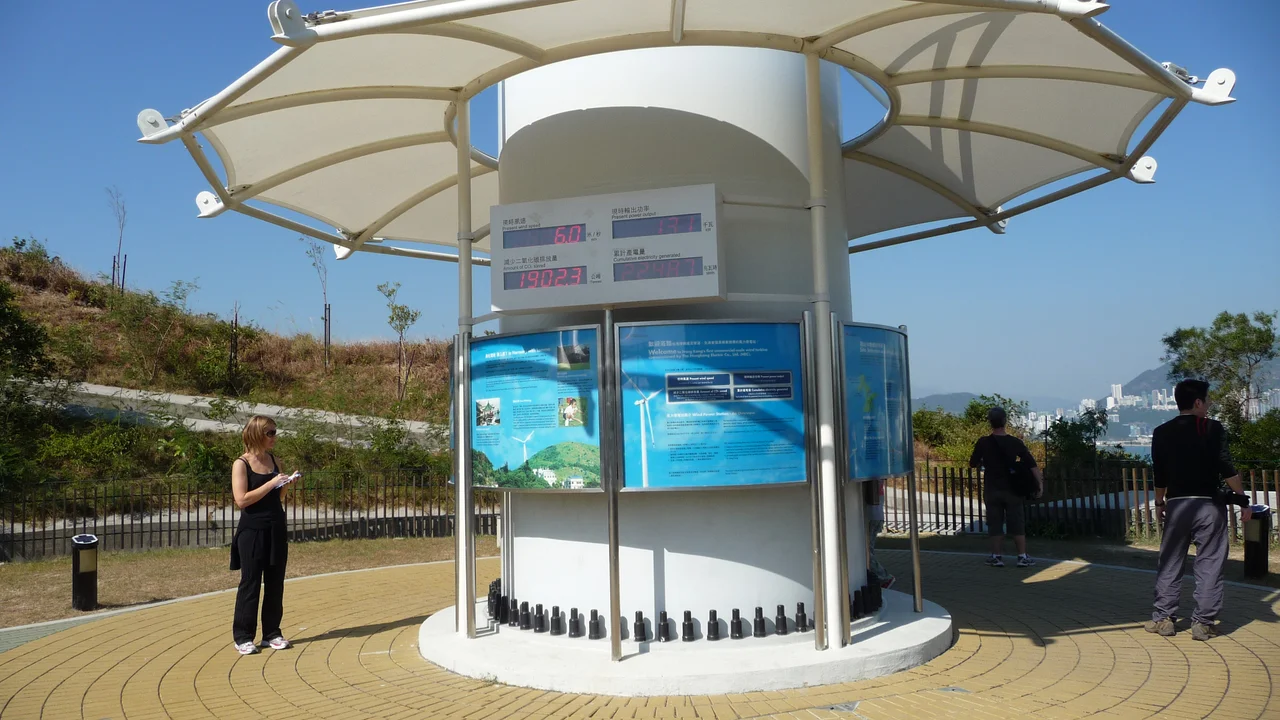
For nearly two decades, Lamma Winds was one of a small number of commercial-scale wind turbines worldwide that welcomed visitors. An exhibition centre was built around the base of the turbine, open daily from 7 AM to 6 PM including weekends and public holidays. The centre explained wind energy, the turbine's mechanics, and Hongkong Electric's renewable energy activities. Getting there was part of the appeal: with no road access, visitors arrived on foot. The walk from Yung Shue Wan Ferry Pier — the main pier for the western, more residential part of Lamma Island — took approximately 40 minutes through the island's interior, past hillside villages and across terrain that gave a sense of Lamma's geography before the turbine came into view. On 11 May 2026, after exactly twenty years of operation, Hongkong Electric permanently shut down the turbine, citing the end of its design lifespan and the unavailability of replacement parts. Decommissioning and dismantling works were announced to follow.
Lamma Island's Longer Story
Lamma Island sits southwest of Hong Kong Island, a rural outlier in a territory famous for density. Its two main villages — Yung Shue Wan to the northwest and Sok Kwu Wan to the east — are reached only by ferry, and the island's lack of private motor vehicles gives it a pace that Hong Kong's urban districts do not offer. Hikers, expats, and weekday escapees from the city fill the trails that connect the villages and wind past the turbine. The Lamma Power Station, visible from the southern shore, anchors the island to the city's energy infrastructure in a way that might seem incongruous but is simply honest: even rural-feeling places in Hong Kong are not disconnected from the systems that power the city. The single turbine turning above it all is a footnote to that story, or perhaps a question mark — a small, steady gesture toward a different kind of future, still very much outnumbered by what surrounds it.
From the Air
Lamma Winds stands at approximately 22.225°N, 114.121°E on the southern hillside of Lamma Island, close to the Lamma Power Station. From the air, Lamma Island is clearly identifiable southwest of Hong Kong Island, separated from it by the Lamma Channel. The turbine and power station are located on the island's eastern side, facing south toward the open South China Sea. Hong Kong International Airport (VHHH) is approximately 20 km to the northwest on Lantau Island. The turbine's 50-metre rotor is visible from low altitudes; recommended viewing altitude is 1,500–3,000 feet for a clear perspective on the turbine's relationship to the adjacent power station and the island's topography.
Nearby Stories
- Lok Ma Chau Loop 2.3 km away
- Portas do Cerco 2.3 km away
- Kweilin Incident 17 km away
- Wanshan Archipelago Campaign 34 km away
- Nanxiong Formation 115 km away
- Battle of Nanpeng Island 148 km away
- Heyuan 169 km away
- Cape Maobitou 632 km away