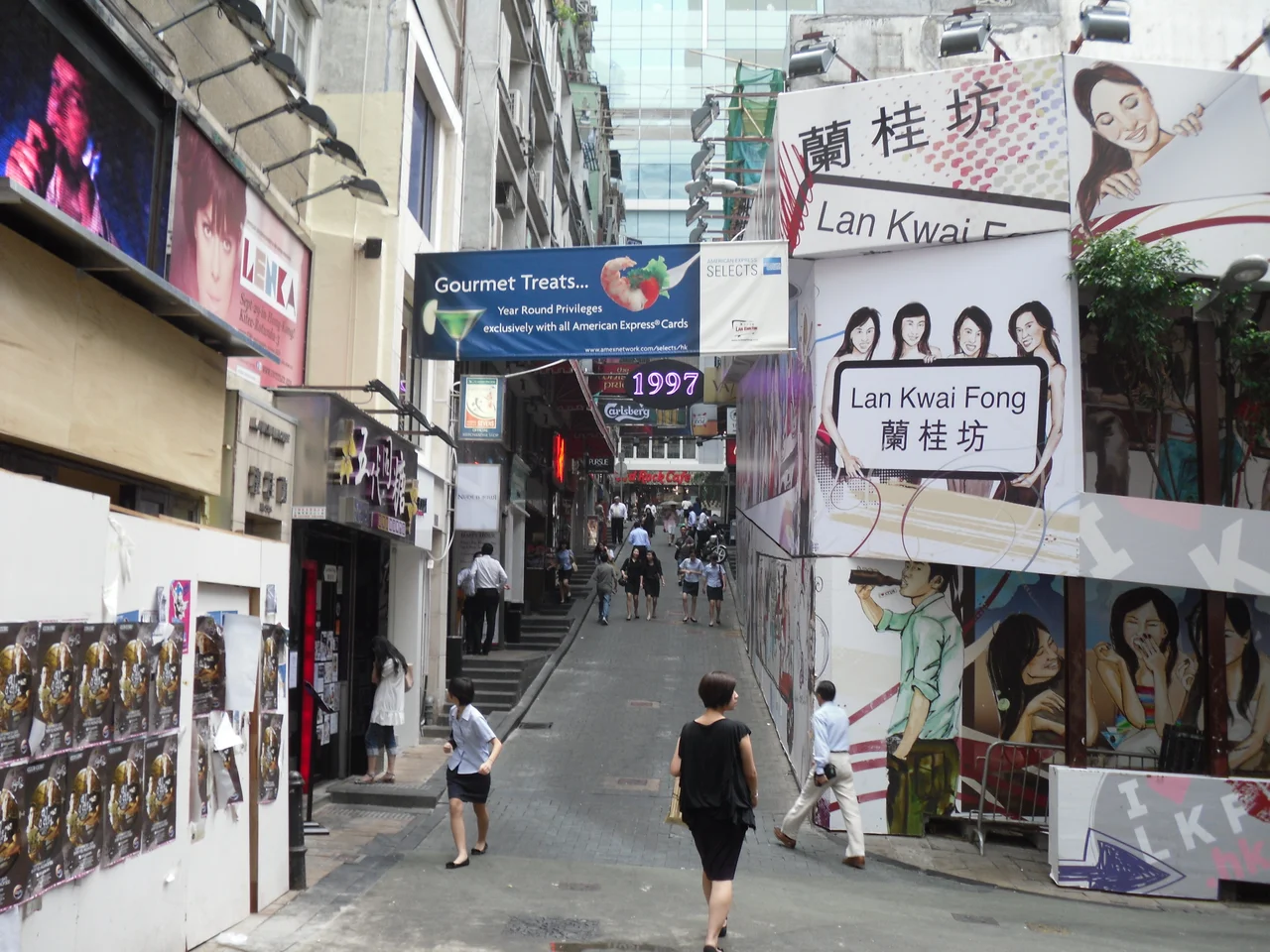

Lan Kwai Fong
Before the cocktails and the bass lines, before the bars stacked three floors high and the crowds spilling into D'Aguilar Street on a Friday night, Lan Kwai Fong was a place where women arranged marriages. The narrow L-shaped alley in Central was known as Matchmaker Lane — *mui yan haang* — lined with the offices of traditional Chinese female matchmakers who brokered unions for Hong Kong families throughout the 19th century. The name Lan Kwai Fong, meaning something closer to 'orchid osmanthus fragrance alley,' replaced it eventually. But the street's talent for bringing people together never really left.
From Hawkers to Disco Lights
For most of the 20th century, LKF — as locals abbreviate it — was a working-class stretch given over to street hawkers. The transformation began on 23 December 1978, when a nightclub called Disco Disco opened in the basement of 40 D'Aguilar Street, founded by Gordon Huthart. For nearly a decade, it drew an international crowd: celebrities, diplomats, expats working the trading desks of colonial Hong Kong, all descending into a basement to dance. It closed in 1986, but by then something irreversible had happened to the neighborhood.
Allan Zeman, a Montreal-raised businessman, arrived in 1983 with an idea borrowed from Crescent Street back home: a gathering place where expats could feel at ease. He opened a restaurant called 'California' and never really stopped building. Over the following decades, Zeman assembled a constellation of bars, clubs, and restaurants across the lanes until he'd earned a nickname that stuck: 'The Father of Lan Kwai Fong.' Today the area extends well beyond its original alley, stretching toward Wellington Street, Wyndham Street, and the Hong Kong Fringe Club.
The Night the Crowd Became a Crush
New Year's Eve 1992 drew more than 15,000 people into a space that could never safely hold them. The lanes of Lan Kwai Fong filled with revellers counting down to 1993, pressed tighter and tighter as midnight approached. When the crowd surged, there was nowhere for anyone to go.
On 1 January 1993, 21 people died and 62 were injured in the crush. They were young people — workers, students, partygoers — who had come to celebrate and never made it home. The Hong Kong government appointed Court of First Instance judge Kemal Bokhary to conduct a formal inquest. His recommendations reshaped how the city manages large outdoor gatherings: the strict crowd-control protocols now in force at public holidays and major events across Hong Kong trace directly back to what happened in that alley on New Year's morning. The joy of the night is remembered; so are the people who were lost in it.
What LKF Is Now
Walk through Lan Kwai Fong on a Wednesday evening and it feels compact, almost quiet by local standards — a cluster of bars and restaurants compressed into lanes barely wide enough for two people to pass comfortably. Come Friday night and the scale shifts entirely. The crowd moves as a single organism, drinks in hand, voices raised above the music leaking from every open door.
The area has diversified over the decades. A small number of art galleries occupy the upper floors alongside the clubs. Wo On Lane and Wing Wah Lane extend the district northeastward. It is no longer solely an expat enclave — it draws Hong Kong locals, tourists, and international visitors in roughly equal measure. The streets close to traffic on big nights; the narrow geometry that made the 1993 disaster possible now means every large event is managed with a care that was absent then.
A Street With Several Identities
Lan Kwai Fong carries three centuries of names. Matchmaker Lane. The site of Hong Kong's most famous night out. A place of grief. The street does not resolve these identities — it holds them simultaneously, the way old cities tend to. You can stand at the junction of D'Aguilar Street and Lan Kwai Fong and see the plaque that marks where the crowd crushed; you can also see the bar that opened in the space two doors down, still busy on any given evening.
The name itself — 蘭桂坊 — has become a brand. Allan Zeman's Lan Kwai Fong Group operates venues across Asia. The district has inspired entertainment complexes in Shanghai and other Chinese cities that borrow its name as shorthand for a certain kind of urban nightlife. Central Hong Kong has expanded enormously around it, but the original L-shaped alley, less than 200 metres long, remains the core: small, dense, and improbably consequential.
From the Air
Lan Kwai Fong sits at approximately 22.281°N, 114.156°E in the Central district of Hong Kong Island, roughly 300 metres uphill from the waterfront. At cruising altitude, the dense high-rise grid of Central is the dominant feature below; the island's steep green ridgeline rises immediately to the south. Hong Kong International Airport (VHHH) is approximately 30 km to the west on Lantau Island, accessible via the Lantau Link bridges. Approach from the east over Victoria Harbour offers the clearest view of the Central skyline. Recommended viewing altitude: 2,000–4,000 feet for the urban context; lower passes are restricted by terrain and controlled airspace around VHHH.
Nearby Stories
- Lok Ma Chau Loop 2.3 km away
- Portas do Cerco 2.3 km away
- Kweilin Incident 17 km away
- Wanshan Archipelago Campaign 34 km away
- Nanxiong Formation 115 km away
- Battle of Nanpeng Island 148 km away
- Heyuan 169 km away
- Cape Maobitou 632 km away