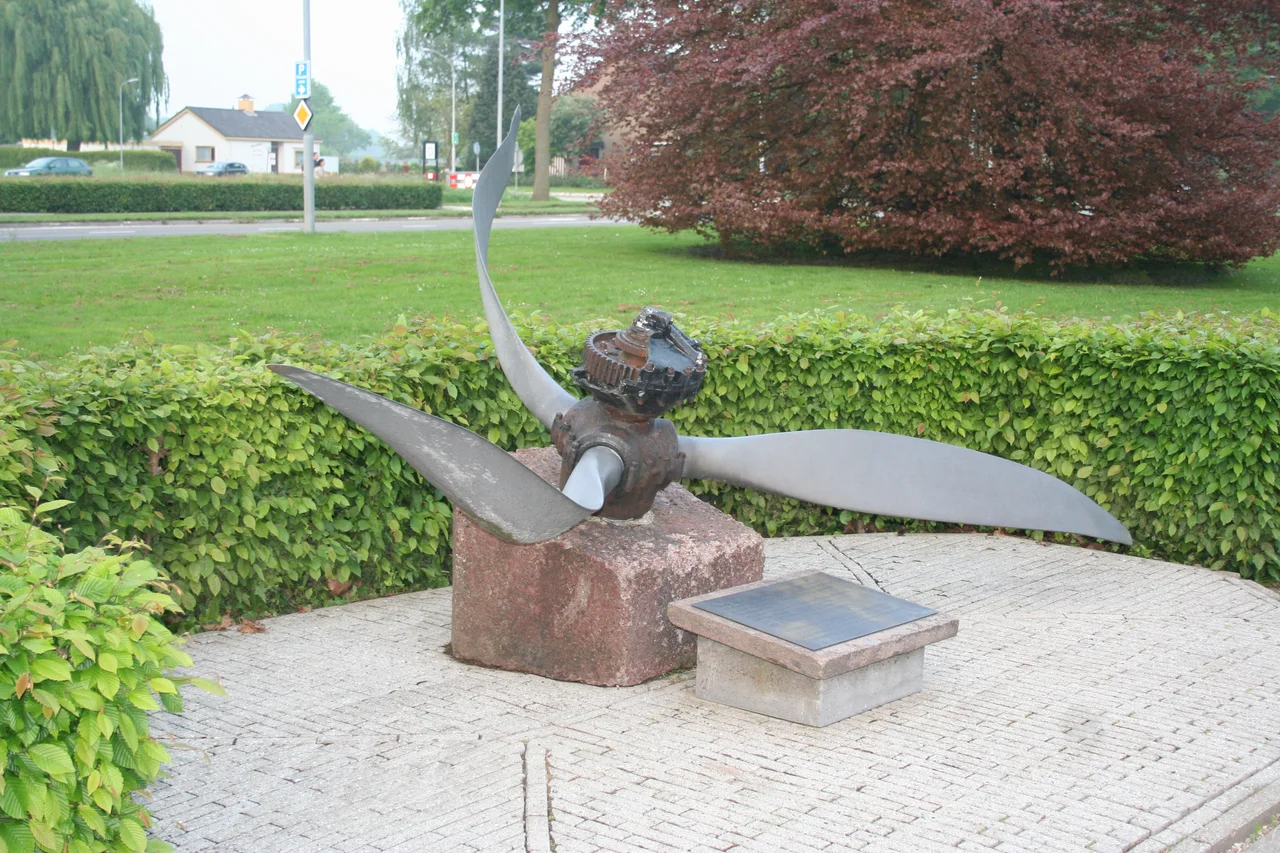

Lancaster Memorial (Netherlands)
At 1:38 in the morning on 23 June 1943, a Lancaster bomber on its way home from a raid on the Ruhr was intercepted in the moonlight above the Dutch village of Beuningen. A Messerschmitt night fighter from the airfield at Gilze-Rijen hit it with cannon fire and it caught fire immediately. The aircraft did not crash at once. For seven minutes the burning Lancaster circled the village, low enough for villagers to come outside and watch, and in those seven minutes the crew did something extraordinary: they dropped their bomb load into the empty fields around Beuningen, so that whatever happened next would not happen to a village full of sleeping families. At 1:45 the plane went into the ground beside the De Steeg road. Six of the seven men on board were killed.
Seven Men From Lincolnshire
They had taken off from RAF Ludford Magna in Lincolnshire that evening, part of a stream of 557 bombers heading for the city of Mülheim in the Ruhr. The crew of Lancaster LM325, call sign SR-J of No. 101 Squadron RAF, was young. Sgt. Roy Waterhouse, the pilot, was twenty. Sgt. Ron Cooper, the mid-upper gunner, was twenty. Sgt. Jack Osborne, the flight engineer, and Sgt. Vin Sugden, the rear gunner, were both twenty-one. Sgt. Ted Smith, the wireless operator, was twenty-two. Flight Officer Beavan Tomkins, the navigator and the oldest man on board, was thirty. The bomb aimer was Sgt. Ted Williams. Mülheim was burning when they turned for home. About two-thirds of the city was destroyed in the raid. The Lancaster crossed the Dutch coast and then ran into Werner Baake, a Luftwaffe night-fighter pilot who would shoot down two more bombers before the night was over.
The Bomb Aimer Who Lived
Ted Williams survived because of where he was lying. The bomb aimer's position in a Lancaster is in the glazed nose, prone, with the escape hatch directly underneath. When the fire took hold he dropped through the hatch and pulled his ripcord. He fainted on the way down. The wind from the west carried him east toward Nijmegen, and he came to in a garden in Heesch. The owner of the house took him in. A local doctor came and treated him for cuts and burns. The Germans soon learned an Allied airman had landed in the neighborhood, and Williams was arrested and sent to Stalag Luft VI, a prisoner-of-war camp on the old Polish-Lithuanian frontier. He stayed there until the war ended. Beavan Tomkins, the navigator, also got out of the plane and pulled his chute, but he did not survive the jump. He was found dead in Heesch. He and his five comrades are buried together in Uden War Cemetery.
The Coincidence in Mallorca
Williams survived but never escaped what had happened to him. He could not understand why, of seven men, only he had walked out of that field. In 1950 he came back to Beuningen for the unveiling of a memorial in the park beside the town hall, with the propeller of his Lancaster set into the monument. Ten relatives of his dead comrades were there. After the ceremony Williams went home and intended never to return. Then, thirty-one years later, on a vacation in Mallorca, he struck up a conversation with another tourist and discovered the man was from Heesch, the village where he had landed. The man's family doctor, it turned out, had been the same doctor who treated Williams's burns in 1943. They became close friends, and in 1983, after four decades, Williams went back. He saw the doctor again, and the owner of the house with the garden, and he visited the field where his crew had died. Ted Williams died in 2004.
A Black Cross, a Propeller, and a Circle of Stones
In 1946, a year after the war ended, villagers put up a simple black cross near the place where the Lancaster came down. Every 4 May, for the Dutch national Remembrance of the Dead, people walked in silence from the town hall to the cross. After the 1950 memorial was unveiled in the park, with the surviving propeller set into it, the silent march had a permanent destination. The black cross stayed up as a small marker. In 2014 the local Scouting branch adopted the memorial and now keeps it tidy through the year. In 2016 the Scouts and townspeople went further and built a proper monument at the crash site itself: a bluestone base with a tablet showing an impression, based on an eyewitness account, of the burning aircraft and a single parachutist drifting away from it. The names and photographs of the seven men are on the tablet. The pedestal stands inside a circle of cobblestones with gravel in the middle, a Scouting symbol for End of Trail, and also for death.
From the Air
Coordinates 51.846°N, 5.754°E, in the park beside the town hall of Beuningen, about eight kilometers west of Nijmegen on the south bank of the Waal. The crash site itself is south of the village center along the De Steeg road toward Wijchen. From the air the village is a compact cluster between the river and the A73 motorway, with open fields stretching south. Nijmegen is the closest landmark, with its broad Waal bridges. Eindhoven Airport (EHEH) is about 50 km southwest; the historic Luftwaffe airfield at Gilze-Rijen (EHGR), from which the night fighter took off, lies roughly 60 km west. Quiet morning passes show the village best.
Nearby Stories
- Beverweerd Castle 1.6 km away
- Ammersoyen Castle 3.5 km away
- Hoge Veluwe National Park 5.8 km away
- Ysselsteyn German War Cemetery 7.6 km away
- Haldern Pop 11 km away
- Berkelland 16 km away
- Baarle-Nassau 24 km away
- Kunstmuseen Krefeld 25 km away