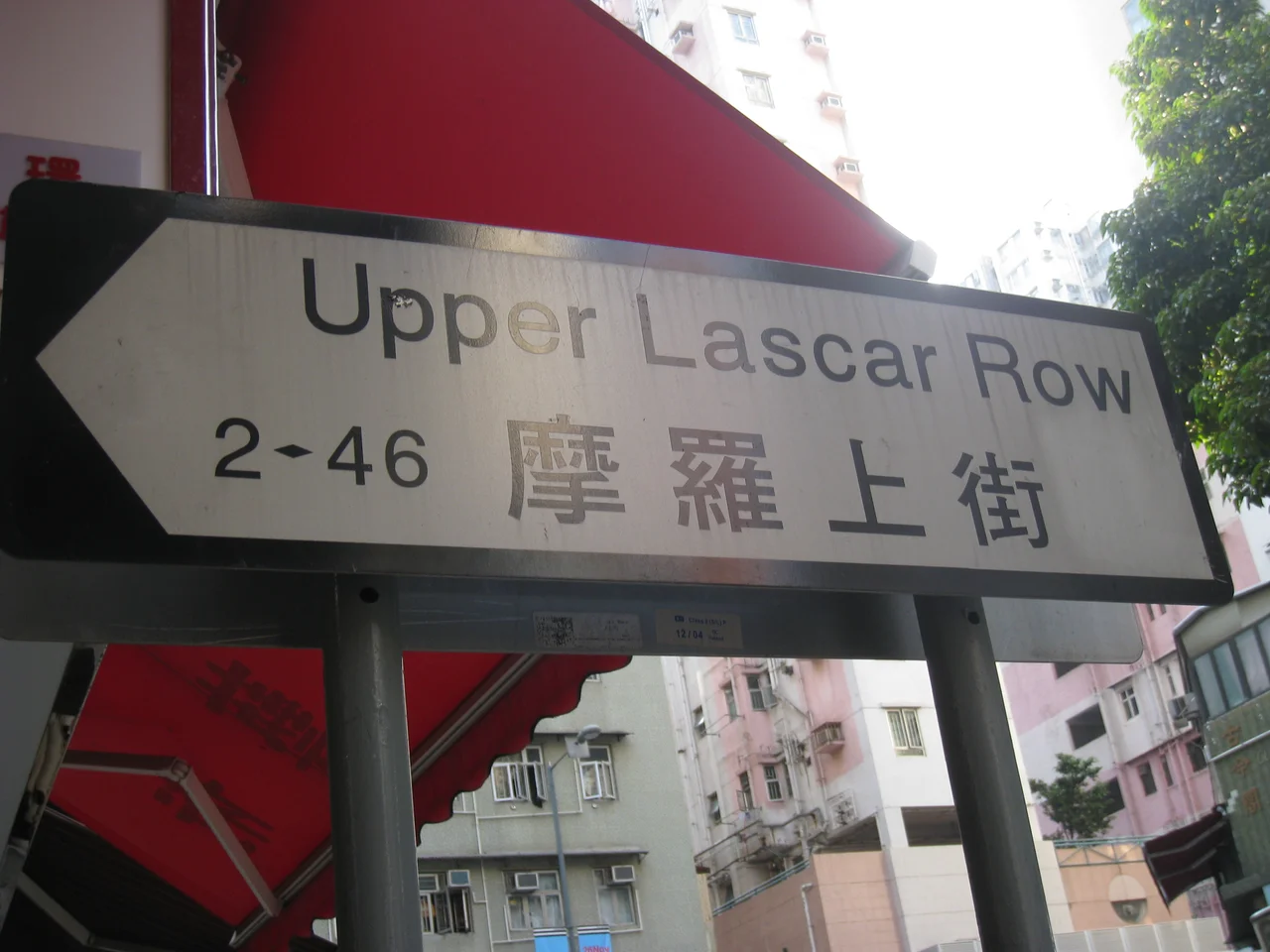

Lascar Row
The street has too many names, which is itself the story. In English it is Lascar Row — Upper Lascar Row and Lok Ku Road together — a name derived from the Persian word *lashkar* (military camp), carried through Arabic into the British colonial vocabulary as a term for Indian and Southeast Asian seamen. In Cantonese it became *摩囉街* — Mouro Street, sometimes rendered as 摩囉 — which came from 'Musselmen,' the British approximation of Muslims from the Middle East who traded in South China. In the antique shops era it became Cat Street. Each name belongs to a different Hong Kong, and the alley in Sheung Wan holds all of them.
Indian Sailors and a Row of Houses
The British colonial administration brought Indian seamen, soldiers, and policemen to Hong Kong in significant numbers throughout the 19th century. Upper Lascar Row takes its name from the row of houses that served as dormitories for these workers — 'row' being the English word for a terrace of similar structures. An Indian police dormitory stood in the street. The Indian community that formed around it established a small market, a place where traders from the subcontinent could conduct business among people who understood the same languages and shared the same practices.
On 11 February 1911, fire broke out on Upper and Lower Lascar Row, destroying 16 houses and damaging another 24. The street was rebuilt. The dormitories and the seamen's quarter eventually disappeared, but the market character persisted, transforming over decades into something different.
Cat Street and Mouse Goods
Since the 1920s, the area around Upper Lascar Row has been a market for antiques, curios, and second-hand goods of every description: old electronics, carved furniture, ceramics, bronze figures, jade, and items of less certain provenance. The street earned a second name in this era: Cat Street. The name comes from Cantonese slang. Stolen goods were called *lou-shu-fo* — mouse goods — and the shoppers who moved carefully through the stalls, picking over the offerings with practiced caution, were likened to cats hunting mice.
Foreigners, particularly, latched onto the Cat Street name. It was vivid, easy to remember, and captured something true about the commercial atmosphere: a place where you looked carefully, asked few questions, and might walk away with something extraordinary if you had the eye for it. The neighbouring Hollywood Road developed a similar reputation for antiques, and the two streets together became a destination for collectors and browsers from across Asia and beyond.
A Name That Cuts Both Ways
By 2010, the Cantonese word 摩囉 had acquired a different weight than it carried in the 19th century. Eight district officers from the Central and Western District brought to the government the concerns of South Asian residents who found the word pejorative — a term that had come to carry a derogatory edge in its colloquial use for Indians. They asked the Hong Kong government to consider renaming the street.
The Lands Department declined. Its ruling was that it did not find the word offensive to South Asians, a position the Democratic Party criticised as reflecting government indifference to ethnic minority concerns. The government's counter-argument was historical: the street name had been in continuous use for over a century, and changing it would diminish the alley's historical value. The word *Mouro*, the official position held, was neutral — a transliteration, not a slur. The debate about what that word means, to whom it belongs, and who gets to decide, has not concluded. The sign on the wall still reads Upper Lascar Row.
What Remains on the Alley
Upper Lascar Row today is a narrow alley running parallel to Hollywood Road, measuring over 500 feet long, lined with the stalls and shops that have made it a fixture on Hong Kong's antique trail. The goods are mixed: some authentic antiques, some reproductions, some objects that defy easy categorization. Vendors who have worked the street for decades sit outside their stalls in the morning light, drinking tea while tourists and serious collectors move past.
The alley connects a street named for Indian seamen with a hill named for a British colonial administrator, in a city built on the intersection of those two worlds. Walk it slowly and the layers accumulate: the Indian dormitory that stood here, the markets of the 1920s, the fire of 1911, the current dispute over what the street should be called and who the name belongs to. The antiques, in a sense, are the least of it.
From the Air
Lascar Row (Upper Lascar Row) is located at approximately 22.285°N, 114.150°E in the Sheung Wan district of Hong Kong Island, running parallel to Hollywood Road at roughly 50–80 metres elevation above sea level on the lower slopes of Victoria Peak. The area is about 1 km west of the Central financial district. Hong Kong International Airport (VHHH) lies approximately 30 km to the west on Lantau Island. From altitude, Sheung Wan is identifiable as the dense urban grid immediately west of Central, backed by the steep green rise of Victoria Peak (552 m). Recommended viewing altitude: 2,000–3,500 feet from the harbour side for the Central-Sheung Wan streetscape.
Nearby Stories
- Lok Ma Chau Loop 2.3 km away
- Portas do Cerco 2.3 km away
- Kweilin Incident 17 km away
- Wanshan Archipelago Campaign 34 km away
- Nanxiong Formation 115 km away
- Battle of Nanpeng Island 148 km away
- Heyuan 169 km away
- Cape Maobitou 632 km away