
Lavrio
In 483 BC, the Athenians made a decision that changed the course of ancient history. A major silver vein had been struck at the mines of Laurion, on the southeastern tip of Attica, and the resulting windfall was significant enough that the city debated publicly what to do with it. Themistocles argued for ships. He won. The revenue went toward building a fleet of 200 triremes, and those ships defeated the Persian navy at the Battle of Salamis three years later. The Athenian Empire, and the cultural flourishing we associate with classical Athens, rested on a foundation of silver pulled from the ground at Lavrio by enslaved workers under miserable conditions. That tension — between the brilliance the silver enabled above ground and the suffering that produced it below — runs through the entire history of this place.
Deep in the Bronze Age
Mining at Lavrio did not begin with Themistocles. The earliest evidence of mineral extraction here dates to the beginning of the Bronze Age, around 3200 BC. Systematic exploitation of the region's silver, lead, and other metallic ores appears to have taken organized form in the 6th century BC under the Athenian tyrant Peisistratus. By the time the great silver strike of 483 BC occurred, Laurion was already a functioning industrial district with infrastructure in place.
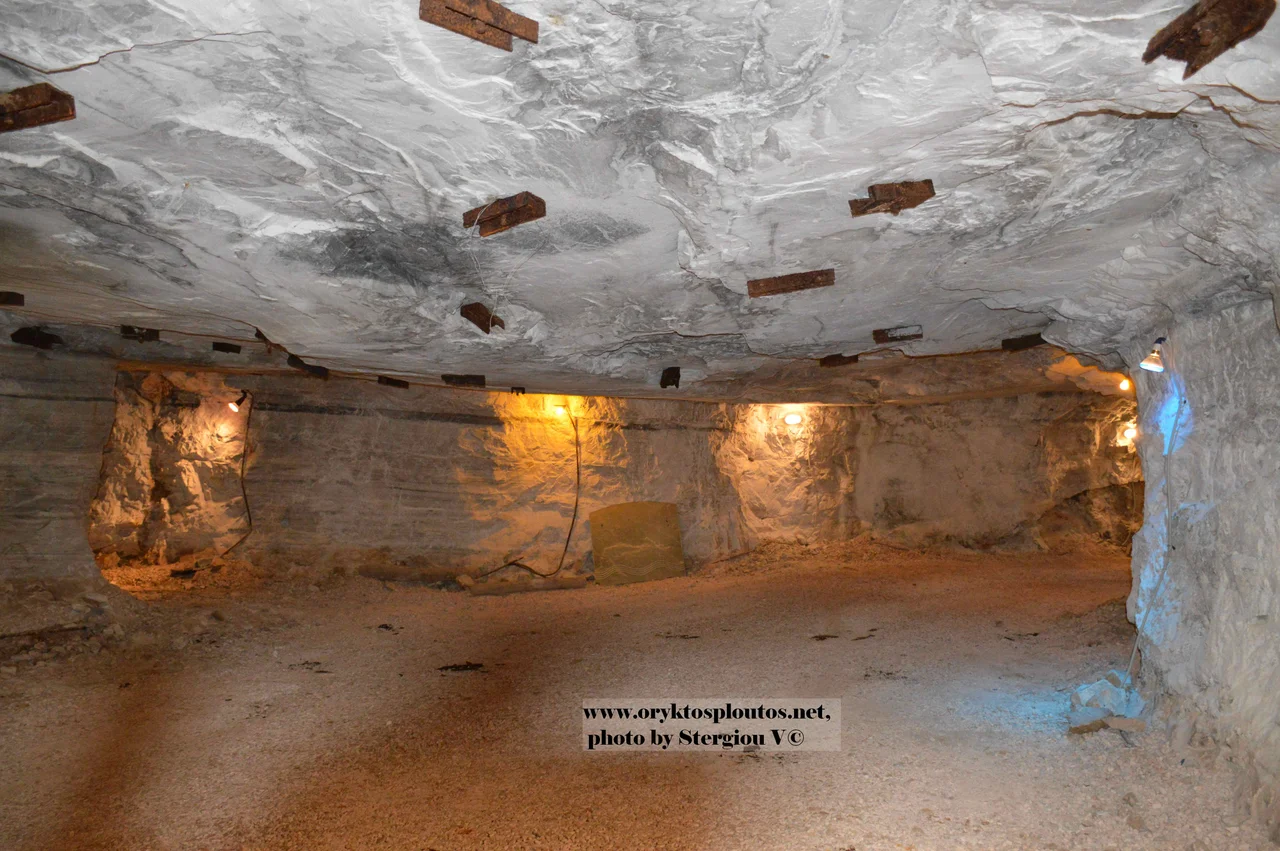
The ancient workings are extensive. Shafts and galleries carved through the hillsides, washing tables for concentrating ore, and — reflecting the near-total absence of rivers or streams in this dry landscape — a sophisticated system of tanks and reservoirs engineered to collect rainwater for washing the ore. These installations survive in various states of preservation across the terrain surrounding the modern town. The ancient silver mint at Laurion, called the Argyrocopeum, produced the characteristic Athenian owl coins that circulated across the ancient Mediterranean world.
At the height of production, as many as 20,000 enslaved people worked the mines. An unrecorded number were children. The ancient sources are brief about their lives, but the phrase 'miserable, dangerous, and brief' captures what the archaeological and textual evidence supports.
The Long Silence and the Return
Toward the end of the 5th century BC, the mines' output declined, partly because the Spartans occupied the inland town of Decelea during the Peloponnesian War, disrupting the supply of enslaved labor. Mining continued at reduced scale for centuries; the geographer Strabo, writing around the 1st century BC, noted that even the tailings — the waste from previous workings — were being reprocessed to extract residual value. The travel writer Pausanias, writing in the 2nd century AD, referred to the mines as something from the past.
After Late Antiquity, the mines fell effectively dormant. The town that grew up at their location — called Ergastiria, meaning 'workshops,' from the Middle Ages until 1908 — maintained a quiet existence through the Byzantine and Ottoman periods without significant industrial activity.
In the late 19th century, French and Greek companies moved in. The target this time was less the silver, which had been largely exhausted in antiquity, than the lead, manganese, and cadmium still present in the ore. The Italian-born industrialist Giovanni Battista Serpieri was central to this revival; a statue of him stands in Lavrio today, sculpted by Georgios Vroutos. The mines reopened. The town grew. And then, in 1896, the tensions that had accumulated between the mining companies and their workers broke into violence.
The Strike of 1896
The Lavrio miners' strike of 1896 followed a familiar 19th-century script, but its resolution was unusually harsh. Workers went on strike. The mining company's guards confronted them. Two workers died. The miners responded by destroying the company's offices and killing the guards. The Greek government sent police. Further clashes followed. The government then deployed the military against the striking workers, resulting in more deaths. The strike ended without most of the workers' demands being met, and a permanent military garrison was established to patrol the mining operations.
The episode was not unique — labor violence at Laurion in 1896 mirrored conflicts at mining sites across Europe and the Americas in the same era. But it carried a particular weight here, on ground where enslaved people had once worked the same ore for a thousand years. The continuity of exploitation was not incidental; it was structural, built into the landscape and into the economics of extraction that had defined the place since the Bronze Age.
The Town at the Tip of Attica
Modern Lavrio sits about 60 kilometers southeast of Athens, on a bay that looks out toward the island of Makronisos to the east. The streets follow a grid layout laid out during the 19th-century industrial revival. The port occupies the center of the bay. Cape Sounio, with its Temple of Poseidon visible from the sea, lies just a few kilometers to the south.
The climate is mild — Lavrio benefits from the cooling sea air and has never recorded a frost, according to the National Observatory of Athens. The Eleftherios Venizelos International Airport is about 35 kilometers away. The old Athens-Lavrion Railway, which once carried workers and ore between the capital and the mines, was abandoned in 1957.
Today Lavrio is most active as a ferry terminal — the port serves Kea, Kythnos, and other Cycladic islands, its hydrofoils and ferries crossing the same channel that ancient triremes once guarded. The Mineralogical Museum houses samples from the region's mineral deposits, and the Archaeological Museum tells the story of the ancient mines. Walking through the landscape outside town, you can still find the mouth of an ancient shaft or the outline of a Roman-era cistern. The ground at Lavrio is full of what it gave and what it kept.
From the Air
Lavrio lies at approximately 37.71°N, 24.06°E at the southeastern tip of Attica, roughly 60 km from Athens city center. From altitude, the town is identifiable by its compact port and grid-plan streets on a bay facing east toward the elongated island of Makronisos. Cape Sounio and the Temple of Poseidon are visible a few kilometers to the south — an excellent navigation landmark. Kea (Tzia) lies roughly 20 km to the southeast across the water. The nearest major airport is Athens International (LGAV), approximately 35 km to the northwest; the airport's runways are visible from altitude on clear days. At 5,000 feet, the terraced mine workings and slag heaps of the ancient mining district are visible on the hillsides inland from the town.
Nearby Stories
- Salamis Naval Base 1.9 km away
- Battle of Andros (1790) 5 km away
- Temple of Aphaia 5.8 km away
- Hydra: The Island That Refused the Car 13 km away
- Gyaros 14 km away
- Saint Ephraim Monastery, Nea Makri 16 km away
- Kythnos 30 km away
- Archaeological Museum of Sifnos 53 km away