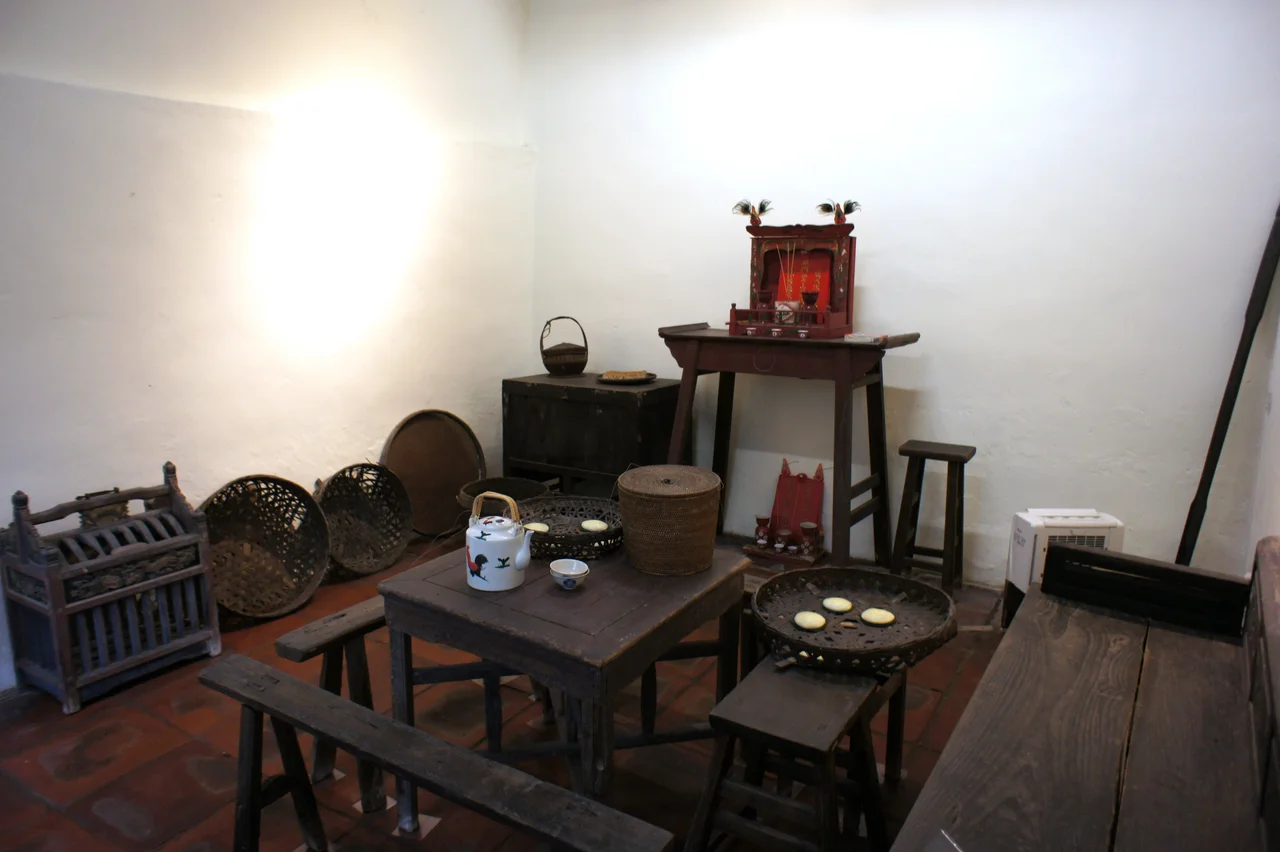

Law Uk Folk Museum
The Law family came to Hong Kong Island from Bao'an County in Guangdong province sometime around the mid-1700s, carrying with them the architectural traditions of the Hakka people. They built their home in the Hakka style — five rooms, thick walls, a central hall, a lightwell instead of windows — on what was then the island's waterfront, with Victoria Harbour at their doorstep. Today that same building stands deep inland, the harbour pushed back by two centuries of land reclamation. The house survived not because anyone planned to preserve it, but because it was rediscovered just in time, in the 1970s, before it disappeared entirely.
Farmers on the Waterfront
When the Law family settled in Chai Wan, most people in the area fished — the sea was close, the living accessible. The Laws were different. Impoverished rice farmers, they raised chickens and pigs on land that backed up against the harbour. Qing Dynasty documents dated 1767 and 1796, which remained in the family's possession for generations, establish the approximate construction date and confirm the family's presence at the site. Those papers surfaced when the house was rediscovered, offering a rare paper trail for a structure most people had forgotten. The family's way of life — small-scale agriculture in a coastal fishing community — gradually eroded as Hong Kong changed around them. The house itself quietly outlasted all of it.
Built Against the World Outside
Law Uk is what Hakka architecture looks like when the outside world is not entirely trusted. The house is symmetrical, centred on a main hall, with five rooms sized to shelter around ten people. Windows are few — pirates and robbers were real concerns in 18th-century coastal Hong Kong — and a lightwell at the front of the hall compensates, drawing daylight into the interior without exposing the household to the street. The design is practical in a specific way: it prioritises security over openness, community over spectacle. A new annex was added during the 1980s restoration, built to match the original style closely enough that the two sit together without obvious seam.
From Workshop to Museum
Before anyone thought to preserve Law Uk, it had become a furniture workshop. Spray paints, flammable goods, metallic clutter — the building that Qing-era farmers had lived in for generations was functioning as a fire hazard by the time it was rediscovered in the 1970s. The Hong Kong government intervened, buying and renovating the property, and eventually opening it as the Law Uk Folk Museum. It became one of three branches of the Hong Kong Museum of History, alongside the Hong Kong Museum of Coastal Defence and the Lei Cheng Uk Han Tomb Museum; that network has since expanded to five branches. Attendance has never been strong — the museum is modest in size, and the surrounding industrial neighbourhood is not a natural draw. Closing it has been considered. It remains open.
The Last One Standing
Chai Wan was once a place where Hakka families like the Laws lived and farmed. That community is gone, replaced by the high-rises and industrial blocks that define the area today. Law Uk is the only Hakka building left in the neighbourhood — a single structure carrying the weight of an entire way of life that otherwise left no physical trace on the landscape. Its status as a declared monument of Hong Kong offers legal protection, though the house already survived more than two centuries without it. What makes it unusual is not just its age or architecture, but what it represents: a people who came from the mainland, built a life on an island waterfront, and left behind exactly one house to prove they were ever there.
From the Air
Law Uk Folk Museum sits at approximately 22.2642°N, 114.236°E in Chai Wan on the eastern end of Hong Kong Island. From the air at 2,000–3,000 feet, the distinctive green hillsides of the eastern district are visible to the north, with the harbour opening to the west. The museum is set among Chai Wan's industrial and residential towers. Hong Kong International Airport (VHHH) is approximately 30km to the northwest across the island. Victoria Harbour, which once bordered this site before land reclamation, remains visible to the northwest. The narrow waters of Lei Yue Mun — the eastern entrance to the harbour — lie just a few kilometres to the north.
Nearby Stories
- Lok Ma Chau Loop 2.3 km away
- Portas do Cerco 2.3 km away
- Kweilin Incident 17 km away
- Wanshan Archipelago Campaign 34 km away
- Nanxiong Formation 115 km away
- Battle of Nanpeng Island 148 km away
- Heyuan 169 km away
- Cape Maobitou 632 km away