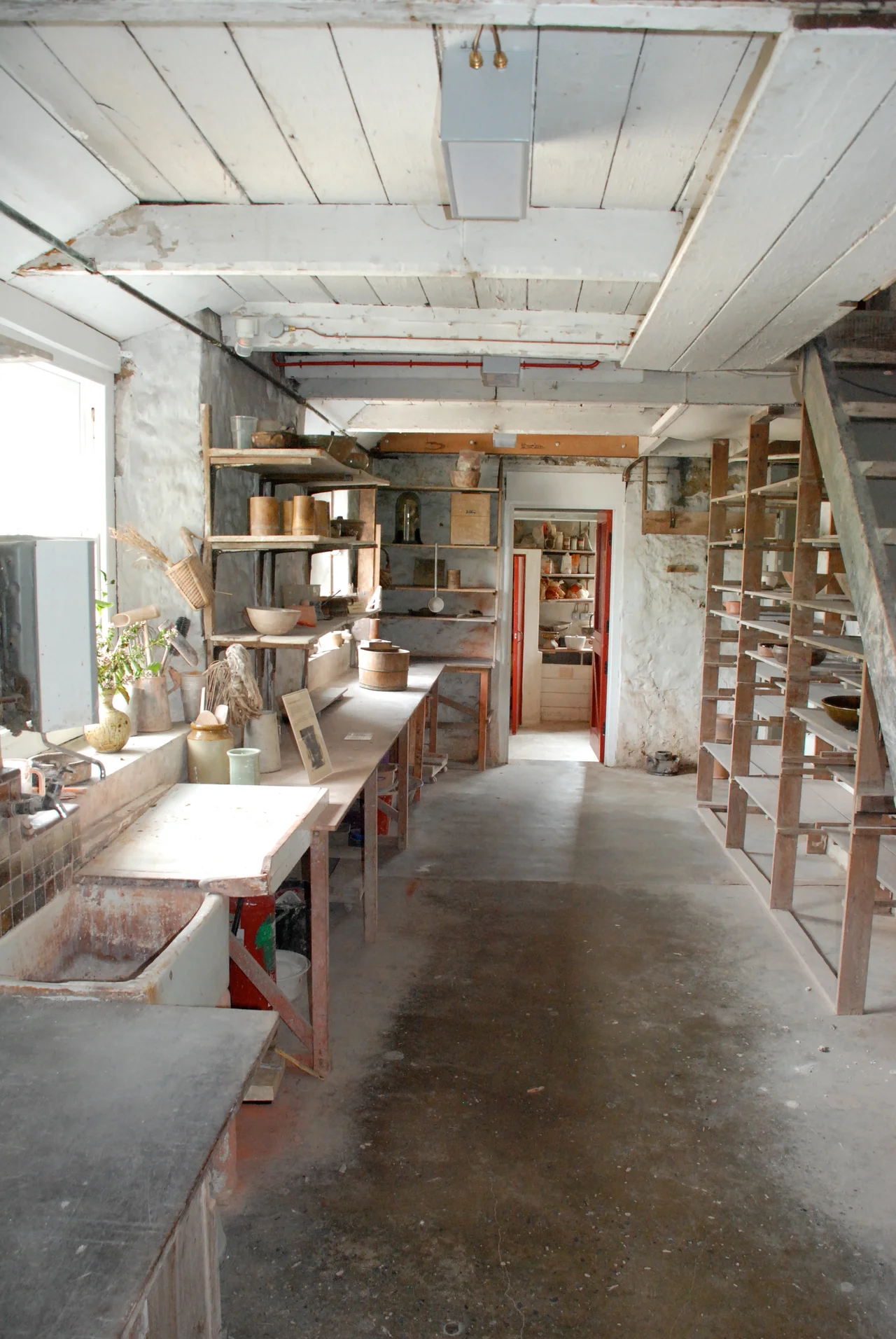

Leach Pottery
In 1920, two men in their thirties arrived at a converted cow shed on the edge of St Ives carrying tools, sketches, and an idea that no English potter had taken seriously before. The shorter of the two, Shoji Hamada, was a 25-year-old graduate of Tokyo's Higher Technical School. The Englishman with him, Bernard Leach, was 33 and had spent the previous eleven years living in Japan, where he had apprenticed under the Sixth Kenzan to learn raku and stoneware in a tradition reaching back to the seventeenth century. What they built on that hillside above Stennack would be the first Japanese-style climbing kiln in the western world, and the cradle of British studio pottery. A century later it is still firing.
A Friendship Forged in Tokyo
Leach, born in Hong Kong to a colonial judge, had returned to Japan in 1909 to teach etching. There he met the philosopher Soetsu Yanagi, the painter Tomimoto Kenkichi, and the young Shoji Hamada. Over a decade in Tokyo and Kyoto, Leach apprenticed in Japanese ceramic traditions and became part of the circle that would become the mingei movement - the philosophy of finding beauty in the everyday objects of unknown craftsmen. By 1920 Leach was ready to come home. He persuaded Hamada to come with him. They picked St Ives partly because Mrs Frances Horne had offered patronage through her Cornish handicrafts guild, and partly because Cornwall had the right clays. The site they took, a former cow and tin-ore shed at the head of Stennack valley, was rough but available.
Matsubayashi Builds the Kiln
Their first climbing kiln was an early failure - the draft was wrong, temperatures uneven. In 1922 Leach wrote to Japan for help, and the master kiln-builder Tsuronosuke Matsubayashi sailed to Cornwall. Matsubayashi, from a family that had built kilns at Asahi-yaki for generations, spent months at Stennack rebuilding the kiln from foundations up. What he produced was a three-chambered traditional Japanese noborigama climbing kiln - the first ever built in the western world. Each chamber sits slightly above the next on the slope, drawing flame up through the stack from a stoking firebox at the foot. Wood-firings ran for three or four days at a time, requiring continuous stoking through the night, and reached temperatures over 1300 C in the upper chambers. The Matsubayashi kiln was used at Leach until the 1970s and survives, restored, on site.
The Workshop That Trained a Generation
Leach's son David trained at North Staffordshire Technical College and took over management in 1937, abandoning earthenware in favour of a new stoneware body suited to local materials. The pottery's apprentice tradition drew makers from around the world. Michael Cardew came as an early student. William Marshall served as a long-term apprentice. Katherine Pleydell-Bouverie joined in 1924. From overseas: Warren MacKenzie from Minnesota, Charmian Johnson from Canada, Len Castle from New Zealand. Each absorbed what came to be called the Leach tradition - quiet, functional, drawing on Korean, Chinese and Japanese precedent as well as English slipware - and carried it home. A small Cornish kiln seeded the studio pottery movements of three continents.
Standard Ware
In 1946, in the lean post-war years, the pottery launched a range called Standard Ware: mugs, jugs, bowls, plates, all designed to be domestic, affordable, beautiful in the unfussy way Leach believed honest workmanship should be. Three glazes only - celadon green, tenmoku black, and oatmeal - sometimes overpainted with simple brown and blue brushwork. Mail-order catalogues went out across Britain. The range was produced continuously until 1979. Pieces are now in the V&A Standard Ware collection and remain a benchmark for what twentieth-century English studio pottery aspired to. Leach himself died in 1979, full of honours, the year the production line finally stopped.
Restoration and Working Life
By the 1990s the pottery had fallen into decline. The buildings were in poor repair, the kiln cold, the apprentice tradition lapsed. Between 2005 and 2008 a £1.7 million restoration, led by the newly formed Bernard Leach (St Ives) Trust, conserved the original buildings, restored the Matsubayashi kiln, and added a modern exhibition space and shop. It reopened in March 2008. Today, under director Libby Buckley and lead potter Roelof Uys, the Leach is again a working studio pottery with a museum and gallery attached. Apprentices throw in the same room where Hamada threw a century before. The Entrance Gallery shows work by Bernard, David and Janet Leach alongside Hamada, Marshall, Cardew and Kenneth Quick. The Cube Gallery rotates contemporary exhibitions. The kiln is fired several times a year, in the slow traditional way, smoke drifting up the Stennack valley exactly as it did in 1922.
From the Air
The Leach Pottery sits on the Stennack road at 50.207 N, 5.493 W, on the western edge of St Ives near the head of the valley. A small whitewashed compound visible from above as a slate-roofed cluster among houses. Best approached at low altitude from St Ives Bay; the South West Coast Path runs along the cliffs less than a mile north. Land's End airfield (EGHC) lies 9 nm south-west; Newquay (EGHQ) 22 nm north-east. The pottery is within walking distance of Trewyn Studio (Hepworth Museum) and the Tate St Ives, making this stretch of granite hillside one of the densest concentrations of twentieth-century craft heritage in Britain.
Nearby Stories
- Wadebridge 8.1 km away
- Caerhays Castle 8.1 km away
- Sevenstones Lightship 16 km away
- Battle off Lizard Point 20 km away
- MV Cita 22 km away
- Carnewas and Bedruthan Steps 30 km away
- 1979 Fastnet Race 71 km away
- HMS Affray 108 km away