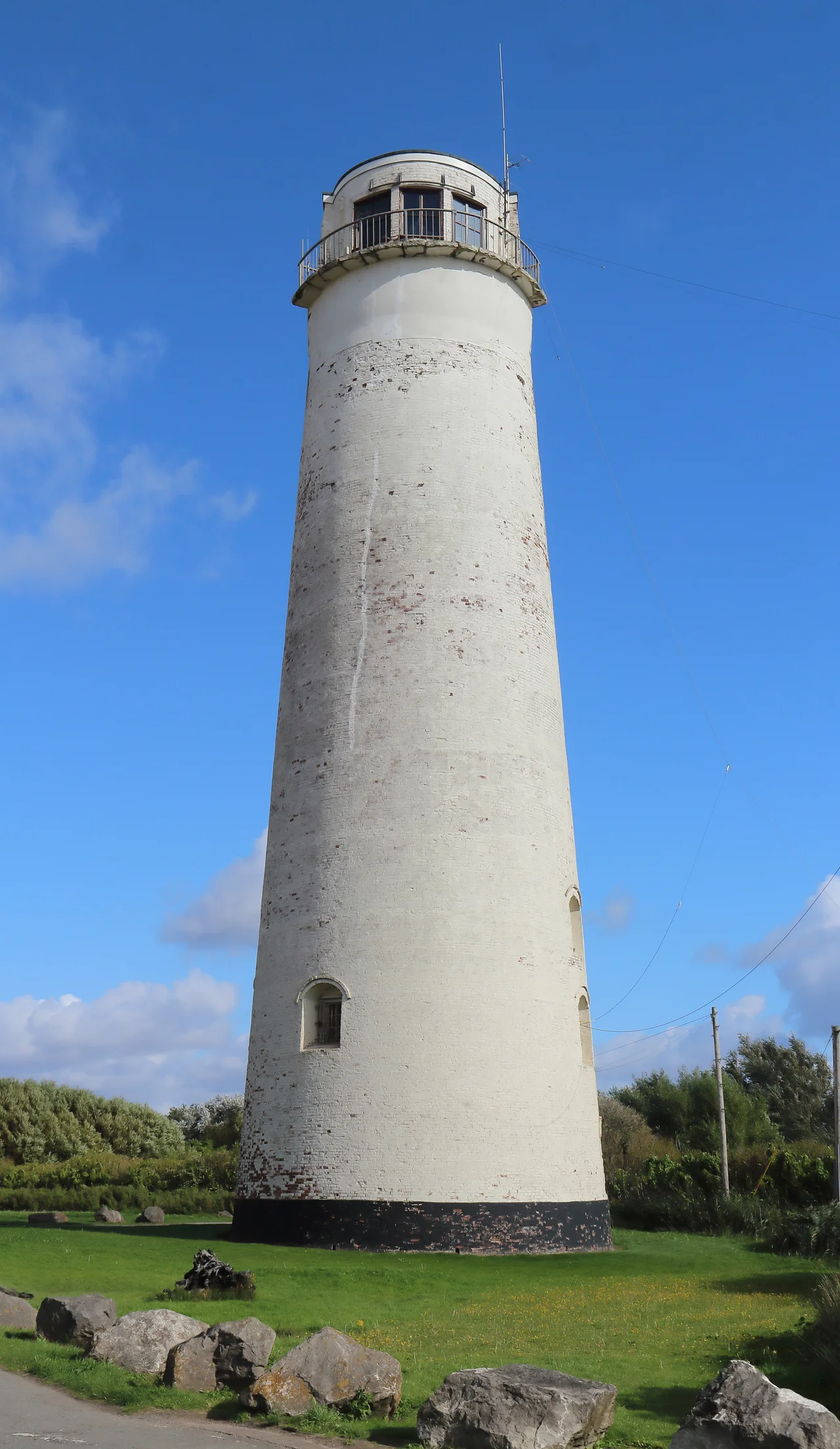

Leasowe Lighthouse
When sailors in 1763 lined up two lights on the Wirral shore, the channel into Liverpool opened for them like a door swinging on its hinges. The taller of the pair still stands. Across Moreton Common, just behind the Mockbeggar Wharf dunes, Leasowe Lighthouse rises 101 feet from the marsh grass, a tapering brick cylinder with cavity walls several feet thick. It is the oldest brick-built lighthouse in the United Kingdom, and for the better part of a decade after it lit its last beam in 1908, the woman who had once tended it kept the kettle on upstairs, serving tea to walkers in the lantern room where the oil lamps used to burn.
Two Lights in a Row
The Liverpool Docks Trustees got their Act of Parliament in 1761, and within two years two lighthouses stood at Moreton on the Wirral. They were called the Upper Mockbeggar Light and the Lower Mockbeggar Light, and they worked in tandem. A ship at sea could line one tower up behind the other and know it was inside Rock Channel, the narrow safe passage that wound between sandbanks toward the Port of Liverpool. The trick was old. The risk it solved was new. Liverpool was becoming the great Atlantic port of the British empire, and every vessel that ran aground on the Hoyle Bank or the Burbo was a cargo lost. The Lower Light gave up first, swept into the Irish Sea by a storm in 1769 and replaced two years later by Bidston Lighthouse on the hill above. The Upper Light, the one we now call Leasowe, kept burning for another 137 years.
A Lighthouse Built Like a Fortress
The brickwork is what makes Leasowe extraordinary. By 1763, lighthouse-builders elsewhere were still favouring stone or timber, and Eddystone, the great trial-and-error case off Plymouth, had only just been finished in stone. The Mersey engineers chose brick, and they chose to build with cavity walls several feet thick — two skins of brickwork enclosing an air gap, an unusual technique for the era. The tower tapers as it rises, seven floors stacked one above the next, with a plain iron balcony just below the lantern. Inside, a wooden staircase wound up to the light until 1898, when it was finally replaced after more than a century of service. From the top, on a clear day, you can see Snowdonia rising blue beyond the Dee estuary, the Liverpool waterfront low across the Mersey, and the Burbo Bank wind farm out where the old sandbanks lie.
Mrs. Williams and the Tearoom
Leasowe went dark for the last time on 14 July 1908. The shipping channels had shifted, the buoys could do the work, and the keeper's job came to an end. The last person to hold it was a Mrs. Williams, the only known female lighthouse keeper of her period anywhere in Britain. When the Mersey Docks and Harbour Board closed the light, Williams refused to leave the building behind. She moved into a small cottage beside it but kept the tower itself open through the summer months, serving tea and cake to Sunday walkers who came out from Liverpool by tram and ferry. She kept the tearoom running for twenty-two years. In 1930 the lighthouse was bought by Wallasey Corporation. Williams died five years later, the door was locked, and the brick tower fell into the slow disrepair that monuments suffer when no one is left to love them.
Saved by Volunteers, Abseiled for Fun
Grade II listing came in 1952, but a listing is not the same as a roof. By the late twentieth century the tower stood derelict on the North Wirral coast, doors boarded, brickwork weathering, lantern empty. What rescued it was a community group — The Friends of Leasowe Lighthouse — who took over the building, stripped back the damp, restored the staircase Mrs. Williams once climbed every evening, and reopened it as a visitor centre. Today the lighthouse is a working community building. Park rangers from the North Wirral Coastal Park use it as a base. Running groups meet beside it. People abseil down the outside of the tower for charity. Film crews scout it. Ghost hunters book overnight investigations. For a 263-year-old brick cylinder built to keep ships off a sandbank, it has accumulated, over time, an extraordinary number of second lives.
Walking the Mockbeggar Shore
The lighthouse stands on Moreton Common, just inland of Mockbeggar Wharf — a name borrowed from nearby Mockbeggar Hall, an old alternative name for Leasowe Castle. This stretch of the Wirral is wide and exposed: salt marsh giving way to dune, dune giving way to a long pale beach where the tide goes out half a mile. The Royal Society for the Protection of Birds runs walks here for godwits, knots and waders. On winter mornings the sky over the Mersey turns the colour of pewter and the lighthouse, plain and squat against it, looks exactly as it must have looked to a captain on the deck of a sugar ship in 1820, lining up his lights and aiming for home.
From the Air
Located at 53.413N, 3.126W on the north Wirral coast, west of Liverpool. The 101-foot brick tower stands inland from the dunes at Mockbeggar Wharf; from the air it appears as a small cylindrical landmark against the broad pale beach and salt marsh. Nearest airport: Liverpool John Lennon Airport (EGGP), approximately 13nm southeast across the Mersey estuary. Best viewed from 1,500-3,000ft on clear days.
Nearby Stories
- RAF Wrexham 3.3 km away
- Birkdale Palace Hotel 3.7 km away
- Turton Tower 4.1 km away
- Tatton Park 5.6 km away
- Abergele Rail Disaster 9.6 km away
- Diglake Colliery Disaster 13 km away
- Ysbyty Ifan 16 km away
- Celtic Array 62 km away