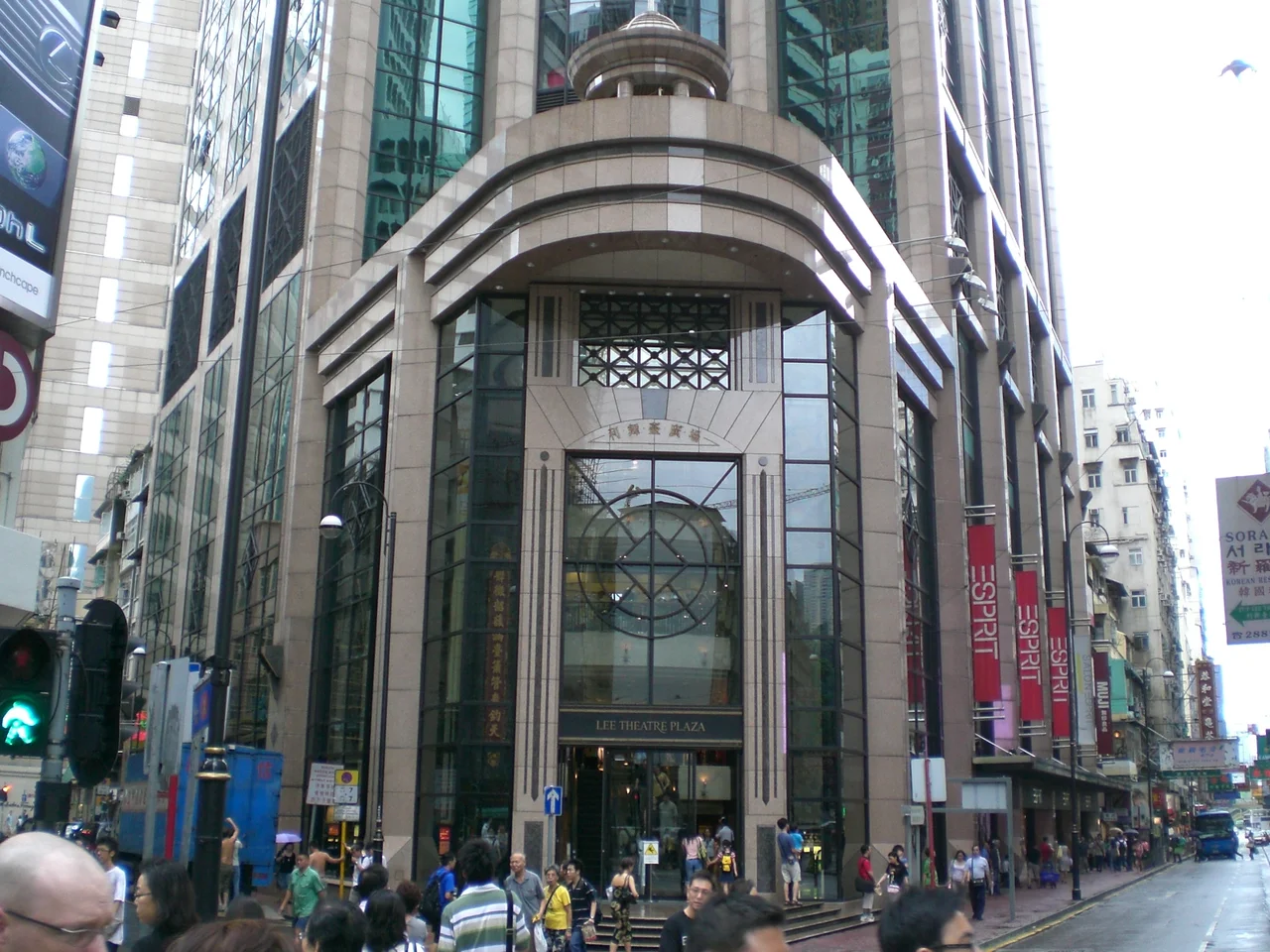

Lee Theatre
Lee Hysan built a theatre in Causeway Bay because his mother loved Cantonese opera and the journey to Western District was long. That is the story at the origin of one of Hong Kong's most storied performance venues: a filial act that became, over sixty years, a civic institution. The Lee Theatre opened in 1925 at the corner of Percival Street and Leighton Road with seating for 2,000 patrons. When the last film — Terminator 2: Judgment Day — flickered across its screen in August 1991, that building was already gone in everything but name. The wrecking crews followed within months.
A Stage for the City
The Lee Theatre was completed in 1925 in the Beaux-Arts style, its ornate facade facing onto Percival Street in a neighbourhood that, at the time, was still developing its identity as a commercial hub. Upon opening, Hong Kong Tramways launched a special late-night service to carry theatregoers home to Shek Tong Tsui — a sign of how immediately the venue became part of the city's rhythm. The theatre supposedly opened to business on 10 February 1927. Over the following decades, it hosted Cantonese opera, concerts, and films, serving the full range of what entertainment meant to Hong Kong audiences. Miss Hong Kong pageants ran there annually from 1973 until the late 1980s, organized by TVB, in which the Lee family held a stake. The Miss Universe pageant came in 1976.
The Voices It Heard
Three names recur whenever people speak of the Lee Theatre: Roman Tam, Teresa Teng, and Liza Wang. All three performed on its stage, and all three were, at different moments, the defining popular voices of Chinese-speaking Asia. Tam's connection to the theatre was especially personal — he gave the farewell concert when the building closed in 1991, a final goodbye that RTHK's Television Division also commemorated with a special programme. The theatre renovated in the 1970s, updating its facilities while keeping the Beaux-Arts bones that made it visually distinctive. By the 1980s, though, the context had changed. Property prices in Hong Kong were rising sharply, and the land on Percival Street had become extraordinarily valuable.
The Demolition Decision
The Lee family sold the land to Hysan Development, their corporate arm, in March 1991. The theatre closed four months later, on 19 August 1991. What drove the decision was straightforward: prime Causeway Bay real estate had become too valuable to use as a theatre. The site was redeveloped into Lee Theatre Plaza, a commercial building completed in 1995. It included a cinema, which itself closed and was converted to a restaurant in 2005. The original theatre left no physical trace at street level. What remained was the name, attached now to a building that shares nothing with its predecessor except a location.
What Persists
A replica facade of the original Lee Theatre was installed at the Hong Kong History Museum — a gesture toward preservation that is also an honest acknowledgment of loss. The real building is gone; what survives is a reconstruction inside a museum, which is perhaps the most Hong Kong outcome imaginable for a beloved structure lost to redevelopment. The story of the Lee Theatre is not unusual in the city's history. Many buildings with comparable cultural weight have been demolished for comparable reasons. What makes this one persist in memory is partly the names associated with it, partly the music, and partly the simple fact that Roman Tam stood on its stage one last time and sang it goodbye.
From the Air
The Lee Theatre site — now Lee Theatre Plaza — sits at approximately 22.2783°N, 114.183°E in Causeway Bay, on Hong Kong Island's north shore. From the air at 2,000–3,000 feet, Causeway Bay's densely packed commercial towers are visible along the harbour edge, with the Causeway Bay Typhoon Shelter just offshore. Victoria Harbour extends to the north, with Kowloon's waterfront visible across the water. Hong Kong International Airport (VHHH) lies roughly 28km to the west-northwest. The Happy Valley Racecourse, one of Causeway Bay's other landmarks, is visible just to the south.
Nearby Stories
- Lok Ma Chau Loop 2.3 km away
- Portas do Cerco 2.3 km away
- Kweilin Incident 17 km away
- Wanshan Archipelago Campaign 34 km away
- Nanxiong Formation 115 km away
- Battle of Nanpeng Island 148 km away
- Heyuan 169 km away
- Cape Maobitou 632 km away