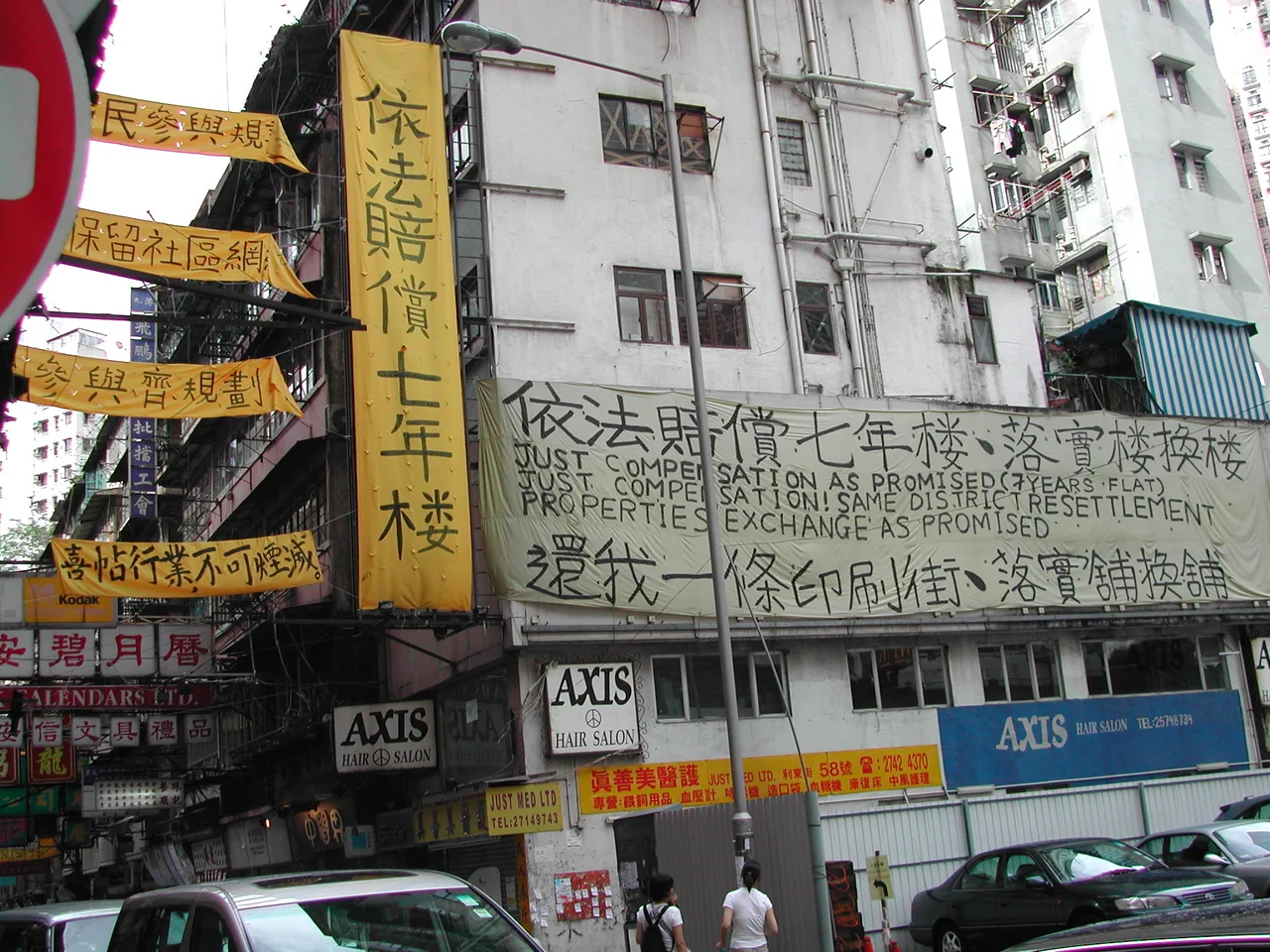

Lee Tung Street
Every wedding in Hong Kong used to begin on Lee Tung Street. Hundreds of thousands of families came to this one lane in Wan Chai to order their wedding cards, their lai see envelopes for the new year, their fai chun New Year couplets, their name cards — all the printed paperwork of Chinese social life. The street had been a printing district since the 1950s, when small shops gathered between Johnston Road and Queen's Road East. By the 1980s it was famous. By 2007, it was gone.
A Street That Printed Celebrations
Lee Tung Street's identity as a printing hub began modestly. In the 1950s, print shops clustered in Wan Chai partly because the neighbourhood was already home to several newspaper headquarters — the Hong Kong Times, Ta Kung Pao, and Wen Wei Po all operated nearby. Some accounts suggest the government of Hong Kong concentrated printers here to make monitoring of publications easier; whatever the original reason, the businesses stayed and multiplied. Through the 1970s and 1980s, wedding card printing became the street's defining specialty. The shops were mostly small, family-run operations. They knew their customers by name and kept records of wedding card orders across generations of the same families. The poet and translator Dai Wangshu had even run a short-lived bookstore here in the early 1950s, adding a literary layer to a street otherwise known for commercial printing.
The Plan and the Resistance
In 1998, the Land Development Corporation — later replaced by the Urban Renewal Authority — announced plans to redevelop the Lee Tung Street and McGregor Street area in a project known as H15. The scheme was approved by the Town Planning Board that year and by the Chief Executive in Council in 1999. By 2003, the Urban Renewal Authority announced it would spend HK$3.58 billion on the project, covering 8,900 square metres. Residents and shop owners pushed back. The H15 Concern Group formed, and members including shop owner May Je staged a three-day hunger strike in protest. Architect Christopher Law produced a counter-proposal — the Dumbbell Proposal — that would have preserved the six-storey tong lau tenement buildings in the middle of the street. The Hong Kong Institute of Planners awarded it a silver prize. The Town Planning Board rejected it in 2005. Appeals failed in 2007.
Displacement and Its Costs
The human arithmetic of the redevelopment was stark. More than 85 per cent of the 647 affected homeowners accepted compensation offers of HK$4,079 per square foot by mid-2005. By 2013, flats in the redeveloped project — renamed Avenue Walk, and then Lee Tung Avenue — were selling for HK$23,000 per square foot. The Urban Renewal Authority received approximately HK$3.4 billion from the project while paying out about HK$1.8 billion in compensation. The shop owners who moved found the economics of displacement brutal. One printer who relocated to Wan Chai Road reported an 80 per cent drop in business. Another who moved to Tai Wong Street East saw her income fall by 40 per cent. The community relationships built across decades of shared commerce — the fabric that made Wedding Card Street more than just a row of shops — were not compensable under any scheme.
What the Song Remembered
In 2008, after the street had been demolished, singer Kay Tse recorded a song called Wedding Card Street. It topped every chart in Hong Kong and held the number one position for the whole year. That a song about a demolished street could dominate the charts is its own kind of statement about what the city had lost and wanted to mourn. The street was not just a place to buy cards; it was a recurring ritual in people's lives, a place associated with the beginning of families. When it was redeveloped, it became Lee Tung Avenue — a pedestrian shopping boulevard that opened in November 2015. The redevelopment kept the street's old Chinese name but replaced its contents entirely. The struggle over Lee Tung Street became a formative episode in Hong Kong's civic history, nurturing a generation of activists and sparking wider conversations about community, heritage, and who urban renewal is actually for.
Legacy of a Street
The Lee Tung Street case entered the record as one of the landmark events of Hong Kong's new social movement — a movement that stressed postmaterialist values like cultural heritage and collective memory over purely economic measures of progress. It stands alongside the demolition of the Star Ferry Pier and Queen's Pier as a moment when residents demanded more than money in exchange for displacement. Among those the struggle produced was Eddie Chu, who went on to become a notable civic figure. The URA did reserve a token space in the redevelopment — 89 square metres for a small museum of Chinese and western wedding traditions. Critics noted that original shop owners could not afford the monthly rent of the rebuilt tenement houses reserved for the wedding industry. The street lives now mostly in memory, in Kay Tse's song, and in the testimony of the families who drove there for generations to order their wedding invitations.
From the Air
Lee Tung Street (now Lee Tung Avenue) sits at approximately 22.2751°N, 114.1721°E in Wan Chai on Hong Kong Island's north shore. From the air at 2,000–3,000 feet, Wan Chai's mix of commercial towers and older residential blocks is visible along the harbour waterfront. Victoria Harbour extends to the north, with the green slopes of the Peak visible to the southwest. The MTR Wan Chai station is close by. Hong Kong International Airport (VHHH) is approximately 28km to the west-northwest. The Hong Kong Convention and Exhibition Centre, one of the district's most recognisable landmarks, is visible nearby along the waterfront.
Nearby Stories
- Lok Ma Chau Loop 2.3 km away
- Portas do Cerco 2.3 km away
- Kweilin Incident 17 km away
- Wanshan Archipelago Campaign 34 km away
- Nanxiong Formation 115 km away
- Battle of Nanpeng Island 148 km away
- Heyuan 169 km away
- Cape Maobitou 632 km away