
Leeds Priory
On a field outside the village of Leeds in Kent, in 1539, the Crown's commissioners took possession of a building that had stood for four hundred and twenty years. The Priory of St Mary and St Nicholas had survived the Black Death, papal disputes, deep debt, and a remarkable canon who quietly wrote history books in its library. It did not survive Henry VIII. What lasted from Leeds Priory is one dovecote, leaning into the soft Kent earth, on the Heritage at Risk Register - a fragment of a fragment of a building that was once one of the wealthiest houses in the county.
The Crevequer Foundation
In 1119, only fifty-three years after the Norman Conquest, Robert de Crevequer and his son Adam founded a priory beside the River Len, in the parish of Leeds. They endowed it with the land, and brought in Augustinian canons - regular clergy who lived under a rule but were not strictly enclosed monks. Robert the Younger, in 1177, added a fulling mill on the river to the priory's income. That mill, used for thickening woollen cloth by pounding it with water-driven hammers, would belong to Leeds Priory for the next three hundred and sixty-two years. Pope Innocent III, the same pope who launched the Fourth Crusade and humbled King John, confirmed the priory under the See of Canterbury in 1198. The original church was built in the Norman style: walls of Kentish ragstone, corners dressed with Caen stone shipped across the Channel from Normandy. It even had a vaulted porch resembling the one still visible today at Snettisham in Norfolk.
The Canon Who Wrote History
During the reign of Richard II, in the 1380s and 1390s, a canon named Thomas Hazlewood arrived at Leeds Priory and stayed. He wrote several history books while in residence here - including "A Compendious Chronicle" - making the priory briefly a centre of scholarship in a way most rural English religious houses never quite achieved. Around the same time, the church itself was being rebuilt in reverse. Normally, medieval builders started with the presbytery at the east end and worked westward. At Leeds, the nave was rebuilt first in the 1320s, then the north transept enlarged in the Decorated Gothic style, and finally the presbytery in the late 1380s or early 1390s - perhaps because the ground sloped sharply upward to the east, forcing the builders to work around the limits of the land. By 1384, the house was valued at £220, 12 shillings and 8 pence, a comfortable sum for a medium-sized Augustinian foundation.
Debt and Survival
Prosperity didn't last. By 1487, the priory was deeply in debt. James Goldwell, the Bishop of Norwich, intervened personally, donating enough to maintain the canons and support an additional priest. The priory limped on for another fifty-two years. Then came Thomas Cromwell, Henry VIII, and the Dissolution. In 1539 the Crown's officials took possession. The last prior, Thomas Day, was pensioned off at £80 a year - a generous sum, suggesting he had cooperated. The house was valued at £362, 7 shillings and 7 pence at its surrender. The King leased the site to Anthony St Leger, an Irish-administrating courtier, for twenty-one years at £22 17s 2d annually. The buildings themselves were demolished and the stone carted away to be reused elsewhere - the standard fate of dissolved English monasteries.
Two Centuries of Owners
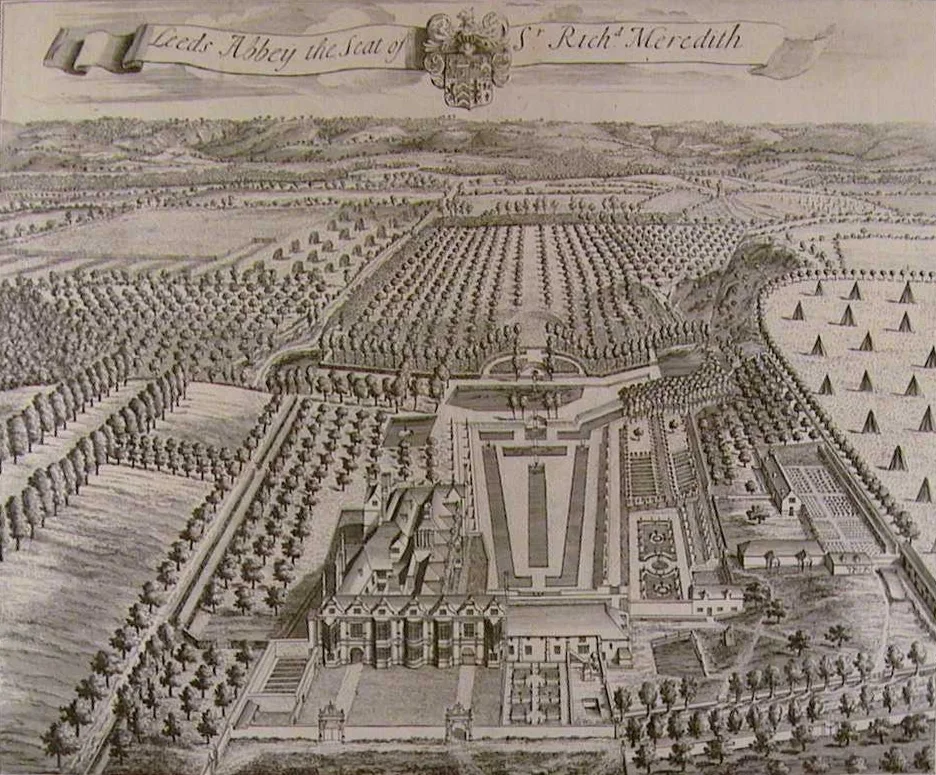
After St Leger came inheritance, sale, and remarriage in a sequence so dense it reads like a property lawyer's notes. Edward VI granted St Leger 229 acres outright in 1551. Warham St Leger inherited in 1559. The estate passed to Sir William Meredith of Stansty in Denbighshire in 1573, then through three more Merediths until Sir Roger died in 1738 and left it to his niece Susanna. She died in 1758 and the estate passed to Sir George Oxenden. In 1765, Oxenden sold it to John Calcraft of Ingress in Kent, who built a mansion on the priory site and landscaped the grounds - bringing in fashionable picturesque gardens of the kind Capability Brown was making famous across England. Calcraft died in 1772, his son inherited, and at the end of the 18th century the mansion was demolished. The site that had held a working priory for four centuries, and an aristocratic country house for over two more, returned to grass.
The Surviving Dovecote
What stands today is a single octagonal pigeon house from the priory's grounds - erected in the years between dissolution and modern times - and the outline in the soil of what was once a Norman church. The site was partially excavated in 1846. In 1973, archaeologists from the Sittingbourne and Swale Group, Sir Joseph Williamson's Mathematical School in Rochester, and the Kent Archaeological Society spent eleven weeks digging through all four seasons. They mapped the church's footprint, the cloister, the chapter house south of the south transept, the warming house and kitchen in the south range. Eleanor de Ferrers, wife of Roger de Leybourne, lies somewhere here. The dovecote is on Historic England's Heritage at Risk Register, meaning the country considers it valuable enough to worry about losing. From cruising altitude over Kent, you can see only a green field beside the River Len. From the ground, with the dovecote's brick walls warm in the afternoon sun, you can almost hear the bells.
From the Air
Located at 51.247 north, 0.611 east, beside the River Len about 6 miles east-southeast of central Maidstone, near the village of Leeds. Leeds Castle (a separate, intact site) lies just to the east. London Gatwick (EGKK) is about 30 nautical miles west; Manston (EGMH) is 28 nm east-northeast. From the air, the priory site is a green field with the surviving dovecote visible as a small octagonal structure.
Nearby Stories
- Blackwall Tunnel 0.2 km away
- London Gateway 2.6 km away
- Canterbury Castle 4.2 km away
- Battle Abbey 7.4 km away
- Plymouth Brethren 9.9 km away
- The Carrington Event: The Solar Storm That Could Happen Again 12 km away
- Clacton Pier 32 km away
- 2008 Channel Tunnel fire 42 km away